
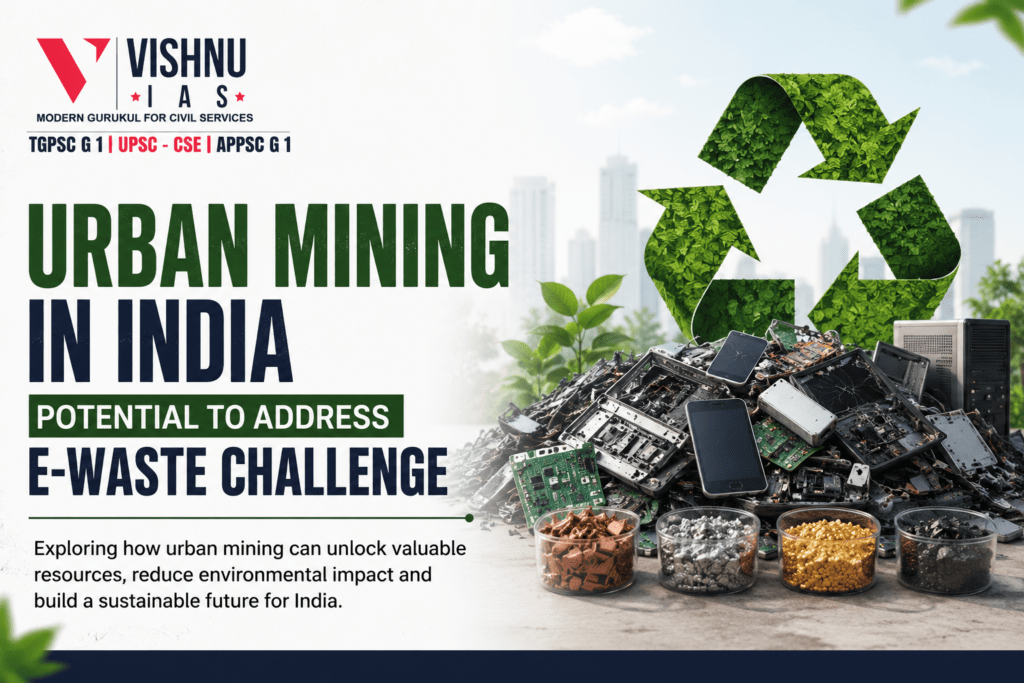
Urban Mining in India: Potential to Address E-Waste Challenge
Introduction
Urban mining in India refers to the systematic recovery of valuable metals, minerals and other materials from discarded products, buildings and infrastructure, instead of extracting them afresh from natural ore deposits. In the context of e-waste, discarded computers, servers, mobile phones, batteries and networking devices constitute an “above-ground mine” containing copper, aluminium, gold, silver, palladium and other critical minerals. CPCB data showed that e-waste generation increased from 7.08 lakh tonnes in 2017–18 to 16.01 lakh tonnes in 2021–22, reflecting the rapid growth in electronic consumption.
Body
I. Urban mining
1. Recovery of valuable and critical materials
- Discarded electronic equipment contains economically valuable materials such as gold, silver, copper, aluminium and palladium, while batteries and advanced electronics also contain strategically important minerals. Scientific dismantling and advanced recycling can recover these materials and return them to the manufacturing cycle, reducing the need for fresh extraction.
Example: Under the E-Waste (Management) Rules, 2022, EPR certificates are generated based on recycling outputs, including gold, copper, aluminium and iron, reflecting the policy emphasis on material recovery.
2. Reducing pressure on virgin mining
- Conventional mining involves land degradation, energy consumption, water use and ecological disruption. Urban mining creates a secondary source of raw materials by recovering metals already present in the economy. Thus, instead of continually digging deeper into the earth, countries can increasingly treat their accumulated stock of electronic products as an above-ground mineral reserve. This supports the transition from a linear “extract, produce, discard” economy to a circular economy.
II. Potential of urban mining
1. Addressing India's rapidly growing e-waste burden
- India is among the world's largest generators of e-waste, with growth driven by rapid digitisation, increasing smartphone penetration, data centres, consumer electronics and renewable-energy technologies. The problem is particularly concentrated in urban areas, creating large and geographically concentrated streams of recoverable materials. Urban mining can therefore convert this concentration from a waste-management challenge into an opportunity for decentralised material-recovery hubs.
Examples of e-waste hotspots: Seelampur and Mustafabad in Delhi, Moradabad in Uttar Pradesh and Bhiwandi in Maharashtra.
2. Strengthening critical-mineral security
- India's future industrial growth depends increasingly on electronics, electric vehicles, batteries, renewable energy and advanced manufacturing, all of which require reliable mineral supplies.
- Urban mining can supplement domestic supplies by recovering materials from secondary sources such as Discarded electronics; Spent lithium-ion batteries; and Other industrial waste streams.
Government Initiative: The Ministry of Mines has launched an Incentive Scheme for Promotion of Critical Minerals Recycling under the National Critical Minerals Mission, with a ₹1,500 crore incentive scheme to promote recycling from sources such as e-waste and spent batteries.
3. Preventing environmental and health hazards
- E-waste is not merely a source of valuable materials; it also contains hazardous substances such as lead, mercury, cadmium and chromium.
- Informal practices such as open burning and acid leaching may release toxic pollutants into the air, soil and groundwater. Scientific recycling through urban mining ensures environmentally compliant processing, safe treatment of hazardous components; reduced soil and groundwater contamination; and lower occupational health risks.
4. Promoting a circular economy and longer product life
- Functional devices can first be refurbished and reused, extending their economic life. Only equipment that cannot be reused should enter the material-recovery process.
Repair → Reuse → Refurbishment → Recycling → Safe disposal.
- The E-Waste (Management) Rules, 2022 also provide for refurbishing certificates, thereby encouraging reuse alongside recycling.
Example: European Union's Right-to-Repair framework seeks to extend product life and reduce premature disposal, demonstrating how product design and repair policies can complement recycling.
5. Creating domestic industrial and technological capability
- Efficient urban mining requires sophisticated technologies for Safe dismantling; Metal separation; Advanced shredding; Hydrometallurgical recovery; Bioleaching and other low-impact recovery methods. Investment in such infrastructure can create a domestic ecosystem for advanced recycling and skilled employment reducing India's dependence on foreign technologies and imported raw materials.
Example: Policy discussions increasingly emphasise R&D in advanced shredding, bioleaching and non-thermal recovery methods to improve material-recovery efficiency.
6. Improving data security and cybersecurity
- Discarded computers, servers and storage devices often contain sensitive personal, corporate and government data. Selecting a recycler solely because it offers the highest resale value or lowest processing cost may create serious data-security risks. Thus, responsible e-waste management also contributes to cybersecurity and institutional security.
III. Challenges limiting the potential of urban mining in India
1. Dominance of the informal sector
- A significant share of e-waste is handled outside scientifically regulated recycling systems. Informal recycling often prioritises easily recoverable materials while hazardous residues and lower-value components are improperly discarded. This results in both material losses and environmental damage.
2. High initial cost of advanced recycling
- Sophisticated recycling requires technology, secure data destruction, collection systems, segregation, environmental safeguards and traceability. Consequently, formal recycling may appear more expensive than informal disposal when decisions are based solely on immediate financial cost.
3. Weak collection and segregation systems
- Many consumers lack awareness regarding authorised collection centres and producer take-back mechanisms. Consequently, valuable materials often fail to reach formal recyclers.
4. Lowest-cost approach to procurement and compliance
- Public and corporate procurement often focuses on maximising resale value and minimising visible processing costs. This creates what may be termed “two balance sheets”.
- The first is financial and immediate, recording purchase price, resale value and savings. The second is strategic and long-term, recording consequences for resource security, environmental sustainability, industrial capability, public health and supply-chain resilience.
IV. Way forward
- Evaluating e-waste decisions based not merely on the lowest immediate cost but on the total lifetime public and strategic value.
- Informal workers possess significant expertise in collection and dismantling. They shall be trained and certified.
- Invest in advanced recycling technologies; R&D in metal recovery and decentralised recycling hubs.
- Policies promoting Right to Repair and durable electronics can further reduce premature waste generation.
Conclusion
Urban mining represents a fundamental shift in India's approach to e-waste, from viewing discarded electronics merely as waste to recognising them as a secondary reserve of valuable and strategic resources. For India, the objective should not simply be to dispose of a computer or mobile phone at the lowest visible cost. The larger calculation must include recovered materials, avoided imports, environmental protection, data security and domestic industrial capability. Thus, yesterday's electronics can become tomorrow's resource base. By combining scientific recycling, life-cycle costing, effective EPR, technological innovation and formal integration of waste workers, India can transform its growing e-waste challenge into an opportunity for a circular economy, critical-mineral security and long-term strategic resilience.