
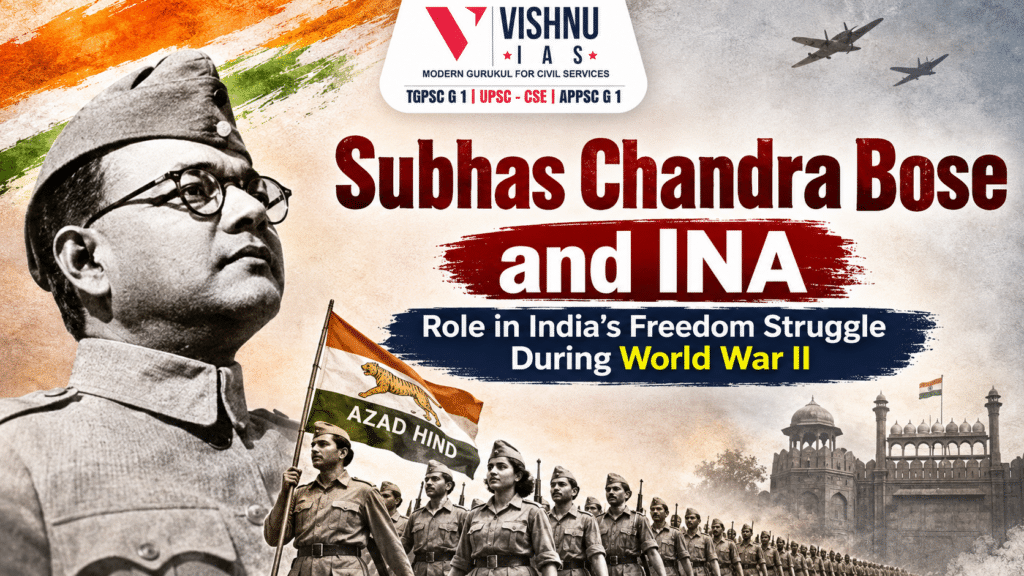
Subhas Chandra Bose and INA: Role in India's Freedom Struggle During World War II
Subhas Chandra Bose and INA played a significant role in India's freedom struggle during the Second World War. Their contribution introduced a new dimension to the national movement through armed resistance, international support and national integration.
Introduction
The Second World War (1939–1945) created opportunities for India's freedom struggle. Subhas Chandra Bose believed that British imperialism could be overthrown through armed resistance and international support. His leadership of the Indian National Army (INA), known as the Azad Hind Fauj, gave a new dimension to India's struggle for independence.
I. Subhas Chandra Bose and the Formation of the INA
1. Ideological Approach
- Bose believed that complete independence could not be achieved through constitutional negotiations alone. He advocated militant nationalism and organised resistance against British rule.
- He served as Congress President in 1938 and 1939. Ideological differences with Gandhi and other Congress leaders led to his resignation in 1939.
- He subsequently established the Forward Bloc in 1939 to unite radical nationalist forces. In January 1941, he escaped British surveillance and travelled to Germany through Afghanistan and the Soviet Union. He sought international assistance to organise an armed struggle against British rule.
2. Formation and Reorganisation of the INA
- The INA emerged during the Second World War in Southeast Asia. It was initially organised in 1942 under Captain Mohan Singh with Japanese support. It mainly comprised Indian prisoners of war captured by Japanese forces.
- Rash Behari Bose played an important role in organising the Indian Independence League.
- Subhas Chandra Bose arrived in Singapore in July 1943 and assumed leadership of the INA. He reorganised the army and mobilised support among the Indian diaspora in Southeast Asia. The INA eventually expanded to approximately 40,000 personnel.
3. Establishment of the Provisional Government of Free India
- On 21 October 1943, he established the Provisional Government of Free India (Azad Hind Government) in Singapore. He assumed the positions of Head of State, Prime Minister and Supreme Commander.
- Japan and several other Axis-aligned countries recognised this government. The government declared war against Britain and the United States.
- The Andaman and Nicobar Islands were transferred to its nominal administration by Japan in December 1943. Bose renamed them Shaheed and Swaraj respectively.
4. Mobilisation and National Integration
- Bose transformed the INA into a symbol of national unity. He promoted the slogan 'Jai Hind' as a symbol of national unity.
- His famous call, 'Give me blood, and I will give you freedom', inspired revolutionary nationalism.
- He established the Rani of Jhansi Regiment under Captain Lakshmi Sahgal. It provided women an opportunity to participate in the armed struggle. The INA brought together Indians across religious, regional and linguistic divisions.
II. Military Campaign
1. Military Campaign against British Rule
- The INA participated in military operations alongside Japanese forces against British India. It participated in the Imphal and Kohima campaigns of 1944. Its objective was to enter India through the northeastern frontier and advance towards Delhi. INA soldiers hoisted the Indian tricolour at Moirang in Manipur in April 1944.
- However, the Japanese defeat at Imphal and Kohima, logistical difficulties, disease and inadequate supplies weakened the INA. Following Japan's surrender in August 1945, the INA's military campaign collapsed.
2. Impact of the INA Trials (1945–46)
- The British conducted the first major INA trial at the Red Fort in November 1945. The accused included Colonel Prem Kumar Sehgal, Colonel Shah Nawaz Khan and Colonel Gurbaksh Singh Dhillon.
- Their religious backgrounds symbolised the secular and national character of the INA. The trials triggered widespread protests among students, workers and ordinary citizens.
- Congress leaders, including Jawaharlal Nehru, participated in the legal defence of INA officers. Public opposition forced the British to reconsider their approach towards the INA prisoners.
3. Impact on the British Indian Armed Forces
- The Royal Indian Navy Mutiny of February 1946 reflected growing dissatisfaction within the armed forces. Naval ratings protested against racial discrimination, poor conditions and colonial authority.
- The INA's example contributed to the growing atmosphere of resistance within the armed forces. These developments raised concerns about the long-term sustainability of British military control over India.
4. Contribution to India's Independence
- It challenged the legitimacy of British colonial authority through and its trials united different political groups and sections of Indian society.
- It demonstrated that Indian soldiers could organise themselves against colonial rule.
- It weakened British confidence in the continued loyalty of Indian military personnel and strengthened the political atmosphere that ultimately contributed to the British decision to leave India.
III. Limitations
Despite its contributions, the INA faced certain limitations. Its military operations depended heavily on Japanese support. The INA suffered from inadequate supplies, disease and military setbacks. Its association with Axis powers created political and moral complexities. It could not independently defeat British forces or liberate India militarily.
Conclusion
Subhas Chandra Bose and the INA gave India's freedom struggle a distinct dimension through armed resistance, international mobilisation and national integration. Although the INA failed militarily, its trials and psychological impact challenged British authority and raised doubts about the loyalty of Indian armed forces. The INA's greatest contribution was not military victory, but its role in undermining the foundations of British colonial rule.