
Battery Waste Management in India: Challenges, Importance & Recycling
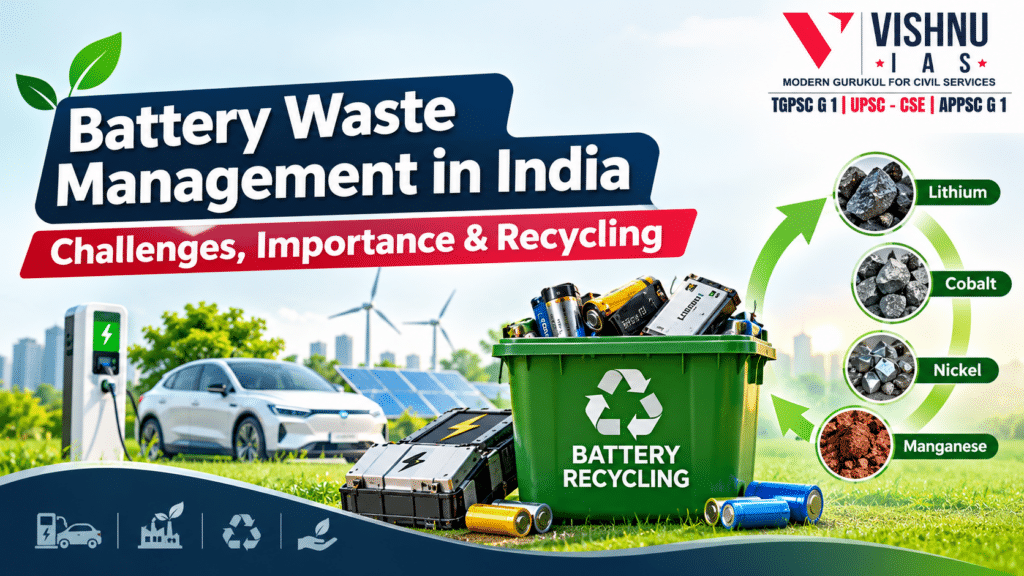
Battery waste management in India is becoming increasingly important as the rapid expansion of electric vehicles (EVs), renewable energy storage and electronic devices has increased the consumption of lithium-ion batteries. Their end-of-life (EoL) disposal poses environmental risks but also offers an opportunity to recover critical minerals such as lithium, cobalt, nickel and manganese.
I. Significance of Battery Waste Management for India
1. Recovery of Critical Minerals
Lithium-ion batteries contain valuable minerals such as lithium, cobalt, nickel and graphite. Recycling helps recover these resources and reduces dependence on imports.
2. Strengthening Resource Security
China dominates global critical mineral processing. Domestic battery recycling can strengthen India's mineral processing capabilities and reduce vulnerabilities arising from geopolitical tensions and supply chain disruptions.
3. Promoting Circular Economy
Recycling converts end-of-life batteries into valuable secondary resources. It promotes resource efficiency by recovering materials for manufacturing new batteries.
4. Reducing Environmental Pollution
Improper disposal of batteries can cause soil and groundwater contamination due to hazardous substances. Scientific recycling prevents unsafe dumping and reduces environmental damage.
5. Supporting Electric Mobility
With the growing adoption of electric vehicles, the volume of spent batteries is expected to increase. Recycling can provide a secondary source of raw materials for domestic EV battery manufacturing.
6. Economic and Industrial Opportunities
Battery recycling can generate employment, attract investments and promote new industries in mineral recovery, battery refurbishment and advanced recycling technologies.
II. Challenges and Measures for Effective Battery Waste Management
1. Dominance of Informal Recycling
A significant share of discarded batteries enters informal recycling channels. Manual dismantling methods are often unsafe and inefficient, resulting in poor material recovery. Formalising and integrating informal waste collectors into regulated recycling networks is essential.
2. Inadequate Recycling Infrastructure
India lacks sufficient advanced recycling and mineral processing facilities. Investment in modern recycling plants, collection centres and transportation networks is necessary.
3. Technological Limitations
Different battery chemistries make mineral recovery technically challenging. Research and development in hydrometallurgy, direct recycling and other advanced technologies can improve recovery rates and mineral purity.
4. Financial Viability
Recycling facilities require significant initial investments and may operate below optimal capacity during the initial years. Patient capital, financial incentives and public-private partnerships can improve their commercial viability.
5. Weak Collection Mechanisms
Consumers often lack convenient systems to return discarded batteries. Manufacturers and EV dealers should introduce accessible take-back and buy-back mechanisms to ensure proper collection.
6. Quality and Safety Standards
India needs uniform standards for battery characterisation, recycled mineral quality and second-life applications. A design-for-recycling approach during battery manufacturing can further improve resource recovery.
7. Strengthening Regulatory Enforcement
Effective monitoring, traceability and strict enforcement of environmental standards are necessary to prevent illegal disposal, unsafe recycling and diversion of battery waste.
III. Government Initiatives and Recent Developments
1. Battery Waste Management Rules, 2022
The rules introduced Extended Producer Responsibility (EPR), making battery producers, including importers, responsible for the collection, recycling or refurbishment of batteries placed in the market. They cover EV, portable, automotive and industrial batteries.
2. EPR Portal
The Central Pollution Control Board (CPCB) has established a centralised online portal for registration, monitoring and exchange of EPR certificates among producers, recyclers and refurbishers.
3. Domestic Recycled Material Mandate
The rules provide for minimum utilisation of domestically recycled materials in new batteries from 2027–28 onwards. This can create predictable demand for recycled resources.
4. Export Restrictions on Battery Black Mass (2026)
The Directorate General of Foreign Trade (DGFT) prohibited the export of specified lithium-ion battery black mass under ITC (HS) Code in November 2026. The measure aims to retain valuable critical minerals within India and strengthen domestic recycling capabilities.
Conclusion
Battery waste management must be viewed beyond conventional waste disposal. It represents an important opportunity to strengthen India's circular economy, reduce import dependence and build domestic critical mineral processing capabilities. A combination of technological innovation, regulatory enforcement, industry participation and consumer awareness can transform battery waste into a strategic national resource.