

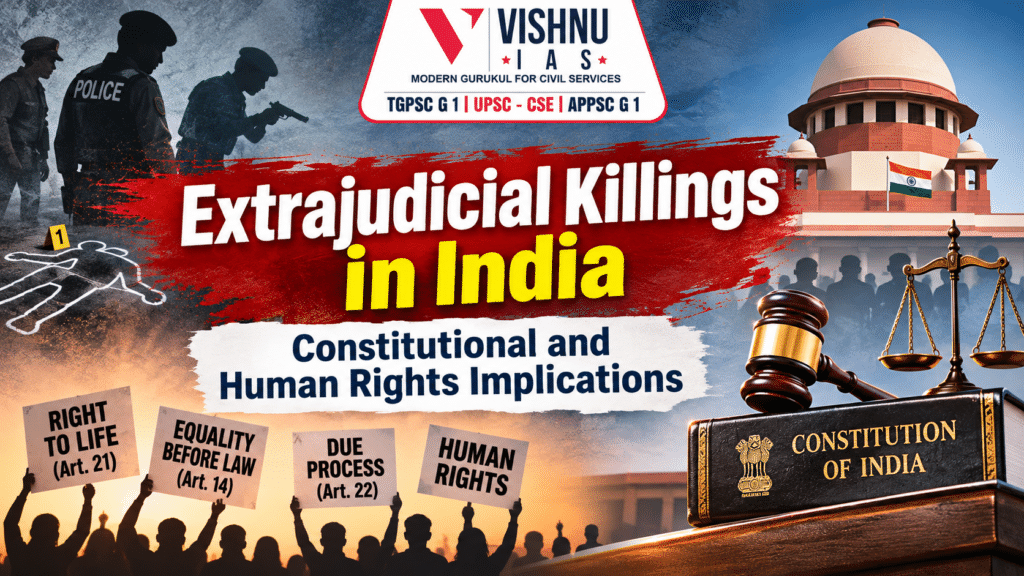
Extrajudicial Killings in India: Constitutional and Human Rights Implications
Extrajudicial Killings in India raise serious constitutional and human rights concerns, particularly regarding the right to life, human dignity and the rule of law. Extrajudicial killings refer to the unlawful killing of individuals by State authorities without judicial trial or due process of law. Although the police are empowered to use reasonable force in the discharge of their duties, encounter killings raise serious concerns regarding the right to life, human dignity and the rule of law. The increasing public acceptance of such killings also poses challenges to constitutional democracy.
I. Constitutional Implications of Extrajudicial Killings
1. Violation of Right to Life (Article 21)
- Article 21 guarantees that no person shall be deprived of life or personal liberty except according to procedure established by law. Encounter killings without lawful justification violate this fundamental right.
2. Violation of Equality Before Law (Article 14)
- Selective use of lethal force without following established legal procedures undermines equality before law and creates arbitrary exercise of State power.
3. Violation of Protection Against Arbitrary Arrest and Detention (Article 22)
- The Constitution provides safeguards against arbitrary arrest and detention. Extrajudicial killings deprive accused persons of the opportunity to exercise these safeguards.
4. Undermining Rule of Law
- Such killings bypass the judicial process and undermine the principle that guilt must be established through a fair trial rather than determined by law enforcement agencies.
5. Separation of Powers
- When police personnel effectively assume the roles of investigator, prosecutor and executioner, it undermines judicial independence and the separation of powers.
II. Human Rights Implications and Institutional Safeguards
1. Violation of Human Dignity
- Extrajudicial killings violate the inherent dignity and fundamental human rights of individuals, irrespective of the nature of the alleged offence.
2. Undermining Presumption of Innocence
- Every accused person is presumed innocent until proven guilty. Encounter killings deny individuals their right to defend themselves through a fair judicial process.
3. Violation of International Human Rights Standards
- Article 3 of the Universal Declaration of Human Rights (UDHR) recognises the right to life, liberty and security. Article 6 of the International Covenant on Civil and Political Rights (ICCPR) protects the inherent right to life.
4. Judicial Safeguards
- In PUCL v. State of Maharashtra (2014), the Supreme Court issued 16 guidelines for investigating police encounter deaths. These include mandatory FIR registration, independent investigation, magisterial inquiry, forensic examination and appropriate action against guilty officers.
5. NHRC Guidelines
- The National Human Rights Commission requires encounter deaths to be reported within 48 hours, followed by relevant investigation reports, including post-mortem and magisterial inquiry reports.
6. Judicial Accountability
- In Om Prakash v. State of Jharkhand (2012), the Supreme Court emphasised that extrajudicial killings are not recognised under the criminal justice system and that accused persons must face trial.
Conclusion
The State has a legitimate responsibility to protect citizens from crime and maintain public order. However, this responsibility cannot justify bypassing constitutional safeguards. Strengthening police accountability, ensuring independent investigations, expediting criminal trials and promoting police reforms are essential to uphold both public safety and the rule of law. Justice must be delivered through the law, not outside it.