


Sikkim–Doklam Region: Strategic Significance in India–China Relations
The Sikkim–Doklam region occupies exceptional strategic importance in India–China relations because of its location at the India–Bhutan–China trijunction and its proximity to the Chumbi Valley and the Siliguri Corridor. The 2017 Doklam standoff demonstrated how developments in this geographically small but strategically sensitive region can have wider implications for India’s national security and bilateral relations with other countries. The issue has gained renewed relevance amid the 25th round of India–China Special Representatives’ talks held in Beijing on August 25, 2026.
I. Strategic significance of the Sikkim–Doklam region
1. Location at a critical trijunction
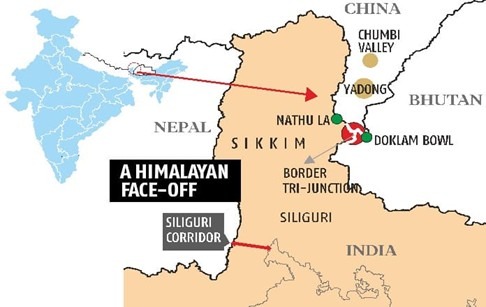
- Doklam lies in the vicinity of the India–Bhutan–China trijunction, with the Chumbi Valley lying to its north and Sikkim to the east. Its location gives the area considerable strategic significance because developments there affect the security interests of all three countries.
- The precise location of the trijunction itself is disputed. India and Bhutan interpret the watershed principle as supporting a trijunction near Batang La, whereas China relies on the reference to Mount Gipmochi in the 1890 Anglo-Chinese Convention to advance a different interpretation. Therefore, the Sikkim sector cannot simply be treated as an entirely settled or “open-and-shut” boundary.
2. Importance of the Chumbi Valley
- The Chumbi Valley is a narrow Chinese salient lying between Sikkim and Bhutan. The geography of the valley makes the surrounding high ground strategically important.
- Control or increased Chinese access around the Doklam–Jampheri Ridge area could improve China’s military and logistical position in the region and place greater pressure on India’s positions in Sikkim. Consequently, developments around Doklam cannot be viewed independently of the wider security dynamics of the Chumbi Valley.
3. Security of the Siliguri Corridor
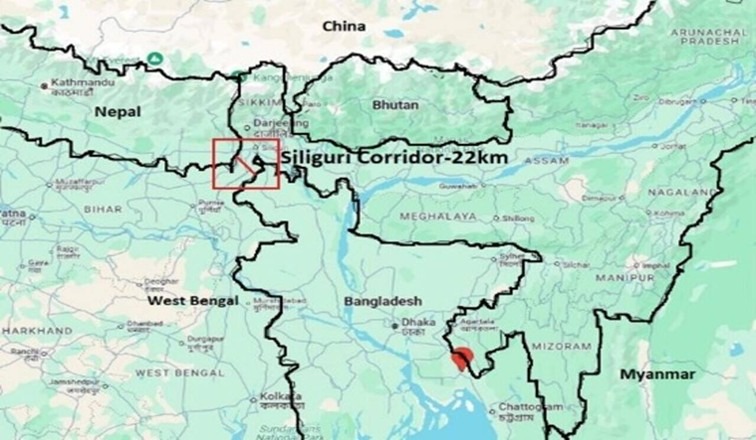
- The most important strategic concern for India is the proximity of the region to the Siliguri Corridor, popularly known as the “Chicken's Neck”. It is the critical land corridor connecting mainland India with the northeastern States.
- The corridor is geographically narrow and is surrounded by Nepal, Bhutan and Bangladesh. It is therefore highly sensitive from the perspective of national security, military logistics and connectivity.
- Any substantial improvement in China’s strategic position towards the Jampheri Ridge and the Chumbi Valley could potentially increase the vulnerability of this corridor.
4. Significance of the 2017 Doklam standoff
- In 2017, China began road construction in the Doklam area. Bhutan objected to the activity, while India intervened because of the security implications arising from the location and India’s special strategic relationship with Bhutan.
- The resulting India–China military standoff continued for about 73 days before disengagement in August 2017.
- The boundary question is not merely a matter of territorial claims. Infrastructure construction, military mobility and control of strategically located terrain can alter the regional security balance.
5. India–Bhutan dimension
- India’s interest in Doklam is also closely connected with its relationship with Bhutan. The region is disputed between Bhutan and China, and Bhutan’s territorial interests are directly involved.
- India therefore has to balance two objectives, protecting its own security interests while respecting Bhutan’s sovereignty and maintaining close India–Bhutan coordination.
II. Relevance of the August 2026 Special Representatives' talks
- 25th round of Special Representatives’ talks on August 25, 2026, between India’s National Security Adviser and Chinese Foreign Minister produced an “Eight Points of Outcomes and Consensus”. Of particular significance was the reference to an “Early and Substantial Harvest” in boundary delimitation and border management.
- The concept is important because India had earlier proposed an early settlement covering the Sikkim Sector and the entire Middle Sector, with the boundary following the watershed principle. A limited settlement confined to areas where the two sides already broadly agree, however, could produce an asymmetric outcome without resolving the more difficult Eastern and Western Sectors.
III. Wider implications
- The Doklam question highlights the interconnected nature of the India–China boundary dispute. The 2005 Agreement on Political Parameters and Guiding Principles envisages a package settlement covering all sectors of the boundary. A selective settlement may therefore raise concerns if it resolves relatively easier areas while leaving strategically important disputed sectors untouched.
- At the same time, the August 2026 outcomes include useful confidence-building measures such as additional meeting points and hotlines, continued pilgrimage and border trade, and continued dialogue on trans-border rivers. These measures can improve communication and reduce the risk of escalation.
Way forward
- Pursuing an agreed framework for boundary settlement before allowing partial delimitation to become the substitute for a comprehensive settlement.
- The highest-watershed principle shall remain important in relevant Himalayan stretches, while trijunctions involving Bhutan or other third countries should be addressed in consultation with the concerned country.
- Strengthening infrastructure, surveillance and logistical connectivity along the northern borders and improve the resilience of the Siliguri Corridor through diversified connectivity.
Conclusion
The strategic importance of Doklam arises not from its geographical size but from its location at the intersection of the Chumbi Valley, the India–Bhutan–China trijunction and the broader security environment surrounding the Siliguri Corridor. The 2017 standoff demonstrated these stakes clearly. The August 2026 Special Representatives' talks indicate some movement in India–China boundary diplomacy, but an “early harvest” should not come at the cost of India’s long-term strategic interests. A durable settlement requires a balanced, comprehensive and mutually agreed framework, rather than a settlement confined to relatively easy segments of the boundary.