
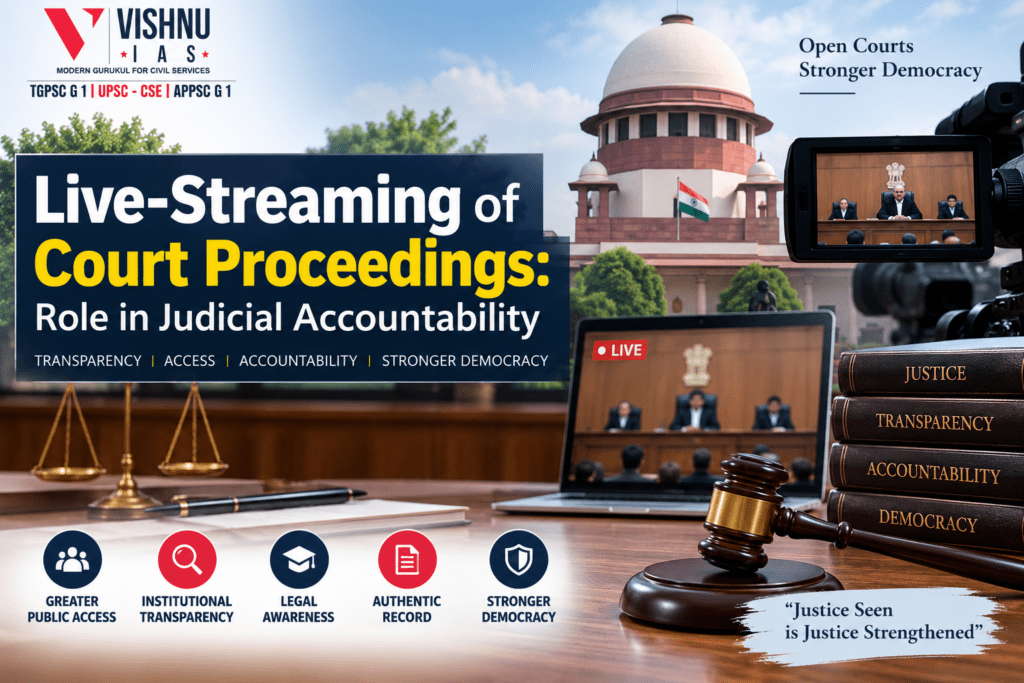
Live-Streaming of Court Proceedings: Role in Judicial Accountability
Judicial transparency is essential for a functioning democracy. Live-streaming of court proceedings can play an important role in promoting judicial accountability by enabling citizens to understand how justice is administered and strengthening confidence in constitutional institutions. Technological access to judicial proceedings can strengthen transparency, accountability and democratic participation, while requiring safeguards to protect privacy, dignity and the administration of justice.
Introduction
Judicial transparency is an essential component of open justice, which enables citizens to understand how justice is administered and strengthens confidence in constitutional institutions. Technological access to judicial proceedings can strengthen transparency, accountability and democratic participation, while requiring safeguards to protect privacy, dignity and the administration of justice.
Body
I. Constitutional and judicial basis for judicial transparency
1. Article 21 and access to justice
Article 21 has been interpreted expansively by the Supreme Court to include fair procedure and access to justice. In Swapnil Tripathi v. Supreme Court of India (2018), the Supreme Court recognised live-streaming of proceedings as part of the right to access justice, particularly in matters of constitutional importance. The Court emphasised the principle of open justice, under which judicial proceedings should ordinarily remain accessible to the public.
2. Article 19(1)(a) and the right to know
The freedom of speech and expression under Article 19(1)(a) has been interpreted to include the right to know and receive information concerning matters of public importance. Public access to court proceedings enables citizens and the media to understand judicial functioning and facilitates informed public discourse. However, this right is not absolute and may be subject to reasonable restrictions under Article 19(2) where necessary, including to protect privacy, public order, morality or the administration of justice.
3. Open justice and judicial accountability
The Supreme Court has repeatedly recognised that courts are public institutions exercising constitutional power and therefore cannot function entirely behind closed doors. In Naresh Shridhar Mirajkar v. State of Maharashtra (1967), the Court recognised the importance of the open-court principle, while also acknowledging circumstances where restrictions may be necessary in the interests of justice.
II. Role of live-streaming in promoting judicial accountability
1. Enhances institutional transparency
- Live-streaming allows citizens to observe proceedings directly instead of depending entirely upon secondary accounts.
- It provides greater visibility into arguments advanced by lawyers, questions raised by judges and the manner in which constitutional issues are examined.
- Example: The Supreme Court began live-streaming proceedings of its Constitution Benches in 2022, enabling wider public access to important constitutional cases.
2. Reduces physical barriers to access
- Physical courtrooms have limited seating capacity.
- Litigants, law students, researchers and members of the public may be unable to attend proceedings because of distance or overcrowding.
- Live-streaming therefore democratises access to judicial proceedings beyond the physical courtroom.
3. Strengthens public confidence
- Direct observation of judicial proceedings can reduce perceptions that courts are inaccessible institutions.
- It enables citizens to understand judicial reasoning and courtroom processes rather than relying solely on selective media reports.
4. Promotes professional accountability
- Greater public visibility can encourage judges, lawyers and other participants to maintain appropriate professional standards. It also enables scrutiny of courtroom conduct.
- Example: In 2024, videos of certain remarks made by a Karnataka High Court judge generated significant public discussion, ultimately leading to suo motu consideration by the Supreme Court.
5. Strengthens legal education and constitutional literacy
- Courtroom proceedings provide practical exposure to constitutional interpretation, advocacy and judicial reasoning.
- Students of law, political science and public administration can learn directly from actual proceedings.
6. Provides an authoritative record
- Official recordings can help establish what was actually said during proceedings. This can help counter inaccurate reporting, fabricated content and misleading social-media narratives.
- An accessible official record can therefore become an important tool against misinformation.
III. Challenges associated with unrestricted dissemination
1. Risk of sensationalism
- Short video clips may remove judicial observations from their broader context. A judge may question a lawyer merely to test an argument, while the isolated exchange may subsequently be portrayed as the judge's final view. This can distort public understanding of judicial proceedings.
2. Privacy and dignity concerns
- Cases involving sexual offences, matrimonial disputes, children and juveniles raise serious privacy concerns. Public dissemination of such proceedings may expose vulnerable individuals to stigma, harassment or further trauma. Therefore, not every proceeding can be treated identically.
3. Impact on judicial functioning
- Excessive social-media scrutiny may make judges and lawyers overly cautious during oral exchanges. Judicial questioning is often exploratory and does not necessarily represent the final reasoning of the Court. Therefore, unrestricted circulation could affect the spontaneity and effectiveness of courtroom deliberation.
4. Commercialisation and manipulation
- Courtroom footage may be edited for views, followers or commercial purposes. AI-generated and manipulated videos can further complicate the problem by creating apparently authentic but false representations of judicial proceedings.
IV. Way forward
- Rather than restricting access, courts should progressively expand live-streaming of proceedings of significant public importance.
- The Supreme Court e-Committee's Model Rules for Live-Streaming and Recording of Court Proceedings, 2021 provide a framework for regulating access and dissemination. It shall be reviewed and updated as and when required.
- Proceedings involving children, sexual offences, matrimonial disputes and other sensitive matters should receive appropriate safeguards.
- AI-generated, doctored or deceptively edited courtroom videos should be clearly prohibited.
Conclusion
Live-streaming represents an important transition from the traditional concept of a physically accessible courtroom to a digitally accessible open court. It can strengthen Article 21-based access to justice, Article 19(1)(a)-based public information rights, legal awareness and institutional accountability. However, transparency cannot mean unrestricted circulation of every courtroom interaction. Privacy, dignity, judicial independence and the integrity of proceedings must also be protected. Therefore, India shall pursue a model of “maximum transparency with minimum necessary restrictions”.