
Gandhian Methods of Non-Violence: Global Impact & UPSC Analysis
Gandhian Methods of Non-Violence: Introduction
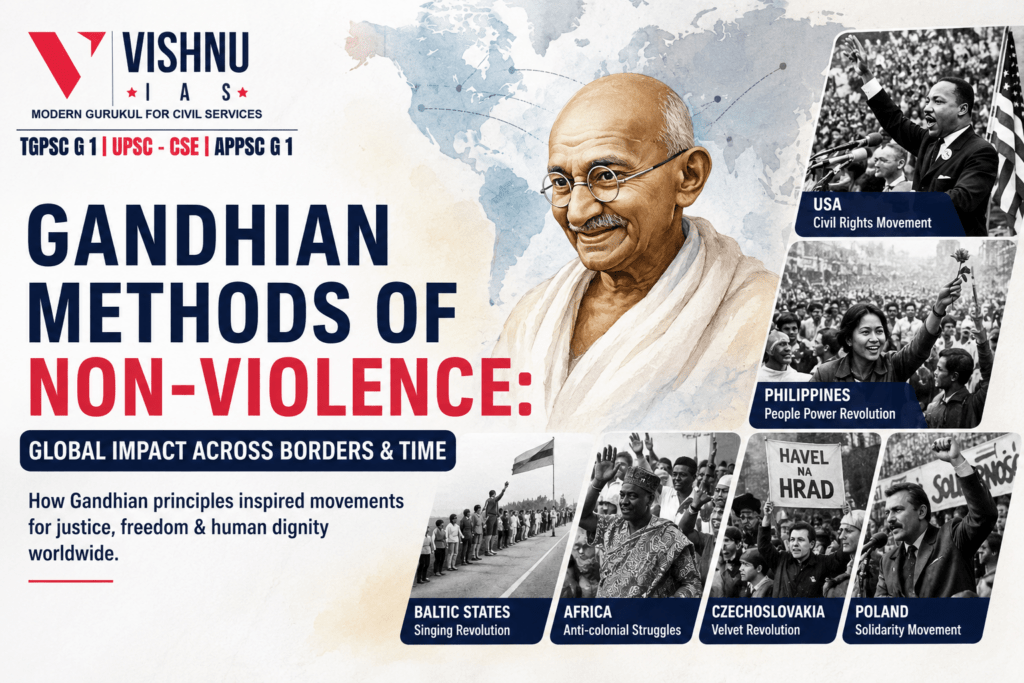
Gandhian Methods of Non-Violence transformed Ahimsa (non-violence) from an ethical principle into a method of political struggle. Through Satyagraha, non-cooperation, civil disobedience, boycott and mass mobilisation, he demonstrated that political objectives could be pursued without armed confrontation. The subsequent adoption and adaptation of these methods in Asia, Africa, Europe and the Americas, across different periods, demonstrates that Gandhian non-violence transcended both geographical boundaries and historical contexts.
United States – Civil Rights Movement
- Gandhian non-violence became a major instrument in the struggle against racial segregation in the United States during the 1950s and 1960s.
- Example: Martin Luther King Jr., who studied Gandhi's philosophy, applied Satyagraha-inspired methods through peaceful marches, boycotts and civil disobedience. The Montgomery Bus Boycott (1955–56), led by King after Rosa Parks' arrest in December 1955, challenged racial segregation in public transport. Similarly, the Birmingham Campaign (1963) used peaceful demonstrations against segregation. Thus, a method originally developed against British colonial rule in India was adapted to fight racial discrimination within a democratic state.
Philippines – People Power Revolution
- Gandhian principles also found expression in the overthrow of authoritarian rule through mass civilian mobilisation.
- Example: In the People Power Revolution of February 1986, millions of Filipinos gathered peacefully in Manila to oppose the authoritarian regime of Ferdinand Marcos. Led politically by figures such as Corazon Aquino and supported by Cardinal Jaime Sin, the movement relied heavily on mass demonstrations and civilian resistance rather than armed insurrection. Marcos eventually left the country, ending his rule.
Baltic States – Resistance to Soviet domination
- Gandhian non-violence also crossed into Cold War Europe, where it was adapted to the struggle for national independence from Soviet rule.
- Example: During the Singing Revolution (1986–91), Lithuania, Latvia and Estonia used songs, peaceful demonstrations and civil resistance to assert national identity and independence. On 23 August 1989, around two million people formed the Baltic Way, a human chain approximately 675 km long, linking Vilnius, Riga and Tallinn. The movement deliberately rejected armed confrontation. Its leaders drew inspiration from Gandhi and Martin Luther King Jr. Lithuania's Gražina Miniotaitė, a prominent theorist of the movement, regarded Gandhi as an important example of successful non-violent resistance against foreign domination.
Anti-colonial struggles beyond India
- Non-violent methods also influenced several movements against colonial rule in the post-World War II period, when political mobilisation increasingly became a means of challenging European imperialism.
- Example: Kwame Nkrumah employed positive action, including strikes, boycotts and mass mobilisation, in Ghana's struggle against British colonial rule. Ghana achieved independence in 1957, becoming an important symbol of African decolonisation. Similarly, Julius Nyerere's political mobilisation in Tanganyika emphasised mass political participation and peaceful constitutional methods during the struggle for independence, achieved in 1961.
Czechoslovakia – Velvet Revolution, 1989
The Velvet Revolution (1989) overthrew the communist government of Czechoslovakia through largely peaceful mass demonstrations. Václav Havel, a dissident and playwright, became the leading figure of the movement. Hundreds of thousands participated in demonstrations, strikes and peaceful protests, forcing the Communist Party to relinquish its political monopoly. Havel became President in December 1989.
Poland – Solidarity Movement, 1980–89
The Solidarity movement, led by Lech Wałęsa, emerged in 1980 from the Gdańsk shipyard strikes against Poland's communist government. It relied substantially on strikes, negotiations, civil resistance and mass mobilisation, rather than armed revolution. Despite repression and the imposition of martial law in 1981, Solidarity survived and participated in the 1989 Round Table Talks, which paved the way for democratic elections and the eventual collapse of communist rule.
Conclusion
Gandhian method of non-violence therefore transcended geographical and historical boundaries because it was not confined to India's anti-colonial struggle. From Martin Luther King Jr.'s America in the 1950s, to African anti-apartheid resistance, the Philippines in 1986, and the Baltic Way of 1989, different societies adapted its methods to their own political conditions. Its enduring significance lies in demonstrating that mass civilian participation, moral legitimacy and withdrawal of cooperation can become powerful instruments of political transformation even against seemingly superior state power.