
India’s Soft Power: Leveraging Cultural Influence for Global Leadership and Sustainable Livelihoods
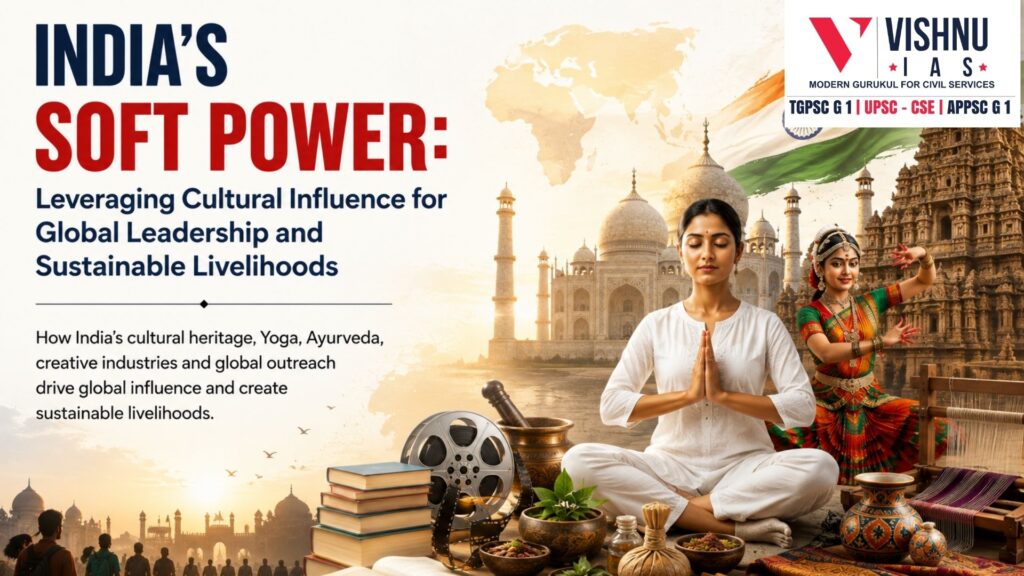
India’s Soft Power can enhance global influence while generating sustainable livelihoods through cultural diplomacy, creative industries, Yoga, Ayurveda, tourism and digital content.
Introduction:
Soft power, a concept developed by Joseph Nye, refers to the ability of a country to influence others through attraction rather than coercion. India possesses considerable soft power rooted in its civilisational heritage, Yoga, Ayurveda, arts, cinema, cuisine, literature, diaspora, democratic values and knowledge traditions. The challenge is to convert this cultural capital into global influence, economic value and sustainable livelihoods.
Body:
I. India’s soft power as an instrument of global influence
1. Civilisational and cultural appeal
India's civilisational heritage, plural traditions, festivals, literature, music, dance, cuisine, handicrafts and handlooms create cultural affinity and enhance India's international image.
Example: The International Day of Yoga, observed globally on 21 June following a UN General Assembly resolution in 2014, has transformed an Indian knowledge tradition into a major instrument of global cultural outreach.
2. Yoga diplomacy
Yoga has become one of India's most visible instruments of cultural diplomacy, enabling people-to-people connections and projecting India's knowledge traditions globally.
Example: ICCR collaborated with Yunnan Minzu University, China, to establish the India-China Yoga College and deputed Yoga professors to the institution. ICCR and the Ministry of AYUSH also facilitate Yoga-related activities through Indian Missions abroad.
3. Ayurveda and traditional knowledge
Ayurveda can combine cultural diplomacy with health diplomacy, wellness tourism, education, research and international trade. India's efforts to standardise, research and internationalise Ayurveda can enhance both its credibility and global reach.
Example: NITI Aayog's strategic roadmap for making Ayurveda global focuses on Availability, Acceptability and Propagation, including strengthening education, research, standards, international collaboration and medical value travel.
4. Creative and digital content
Cinema, music, literature and digital content allow Indian stories and regional cultures to transcend geographical and linguistic boundaries. Digital platforms have substantially expanded the reach of India's cultural output.
Example: WAVES OTT, Prasar Bharati's digital platform, provides access to Indian cultural, educational, archival and multilingual content to audiences globally. It crossed 1 crore registered users in June 2026 and reaches audiences in more than 130 countries.
5. Diaspora and people-to-people linkages
India's diaspora acts as a bridge between India and foreign societies by facilitating cultural exchange, investment, entrepreneurship, knowledge transfer and diplomatic goodwill.
6. Contemporary achievements
India's soft power increasingly extends beyond traditional culture to include democracy, space achievements, Digital Public Infrastructure, humanitarian assistance and development partnerships, enhancing India's image as a capable and responsible global actor.
Example: India’s UPI has been adopted or integrated in countries such as Singapore, France and Sri Lanka; Initiatives such as Vaccine Maitri demonstrated India’s capacity to provide affordable vaccines abroad; Development projects under India’s Lines of Credit have supported infrastructure and capacity-building across the Global South.
II. Converting soft power into sustainable livelihoods
1. Cultural industries as employment generators
Tourism, cinema, music, fashion, publishing, wellness, handicrafts, handlooms and performing arts can generate employment while simultaneously projecting Indian culture globally.
Example: Heritage and cultural tourism can create local employment for artisans, performers, guides, hospitality workers and small enterprises.
2. Traditional skills as economic assets
India's artisans and cultural practitioners possess valuable skills but often lack adequate access to finance, technology, branding, intellectual property protection and international markets. Linking them with modern markets can convert cultural heritage into sustainable income.
Example: GI-tagged products such as Kanchipuram Silk, Darjeeling Tea and Aranmula Kannadi demonstrate the potential to convert cultural identity and traditional skills into market value.
3. Ayurveda and wellness economy
Ayurveda can generate employment through wellness services, medical value travel, education, research, manufacturing and exports, provided that quality standards, scientific evidence and international regulatory acceptance are strengthened.
4. Digital creator economy
Technology enables artists, filmmakers, musicians, writers and creators to directly access global audiences and markets.
Example: In 2026, the govt. launched MyWAVES, a citizen-creator platform on WAVES OTT, alongside a national AI-skilling initiative for creators and media professionals, reflecting the growing convergence of technology and the creative economy.
III. Challenges
1. Fragmented institutional approach
India's soft-power ecosystem involves multiple institutions such as MEA, ICCR, Ministry of Culture, Ministry of Tourism, Ministry of Ayush and Ministry of Information & Broadcasting. Greater coordination is required to translate individual initiatives into a coherent national strategy. Thus, India shall adopt an integrated approach
2. Weak conversion
Cultural recognition does not automatically generate income for artisans and knowledge-holders. Weak branding, limited market access, inadequate financing and fragmented supply chains constrain their earning potential. Initiatives such as One Airport One Product (OAOP) demonstrates how soft power can acquire an economic dimension by taking India's local cultural products to national and international consumers
3. Need for global standards and credibility
Traditional knowledge systems such as Ayurveda require research, standardisation, quality assurance, practitioner training and international regulatory recognition to compete effectively in global markets. India's Ayurveda strategy shall focus on international research partnerships, standardised education, quality assurance, global accreditation and medical value travel, thereby converting traditional knowledge into a credible global knowledge and economic sector.
Conclusion:
India's soft power is not merely a diplomatic asset but also an economic and developmental resource. India does not need to create soft power; it needs to organise, connect, protect and scale its existing cultural capital. A coordinated ecosystem linking culture with technology, tourism, trade, education and entrepreneurship can ensure that India's cultural heritage generates both global influence and dignified livelihoods. Thus, the Saptadhara vision can help transform India from a repository of cultural wealth into a global cultural and creative powerhouse.