
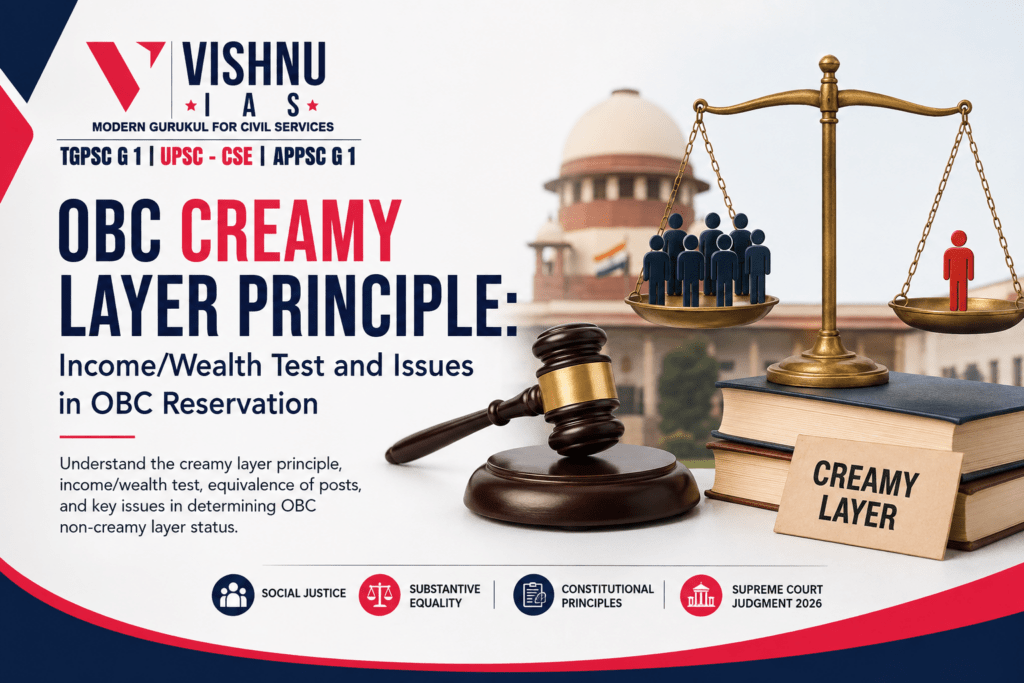
OBC Creamy Layer Principle: Income/Wealth Test and Issues in OBC Reservation
The ‘creamy layer’ principle refers to the exclusion of the relatively advanced sections among the Other Backward Classes (OBCs) from reservation benefits so that affirmative action reaches those who continue to face social and educational backwardness. The principle was judicially developed in Indra Sawhney v. Union of India (1992). The recent Supreme Court judgment in Union of India v. Rohith Nathan & Ors. (11 March 2026) has again highlighted the need to ensure that OBC creamy-layer status is not determined merely through parental income, but also considers the status and category of the parent's post.
Body
I. Constitutional and Judicial Basis of the Creamy-Layer Principle
1. Balancing Affirmative Action with Substantive Equality
- Articles 15(4) and 16(4) enable the State to make special provisions for the advancement of socially and educationally backward classes and for their inadequate representation in public employment.
- However, the benefits of reservation are intended for those who continue to suffer from backwardness and should not be disproportionately cornered by the relatively advanced sections within an OBC community.
- Indra Sawhney v. Union of India (1992): The nine-judge Constitution Bench upheld reservation for OBCs subject to the exclusion of the socially advanced ‘creamy layer’. Thus, creamy-layer exclusion became an important component of the constitutional scheme of OBC reservation.
2. Evolution of the Creamy-Layer Concept
- In State of Kerala v. N.M. Thomas (1976), Justice Krishna Iyer referred to the danger of reservation benefits being appropriated by the “creamy layer”.
- The principle was subsequently given a clear constitutional and operational framework in Indra Sawhney (1992).
- Ashoka Kumar Thakur v. Union of India (2008) further reaffirmed the relevance of creamy-layer exclusion in the context of OBC reservation in educational institutions.
II. Income/Wealth Test and Its Application
1. 1993 Office Memorandum
- Following Indra Sawhney, the Government issued the 8 September 1993 O.M. prescribing categories for creamy-layer exclusion.
- The framework is not based exclusively on income. It contains status-based and occupational criteria covering categories such as constitutional/statutory office holders, certain higher-level government employees, professionals and persons with specified property or income characteristics.
2. ₹8 Lakh Ceiling
- The present income ceiling under the Central framework is ₹8 lakh per annum. However, it is incorrect to treat this as a simple test under which every OBC family earning above ₹8 lakh automatically becomes creamy layer.
- Under the 1993 framework, income from salaries and agricultural land is excluded while applying the Income/Wealth Test. Therefore, the nature and status of the parent's employment remain important.
III. Controversy Over Equivalence of Posts and Salary Income
1. Differential Treatment of Government and Non-Government Employees
- A major problem arose in cases where OBC candidates' parents were employed in PSUs, banks, insurance institutions, autonomous bodies and other organisations, but their posts had not been formally equated with corresponding government posts.
- For parents in government service, their rank/status and category of post could be considered. However, where equivalence had not been established for non-government or PSU posts, authorities applied the Income/Wealth Test differently.
- This resulted in similarly situated OBC candidates potentially receiving different treatment merely because the Government had not determined the equivalence of their parents' posts.
2. 2004 DoPT Clarification
- The controversy was intensified by the interpretation of a 2004 Department of Personnel and Training (DoPT) clarification, which resulted in salary income being considered in certain cases where equivalence of posts had not been established.
- The Parliamentary Committee on the Welfare of OBCs subsequently repeatedly raised concerns regarding this differential application and pressed for a proper mechanism to establish equivalence of posts.
3. Supreme Court Judgment: Union of India v. Rohith Nathan (2026)
- In Union of India v. Rohith Nathan & Ors. (11 March 2026), the Supreme Court held that determining OBC creamy-layer status solely on the basis of income is legally unsustainable.
- The Court emphasised that the status and category of the parent's post are essential considerations, and that income from salary alone cannot be the sole criterion for exclusion.
- The Court found that treating candidates differently merely because their parents worked in organisations where equivalence with government posts had not been established amounted to “hostile discrimination”, violating the equality principle under Article 14.
- The judgment consequently required the Government to follow the existing framework consistently and directed appropriate relief for candidates who had been denied OBC non-creamy-layer benefits through the erroneous application of the income test, including the creation of supernumerary posts wherever necessary.
IV. Major Issues Arising from the Present Framework
1. Absence of Uniform Equivalence Criteria
- There is no sufficiently clear and universally applicable mechanism for determining equivalence between posts in government service and those in PSUs, banks, autonomous institutions and other organisations.
2. Risk of Converting Creamy-Layer Exclusion into an Income Test
- Treating the ₹8 lakh threshold as an independent income test can undermine the very rationale of creamy-layer exclusion.
- OBC reservation addresses social and educational backwardness, whereas poverty or income alone cannot capture the full extent of social advancement. Hence, income should supplement, and not replace, the status-based assessment.
3. Administrative Overlap and Policy Delay
- The issue requires coordination between the Department of Personnel and Training (DoPT) and the Ministry of Social Justice and Empowerment.
- While DoPT plays a central role in reservation-related service rules, the determination of equivalence and broader policy formulation requires inter-ministerial coordination.
- The continuing disagreement over institutional responsibility has delayed the formulation of a comprehensive framework.
4. Implementation and Retrospective Difficulties
- The Supreme Court's interpretation raises practical questions concerning candidates who were previously denied non-creamy-layer status because salary income was incorrectly included.
- This creates issues relating to completed recruitments, service allocation, seniority and creation of supernumerary posts, requiring a legally sound and administratively workable implementation mechanism.
V. Way Forward
1. Establish Objective Equivalence of Posts
- The Government should establish a transparent, uniform and periodically updated framework for determining equivalence between government and non-government posts.
- The criteria should include level of responsibility and decision-making authority; recruitment qualifications and selection process; pay level and service hierarchy; nature and complexity of duties; supervisory and administrative powers; and career progression and institutional status.
2. Harmonise Status and Income Criteria
- The Government should clearly distinguish between status-based exclusion and the Income/Wealth Test and ensure that salary income is not mechanically treated as a substitute for determining occupational status.
3. Strengthen Inter-Ministerial Coordination
- The DoPT and Ministry of Social Justice and Empowerment should jointly formulate clear operational guidelines, with a designated institutional mechanism for resolving disputes relating to equivalence of posts.
- A transparent system would reduce arbitrariness, litigation and delays in issuing OBC-NCL certificates.
4. Periodic Review of the Framework
- The Government should periodically review the creamy-layer criteria to account for changes in income levels, occupational structures, public-sector employment patterns and socio-economic mobility, while ensuring that any revision remains consistent with constitutional principles and judicial directions.
Conclusion
The creamy-layer principle is essential for ensuring that OBC reservation benefits reach the genuinely backward sections rather than becoming concentrated among the relatively advanced sections. The Indra Sawhney judgment established the constitutional foundation, while the 2026 Rohith Nathan judgment has clarified that creamy-layer determination cannot be reduced to a mechanical income test. The controversy over salary income and equivalence of posts demonstrates the need for a uniform, transparent and status-sensitive framework. Thus, India's objective should be to combine social justice with substantive equality by ensuring that the creamy layer is effectively excluded while genuine OBC beneficiaries are not denied reservation through arbitrary or inconsistent application of the Income/Wealth Test.