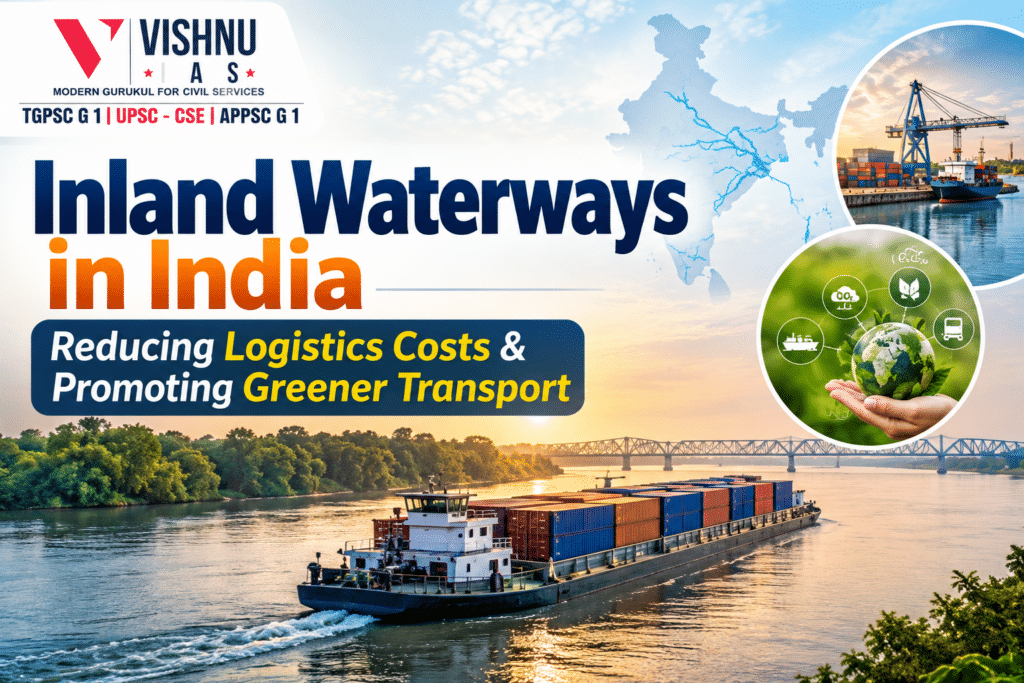
Inland Waterways in India: Reducing Logistics Costs & Promoting Green Transport
Inland Waterways in India – Introduction
Inland Waterways in India refer to the movement of people and goods through navigable rivers, canals, lakes, backwaters and related inland water channels. India has 111 National Waterways (NWs) of which 32 are operational. Cargo movement on National Waterways reached 145.84 million metric tonnes in FY 2024-25, indicating the growing relevance of waterways in India’s transport network.
“Inland waterways offer India an opportunity to reduce logistics costs while promoting greener and multimodal freight transport.” Discuss.
I. Logistics costs reduce
a. Energy-efficient mode of transport
- Inland waterways are particularly suitable for transporting bulk and heavy cargo over long distances.
- It uses about 3–6 times less energy than road transport and up to two times less than rail, making it economically attractive for appropriate cargo.
b. High carrying capacity
- A vessel carrying around 2,000 tonnes can potentially substitute for nearly 125 trucks of 16-tonne capacity each.
- This reduces the number of vehicles required for bulk transportation and can lower fuel, maintenance and handling costs.
c. Lower infrastructure and operating costs
- Unlike roads and railways, waterways can utilise naturally available river channels, reducing the requirement for extensive land acquisition and continuous construction of transport corridors.
- Their lower operating costs can contribute to India's objective of reducing overall logistics costs.
II. Environmental advantages
a. Lower carbon footprint
- The greater fuel efficiency of water transport translates into lower emissions per unit of freight transported. It also generates less noise than conventional land-based transportation.
b. Reduced road congestion
- Shifting suitable freight from roads to waterways can reduce the number of heavy vehicles on highways, thereby easing congestion, reducing road wear and lowering fuel consumption.
c. Lower land requirement
- Waterways require comparatively less additional land for the basic transport corridor. This makes them potentially useful for sustainable freight expansion, provided river ecosystems are adequately protected.
III. Multimodal integration
- The development of Multi-Modal Terminals, Inter-Modal Terminals, cargo aggregation hubs and Multi-Modal Logistics Parks can enable seamless movement between waterways, roads and railways. This can reduce handling delays and improve supply-chain efficiency.
- Example: NW-1
- The Jal Marg Vikas Project (JMVP) on National Waterway-1 seeks to strengthen navigation and multimodal connectivity along the Ganga-Bhagirathi-Hooghly system, demonstrating how waterways can be integrated with India's larger freight network.
IV. Significance
a. Northeast India
- The Brahmaputra, designated as National Waterway-2, can provide an important transport corridor for Assam and the wider Northeast. Better river connectivity can reduce the region's logistical disadvantages and improve access to markets.
b. India-Bangladesh connectivity
- The Bogibeel–Dhaka methanol shipment demonstrates the potential of NW-2 to connect the Northeast with Bangladesh and, through the Indo-Bangladesh Protocol Route, with wider regional and overseas markets.
c. Regional integration
- Inland waterways can complement India's connectivity initiatives with Bangladesh, Bhutan and Nepal, while also supporting broader regional trade and economic integration.
V. Regional development
- Cheaper movement of agricultural produce, minerals, construction material and other bulk commodities can improve market access and strengthen regional value chains.
- Development of terminals, vessel operations, cargo handling, warehousing, ship repair and logistics services can generate employment along waterways.
- Waterways also have potential for river tourism, cruise services and passenger transport, providing an additional economic use beyond freight movement.
VI. Challenges
- Indian rivers experience seasonal fluctuations in water levels, siltation and changing river morphology. Maintaining navigable depth therefore requires regular hydrographic surveys, channel marking, river training and appropriate dredging.
- A waterway becomes commercially viable only when cargo can efficiently move between the river terminal and its final destination. Inadequate road and rail connectivity can therefore negate the cost advantage of IWT.
- There is inadequate availability of suitable inland vessels for different types of cargo. Limited industrial clusters along some waterways also restrict the creation of a steady cargo base.
- Unregulated dredging, river training and construction may affect river morphology and aquatic ecosystems. Therefore, waterway development needs to balance navigational requirements with ecological flows, biodiversity and river health.
Conclusion
Inland waterways is not an alternative that replaces roads and railways, but a complementary component of an integrated multimodal freight system. Their high carrying capacity, lower energy intensity and potential to reduce road congestion make them particularly valuable for bulk freight. At the same time, navigational constraints, inadequate last-mile connectivity, limited vessel capacity and ecological concerns need to be worked upon.