

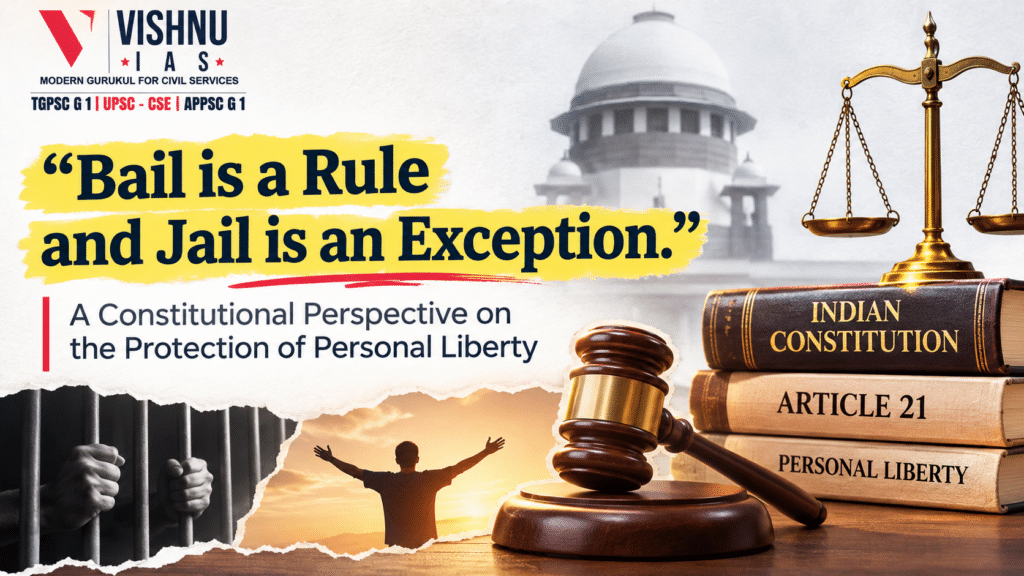
Bail Is a Rule and Jail Is an Exception: Constitutional Protection of Personal Liberty
The principle of “Bail is a rule and jail is an exception” is a fundamental tenet of India's criminal justice system. It is based on the presumption of innocence, which holds that an accused person is presumed innocent until proven guilty. The principle seeks to prevent unnecessary deprivation of personal liberty before conviction.
I. Constitutional and Legal Foundations of the Principle
1. Article 21
- Article 21 guarantees that no person shall be deprived of life or personal liberty except according to the procedure established by law. Such procedure must be fair, just and reasonable.
- The denial of bail without adequate justification can result in arbitrary deprivation of personal liberty, particularly when the accused has not been convicted.
2. Article 14
- Article 14 guarantees equality before the law and equal protection of the laws. Bail decisions must be based on relevant legal considerations rather than arbitrary factors, social status, economic position or personal prejudices.
3. Article 22
- Article 22 provides safeguards against arbitrary arrest and detention, including the right to be informed of the grounds of arrest, the right to consult a legal practitioner and production before a magistrate within 24 hours, subject to constitutional exceptions.
4. Presumption of Innocence
- The principle of presumption of innocence places the burden of proving guilt on the prosecution. Therefore, imprisonment before conviction should be justified by compelling circumstances rather than treated as a routine measure.
II. Judicial Interpretation
- In State of Rajasthan v. Balchand (1977), the Supreme Court articulated the principle that bail should generally be granted and imprisonment should be an exception.
- In Gudikanti Narasimhulu v. Public Prosecutor (1978), the Supreme Court emphasised that judicial discretion in bail matters must be exercised judiciously, keeping in view the individual's liberty and the interests of justice.
- In Hussainara Khatoon v. State of Bihar (1979), the Supreme Court recognised the right to speedy trial as an integral part of Article 21. It highlighted the plight of undertrial prisoners who remained incarcerated for prolonged periods, sometimes for periods exceeding the punishment prescribed for their alleged offences.
- In Sanjay Chandra v. CBI (2012), the Supreme Court observed that the object of bail is neither punitive nor preventive. Its primary purpose is to secure the presence of the accused during trial.
- In Satender Kumar Antil v. CBI (2022), the Supreme Court issued directions to prevent unnecessary arrests and prolonged detention of undertrial prisoners. It emphasised that courts must ensure that procedural safeguards are followed and that bail applications are decided in accordance with established legal principles.
- Recently, the Madras High Court expressed concern over the denial of bail by subordinate courts in a case involving bailable offences. It clarified that judicial officers cannot exercise discretion to refuse bail when the law recognises the accused's entitlement to bail. The Court also emphasised that the gravity of allegations, pending investigation or apprehension of evidence tampering cannot be used indiscriminately to deny bail in such cases.
III. Exceptions
- Although bail is generally the rule, it is not an absolute or unconditional entitlement in every criminal case.
- In cases involving serious offences, including terrorism, organised crime and certain economic offences, courts may impose stricter conditions for granting bail, subject to the applicable law.
- Bail may be refused where there are reasonable grounds to believe that the accused may abscond, influence witnesses, tamper with evidence or commit further offences.
- Certain special legislations, such as the Unlawful Activities (Prevention) Act (UAPA) and the Prevention of Money Laundering Act (PMLA), prescribe stringent conditions for granting bail subject to Constitution.
IV. Challenges
- Pendency of cases and inadequate judicial capacity contribute to prolonged detention of undertrial prisoners.
- Poor and marginalised individuals often struggle to arrange sureties or meet bail conditions.
- Many accused persons are unaware of their legal rights and available remedies.
- Arbitrary Exercise of Discretion: Inconsistent interpretation of bail principles by subordinate courts can undermine equality before law.
- Excessive undertrial detention contributes to prison overcrowding and affects the dignity and rehabilitation of prisoners.
Conclusion
The principle of “Bail is a rule and jail is an exception” reflects the constitutional commitment to individual liberty, human dignity and the rule of law. While the State has a legitimate responsibility to prevent crime and ensure fair investigation, such objectives cannot justify arbitrary deprivation of liberty. As the Supreme Court emphasised, courts must act as guardians of liberty, ensuring that the process of criminal justice does not itself become a form of punishment.