
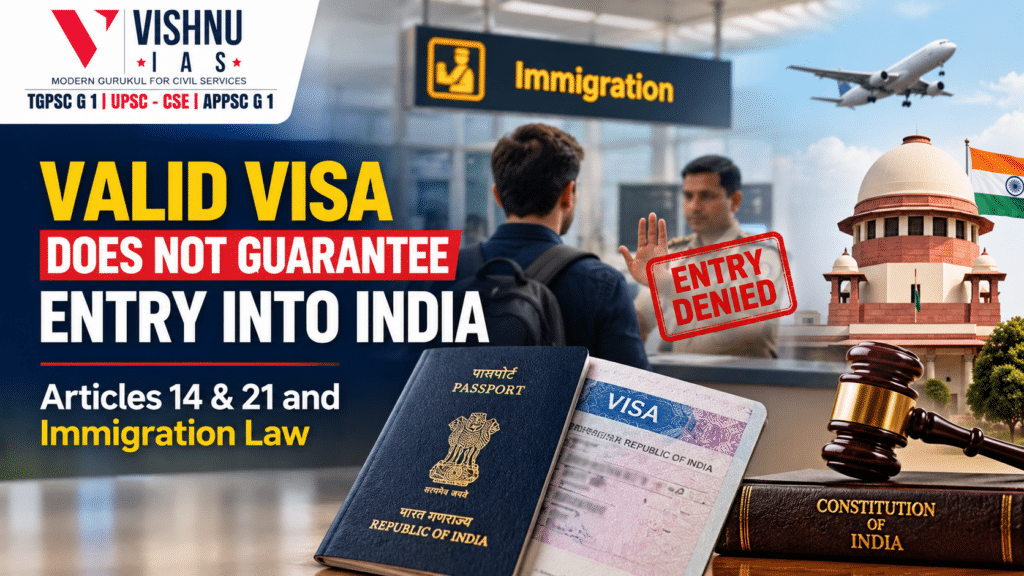
Valid Visa Does Not Guarantee Entry into India: Articles 14 & 21 and Immigration Law
Body
I. Constitutional Position of Foreign Nationals
Article 14 - Equality Before Law
- Article 14 uses the expression “any person” and therefore its protection extends to foreigners as well as citizens. However, equality does not require identical treatment where there are legitimate grounds for differentiation.
- In Hans Muller of Nurenburg v. Superintendent, Presidency Jail (1955), the Supreme Court recognised that State considerations may justify reasonable classification among foreigners and held that the relevant provisions did not violate Article 14.
Article 21: Protection of Life and Personal Liberty
- Article 21 also applies to foreigners. A foreign national cannot be deprived of life or personal liberty except according to procedure established by law.
- The Supreme Court in Hans Muller specifically recognised that constitutional limitations under Articles 21 and 22 apply to governmental action affecting the liberty of foreigners.
Article 19: Rights Reserved for Citizens
- Fundamental freedoms under Article 19 are available only to citizens.
- In Louis De Raedt v. Union of India (1991), the Supreme Court held that a foreigner's fundamental right is confined to protections such as Article 21 and does not include the Article 19(1)(e) right to reside and settle in India.
II. State's Sovereign Power Over Immigration
Admission and Expulsion of Foreigners
- The Constitution places matters relating to aliens, admission into and expulsion from India within the Union's domain.
- In Hans Muller, the Supreme Court recognised the broad legislative and executive authority of the Union concerning foreigners, including restrictions on their movement and expulsion.
Immigration and Foreigners Act, 2025
The new Act provides the statutory framework governing immigration and foreigners in India and came into force on 1 September 2025.
Requirement of Valid Documents
- Section 3 requires a foreigner seeking to enter India to possess a valid passport or travel document and visa. However, possessing these documents does not by itself make admission unconditional.
- The statutory scheme permits immigration authorities to examine the foreigner's documents and determine admissibility.
- The Act empowers the Central Government to issue orders, directions or instructions concerning foreigners. Therefore, immigration clearance remains subject to the statutory framework and considerations such as national security, sovereignty, public order and public health.
III. Judicial Precedents Establishing the Principle
Hans Muller Case (1955)
- The Constitution Bench upheld the legislative framework concerning foreigners and recognised the wide power of the State to regulate the presence and expulsion of foreigners.
- At the same time, it acknowledged that Article 21 protects foreigners against deprivation of personal liberty except according to law.
Louis De Raedt Case (1991)
- The Supreme Court held that foreigners do not possess the Article 19(1)(e) right to reside and settle in India.
- It further recognised the Government's power to expel foreigners, while affirming Article 21 protection.
Recent Delhi High Court Judgment
- In the recent Annagurbanova vs. Union of India case (2026), the petitioner possessed a valid passport and business visa but was denied entry at the airport.
- The Court held that there was no inherent or legally enforceable right of a foreign national to enter India.
- Entry of foreigners may be restricted if it has implications for national security, foreign relations, sovereignty and public order.
- It also observed that immigration authorities may consider confidential or adverse inputs concerning national security and public order.
Conclusion
Thus, a visa is an authorisation to seek admission rather than an indefeasible right of entry. India's constitutional framework strikes a balance between the protection of foreigners under Articles 14 and 21 and the sovereign authority of the State to regulate immigration. The principles laid down in Hans Muller and Louis De Raedt, now operating alongside the Immigration and Foreigners Act, 2025, establish that national security and sovereign immigration control can justify refusal of entry.