

Agricultural Value-Chain Financing in India: Rationale & Rural Prosperity
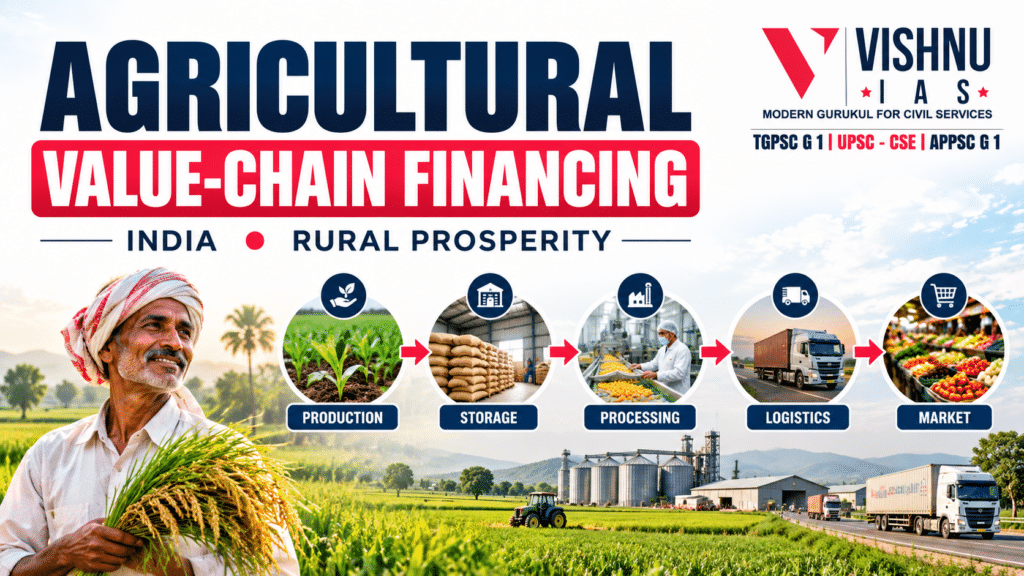
Agricultural value-chain financing can play a crucial role in transforming India's rural economy by moving beyond production finance towards financing the entire agricultural value chain. India has built a strong institutional framework for financing agricultural production through Kisan Credit Cards, cooperative credit institutions, Regional Rural Banks and commercial banks. However, agricultural value is created not merely at the farm but across the entire chain of aggregation, storage, processing, transportation, marketing and retailing. Therefore, the next phase of agricultural transformation requires a shift from production-centric credit towards agricultural value-chain financing, which can enable farmers and rural enterprises to capture a larger share of the value generated after harvest.
Body
I. Need for Shift in Financing
1. Production credit is necessary but insufficient:
Traditional agricultural finance largely addresses the farmer's input requirements such as seeds, fertilisers, irrigation and farm operations. However, substantial value is generated after harvesting through storage, grading, processing, packaging, branding and marketing.
2. Post-harvest financing gap:
Farmers often sell immediately after harvest because of inadequate storage and working capital, leading to distress sales. Similarly, agro-processors may possess adequate processing capacity but lack sufficient working capital to procure and hold seasonal agricultural commodities.
3. Seasonality of agricultural commodities:
Unlike dairy, poultry and fisheries, many crops generate income only during particular harvesting periods. A processor may need to procure a year's raw material within a few weeks and finance its inventory for several months. Hence, conventional short-term production loans may not adequately meet such requirements.
4. Low level of value addition:
India's relatively low level of agricultural processing compared with several developed and Asian economies indicates considerable scope for shifting finance towards post-harvest activities.
While only about 10–12% of agricultural produce is processed in India, the corresponding level is estimated at around 35–45% across East, South and Southeast Asia and often exceeds 60% in many developed economies.
In these economies, agricultural transformation is supported by financing systems aligned with commodity-specific value chains rather than production alone.
5. Fragmented agricultural value chains:
Small and marginal farmers, FPOs, aggregators, warehouses, processors and logistics providers often face different financing requirements. A comprehensive financing architecture is necessary to connect these actors.
II. Rationale and Significance of Value-Chain Financing
Higher value realisation for farmers:
- Access to storage and post-harvest credit allows farmers to avoid distress sales immediately after harvest and sell when market conditions are more favourable.
- The Credit Guarantee Scheme for e-NWR Based Pledge Financing (CGS-NPF) provides a ₹1,000-crore corpus to support post-harvest finance against electronic negotiable warehouse receipts, thereby strengthening warehouse-backed lending.
Promotion of food processing:
- Value-chain finance can provide working capital and investment finance to processors, enabling greater conversion of raw agricultural commodities into higher-value products.
- The Pradhan Mantri Kisan SAMPADA Yojana (PMKSY) supports integrated food-processing and preservation infrastructure, including cold chains and value-addition infrastructure.
Reduction in post-harvest losses:
- Financing warehouses, cold storage, grading and sorting facilities helps preserve agricultural produce and improves its marketability.
- AIF provides 3% interest subvention and credit-guarantee support for eligible loans, thereby reducing financing constraints for such investments
- It specifically supports post-harvest infrastructure such as warehouses, cold chains, sorting and grading units and logistics facilities.
Rural employment and industrialisation:
- Processing, packaging, transportation, cold-chain management and marketing generate employment beyond farming.
- Thus, agricultural value-chain finance can facilitate the emergence of rural agro-industries and non-farm employment.
Farmer Producer Organisations:
- FPOs can aggregate the produce of small farmers, improve bargaining power and undertake collective storage, processing and marketing.
- Access to institutional finance can enable them to move from being merely producer collectives to market-oriented rural enterprises.
Better market integration:
- Platforms such as e-NAM improve price discovery and connect farmers with a wider pool of buyers.
- More than 1.5 crore farmers and 2.5 lakh traders were registered on the platform.
- Financial support combined with digital agricultural markets can therefore improve the movement of produce from farm to consumer.
Crowding-in of private investment:
When risks are reduced through credit guarantees, warehouse receipts and predictable cash-flow mechanisms, private banks, NBFCs and investors can participate more actively in agricultural value chains.
Inclusive rural prosperity:
Value-chain financing can distribute economic opportunities across farmers, aggregators, warehouse operators, processors, transporters and retailers.
III. Way Forward
- WDRA-accredited warehouses should be developed near production centres, enabling farmers and aggregators to obtain credit against stored produce.
- Institutional credit should be better integrated with the Agriculture Infrastructure Fund (AIF) to expand warehouses, cold chains, grading, sorting and other post-harvest infrastructure.
- PM Kisan SAMPADA Yojana, PMFME and PLISFPI should be linked more effectively with institutional credit to develop complete farm-to-market value chains.
- Integration of e-NAM, digital warehouse receipts, transaction records and digital payments can improve credit assessment, reduce information asymmetry and facilitate faster lending.
- Awareness and digital literacy among farmers and FPOs should be strengthened to improve access to digital credit, warehouse receipts and online agricultural markets.
- FPOs shall receive better access to working capital, credit guarantees, professional management and market linkages so that they can undertake aggregation, processing and marketing.
Conclusion
Moving towards agricultural value-chain financing can connect production with storage, processing, logistics and markets, thereby improving farmer realisation, creating rural employment and promoting agro-based industrialisation. A comprehensive financing architecture combining credit, infrastructure, risk mitigation and market access can therefore become an important pillar of India's transition towards Viksit Bharat 2047.