
AFSPA 1958: Meaning, Circumstances, Powers & Safeguards
The Armed Forces (Special Powers) Act (AFSPA), 1958 was enacted to enable the armed forces to assist civil authorities in areas facing serious insurgency or armed violence. It operates only after an area is declared a “disturbed area” under Section 3. The Act was originally enacted in the context of the Naga insurgency and was subsequently extended to other parts of the Northeast.
I. AFSPA, 1958
1. Legal framework:
- AFSPA enables specified members of the armed forces to exercise special powers in areas notified as disturbed.
- Section 3 provides for the declaration of a disturbed area, while Sections 4 and 5 deal principally with special powers and procedures relating to arrest.
- Section 6 provides protection against prosecution, suit or other legal proceedings for acts done or purported to be done under the Act without prior sanction of the Central Government.
2. Federal dimension:
- Both the Central Government and the Governor of a State can declare an area disturbed under Section 3. Thus, the geographical application of AFSPA need not be determined exclusively by the Union Government.
- The Supreme Court has also held that the Central Government should ordinarily consult the State Government before making such a declaration.
II. Circumstances for invoking AFSPA
1. Insurgency and armed groups:
- The original context was the Naga insurgency, after which the legislation was extended to other parts of the Northeast.
- Persistent armed insurgency and the movement of insurgent groups have historically been important reasons for its continuation in Nagaland and parts of Arunachal Pradesh.
2. Breakdown of normal security mechanisms:
- AFSPA becomes relevant where the scale of violence exceeds the effective capacity of ordinary policing and requires deployment of the armed forces in aid of civil power.
3. Periodic assessment:
- The Supreme Court in Naga People's Movement of Human Rights v. Union of India (1998) upheld AFSPA but stressed safeguards against arbitrary exercise of power. The Court observed that a disturbed-area declaration should not be treated as permanent and envisaged periodic review.
4. Manipur as an example of changing security conditions:
- AFSPA's trajectory in Manipur illustrates that its geographical application can expand or contract according to security conditions. It was withdrawn from several Valley areas between 2022 and 2023 as the security situation was considered to have improved. Following the ethnic violence that began in May 2023, the Centre subsequently restored AFSPA in several areas.
5. Current application:
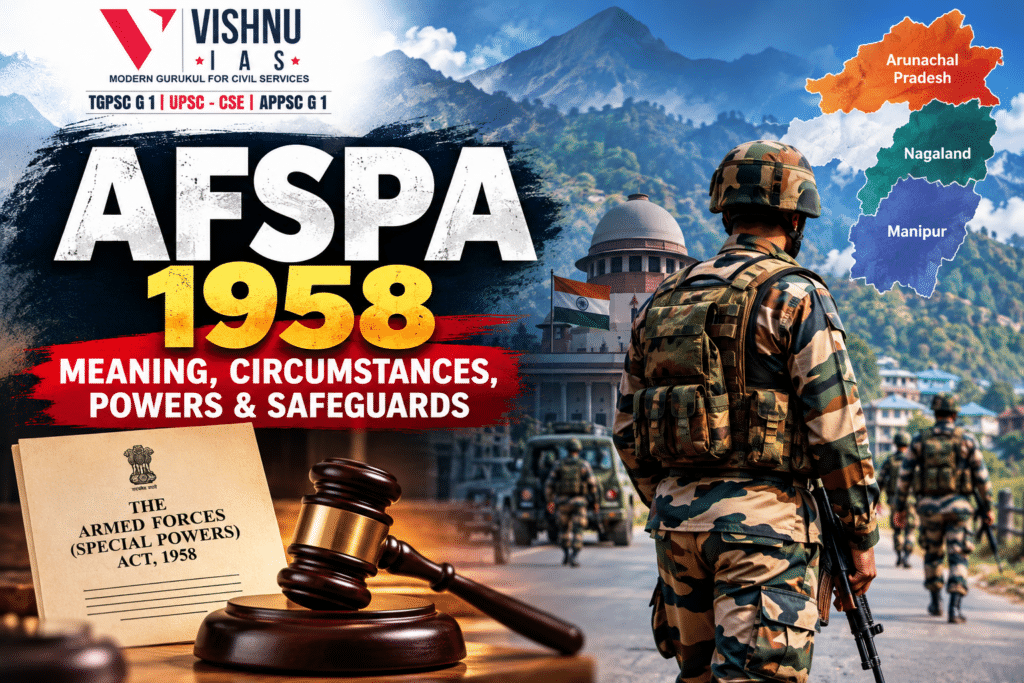
- Recently, the Union Government has extended AFSPA for another six months from 1 October 2026 to 31 March 2027 in specified areas of Manipur, Nagaland and Arunachal Pradesh.
III. Powers conferred under AFSPA
1. Power to use force:
- Under Section 4(a), an authorised officer may, after giving due warning, use force, including force causing death, against a person acting in contravention of a law or order prohibiting assembly or carrying weapons, ammunition or explosives, subject to the statutory conditions.
2. Power to destroy arms and fortified structures:
- Section 4 permits authorised personnel to destroy arms dumps, fortified positions, shelters or structures used as training camps or hide-outs by armed groups.
3. Arrest without warrant:
- Armed forces personnel can arrest without warrant a person who has committed or is reasonably suspected of having committed a cognizable offence, subject to the Act.
4. Search without warrant:
- They can enter and search premises without warrant to make an arrest or recover persons wrongfully restrained, arms, ammunition or explosives. They may also stop and search vehicles or vessels suspected of carrying such persons or material.
5. Duty after arrest:
- Under Section 5, a person arrested under the Act must be handed over to the officer-in-charge of the nearest police station with the least possible delay, together with a report explaining the circumstances of the arrest. The Supreme Court has emphasised that the armed forces do not replace the State's civil and criminal-justice machinery.
6. Legal protection:
- Section 6 requires prior sanction of the Central Government before prosecution or other legal proceedings can be instituted against a person for anything done or purportedly done under the Act. This provision is intended to protect personnel acting in difficult counter-insurgency situations, but it has also generated concerns regarding accountability.
IV. Judicial safeguards and accountability
- In Naga People's Movement of Human Rights v. Union of India (1998), the Constitution Bench upheld the constitutional validity of AFSPA. However, it clarified that the armed forces operate in aid of civil power, rather than replacing the civil administration. The Court also emphasised safeguards and compliance with the Army's “Do's and Don'ts”.
- In Extra Judicial Execution Victim Families Association v. Union of India (2016–2017), concerning alleged extra-judicial killings in Manipur, the Supreme Court held that allegations of excessive or retaliatory force resulting in death require thorough enquiry even in disturbed areas. The existence of AFSPA does not place alleged unlawful killings beyond investigation. Thus, Section 6 protection is a procedural safeguard against frivolous litigation, not an absolute immunity from investigation or judicial scrutiny.
Conclusion
AFSPA represents an exceptional legal framework designed to address exceptional security conditions. Its continuing relevance lies in providing operational support to armed forces confronting insurgency and armed violence; however, its legitimacy also depends upon necessity, proportionality, periodic review and accountability.