

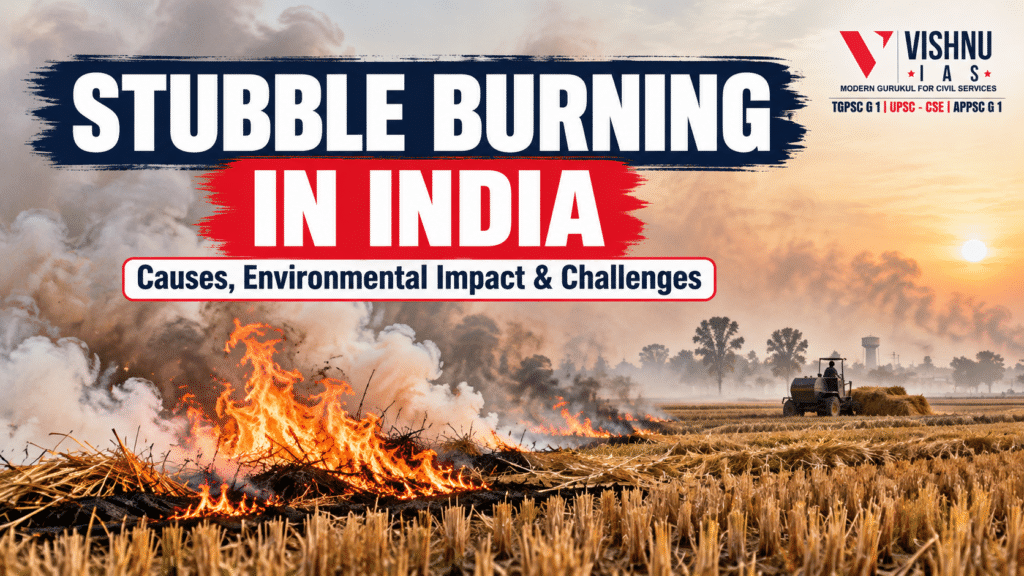
Stubble Burning in India: Causes, Environmental Impact and Challenges
Introduction
Stubble burning in India refers to the intentional burning of crop residue left after harvesting, particularly paddy straw in Punjab and Haryana. Despite its contribution to air pollution, soil degradation and health problems, the practice persists due to a combination of economic constraints, agricultural policies, technological limitations and regulatory gaps.
Reasons for the Persistence of Stubble Burning
1. Narrow Window Between Paddy Harvesting and Wheat Sowing
The short interval between harvesting paddy and sowing wheat leaves farmers with little time to clear their fields. Delayed paddy transplantation and long-duration varieties such as PUSA-44 have pushed harvesting towards late October and early November, leaving barely 10–15 days for the next crop. Burning becomes a quick method of clearing fields.
2. Agricultural Policies Favouring Paddy and Wheat
- The minimum support price (MSP) and assured government procurement of paddy and wheat discourage farmers from diversifying into alternative crops.
- Between 2012 and 2024, government procurement accounted for approximately 87% of paddy production in Punjab and 74% in Haryana, compared with 37% nationally. This reinforces the rice–wheat cropping cycle and the recurring generation of paddy straw.
3. High Cost and Limited Availability of Alternatives
- Crop residue management machinery, such as Happy Seeders and Super Seeders, requires substantial investment and suitable tractors.
- Hiring machinery can cost around ₹10,000, while ex-situ residue management may cost ₹1,500–₹2,500 per acre.
- Delays in machinery availability during the peak harvesting season further reduce its practical usefulness for farmers.
4. Labour Shortages and Economic Considerations
Manual removal of paddy straw is labour-intensive, time-consuming and expensive. Mechanised harvesting also leaves substantial quantities of residue in the field. For farmers operating under tight sowing schedules and financial constraints, burning is often the cheapest and fastest available option.
5. Agricultural Incentives and Groundwater Dependence
The availability of free or highly subsidised electricity encourages groundwater extraction for water-intensive paddy cultivation. Although the Punjab Preservation of Sub-Soil Water Act, 2009, sought to conserve groundwater by delaying paddy transplantation, it also shifted harvesting towards the period immediately preceding wheat sowing. Thus, a groundwater conservation measure inadvertently intensified the time pressure contributing to stubble burning.
6. Inadequate Markets for Crop Residue
- Although paddy straw can be used in biomass power generation, compressed biogas, bioethanol and other industries, collection, transportation and storage remain challenging.
- The absence of assured buyers and remunerative prices discourages farmers from selling or supplying residue to industrial units.
7. Limitations of Regulatory Enforcement
- Despite restrictions and penalties, enforcement is difficult across large agricultural areas. Penalising farmers without providing affordable alternatives generates resistance and encourages concealment rather than compliance.
- Effective monitoring also remains challenging because satellite systems miss fires occurring outside their observation windows. Polar satellites that orbit the Earth’s poles observe India only at fixed times of the day, from 10:30 am to 1:30 pm. A study by ISRO scientists using geostationary satellite observations showed that farmers have shifted to stubble burning in the evening hours to avoid polar satellites.
8. Weak Coordination and Implementation Gaps
- Crop residue management requires coordination among agricultural departments, machinery suppliers, farmer organisations, local bodies and biomass-based industries.
- Delays in subsidies, inadequate custom-hiring facilities and insufficient industrial capacity limit the effectiveness of existing interventions.
Conclusion
The persistence of stubble burning reflects a structural problem rather than merely individual non-compliance. Addressing it requires a combination of affordable crop residue management, assured markets and remunerative prices for straw, incentives for crop diversification, improved machinery access and effective monitoring. Moving from a predominantly punitive approach towards one that makes sustainable residue management economically viable for farmers is essential for achieving cleaner air and sustainable agriculture.