
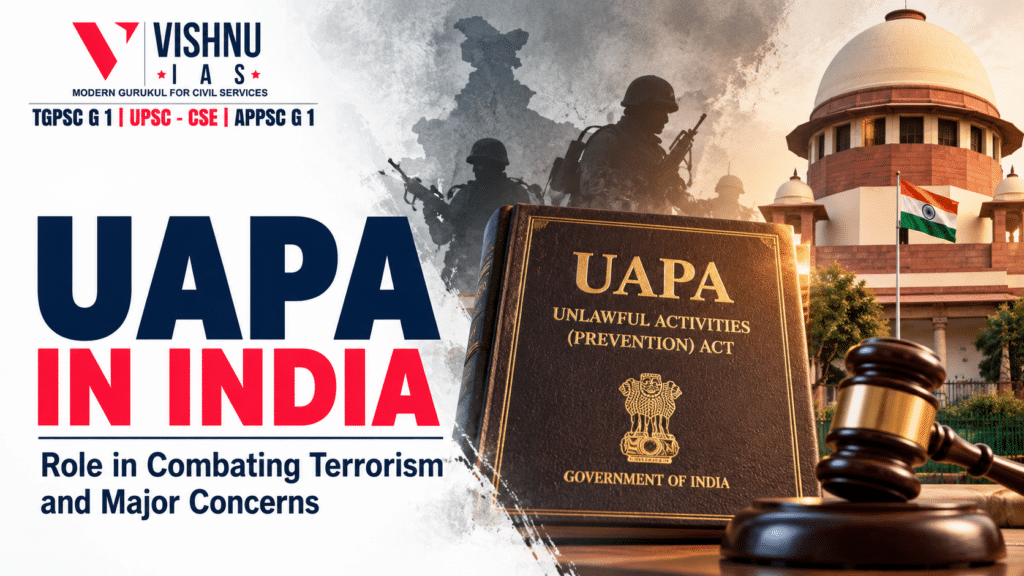
UAPA in India: Role in Combating Terrorism and Major Concerns
The UAPA in India, formally known as the Unlawful Activities (Prevention) Act, 1967, is India's principal anti-terrorism legislation. Originally enacted to prevent unlawful activities threatening India's sovereignty and territorial integrity, it was strengthened through amendments, particularly in 2004, 2008, 2012 and 2019, to address evolving terrorist threats.
I. Role of the UAPA in Combating Terrorism
1. Preventing Terrorist Activities
The Act criminalises terrorist acts and activities such as terrorist recruitment, conspiracy, harbouring terrorists and providing support for terrorist activities. It enables the State to intervene against threats to national security before they escalate.
2. Banning Terrorist Organisations
The Central Government can declare organisations unlawful or designate them as terrorist organisations under the Act.
3. Disrupting Terror Financing
The UAPA penalises the raising and provision of funds for terrorist activities. Its provisions also facilitate the seizure and forfeiture of property linked to terrorism, which disrupts the financial networks that sustain terrorist organisations.
4. Individual Involvement
The 2019 amendment empowered the Central Government to designate individuals as terrorists under specified statutory grounds, in addition to listing terrorist organisations. This addresses threats posed by individuals who operate independently of formally organised groups.
5. Strengthening Investigation and Prosecution
The Act provides special investigative procedures for terrorism-related offences. Under Section 43D, the period for filing a charge sheet may be extended up to 180 days, subject to the statutory conditions and judicial approval. The National Investigation Agency (NIA) also investigates and prosecutes offences under the Act, strengthening the national response to terrorism.
II. Major Concerns
1. Stringent Bail Provisions and Prolonged Incarceration
- Section 43D(5) imposes stringent restrictions on bail when the court finds reasonable grounds for believing that the accusation is prima facie true. Consequently, accused persons may remain in prison for extended periods before their guilt is established.
- Example: Prolonged pre-trial detention of Umar Khalid and Sharjeel Imam in the 2020 Delhi riots conspiracy case has highlighted the debate over bail, trial delays and personal liberty. Their detention and bail proceedings illustrate the wider concern that trials under stringent anti-terror laws may take years to conclude.
2. Concerns Regarding Fundamental Rights
- The Act raises concerns about its compatibility with Articles 14, 19 and 21 of the Constitution.
- Broad interpretations of unlawful activities may affect freedom of speech and association under Article 19, while prolonged detention without timely trial raises questions concerning personal liberty and due process under Article 21.
3. Potential Criminalisation of Dissent
- The Act may be invoked against activists, journalists, students and individuals expressing dissenting political views.
- Where the distinction between peaceful dissent and conduct connected with terrorism is not carefully maintained, the law may discourage legitimate criticism and public participation.
- Example: The 2024 controversy surrounding the prosecution sanction against author Arundhati Roy over alleged unlawful activity linked to statements made at a 2010 event renewed debate about the limits of free expression under the Act.
4. Individual Designation and Due Process
- The 2019 amendment permits individuals to be designated as terrorists without a prior criminal conviction.
- Although the provision seeks to address threats posed by individuals outside formal organisations, concerns arise regarding reputational damage, procedural fairness and the possibility of arbitrary designation.
5. Broad Definitions and Scope for Misuse
- The interpretation of terms associated with unlawful activities and terrorist acts can raise concerns about legal certainty.
- If the law is applied without sufficient attention to the nature of the conduct and supporting evidence, actions that do not meet the threshold of terrorism may attract stringent provisions.
6. Low Conviction Rates and Delayed Justice
- A large number of cases involving serious allegations remain pending, while only a proportion result in convictions.
- This raises questions about investigative quality, the sufficiency of evidence and the effectiveness of prosecution.
III. Judicial Safeguards
1. Constitutional Courts as Safeguards
In Union of India v. K.A. Najeeb (2021), the Supreme Court held that statutory restrictions on bail do not prevent constitutional courts from granting bail where prolonged incarceration and the unlikelihood of a timely trial infringe fundamental rights.
2. Preventing Arbitrary Application
The Supreme Court's decision in NIA v. Zahoor Ahmad Shah Watali (2019) addressed the approach courts should adopt while considering bail under Section 43D(5). Its interpretation has also generated debate about the limited scope for detailed examination of evidence at the bail stage.
Conclusion
The UAPA is an instrument for protecting India's sovereignty and combating terrorism. However, national security and constitutional liberty must operate as complementary objectives rather than competing absolutes. Clearer legal standards, accountable investigations, timely trials and effective judicial oversight are essential to ensure that the Act remains both effective against terrorism and consistent with democratic principles.