
Legislative Councils in Indian States: Creation, Composition and Abolition
Legislative Councils in Indian States are an important component of India's parliamentary framework, providing an additional legislative chamber for deliberation, scrutiny and representation of diverse interests. The Constitution allows States the flexibility to adopt either a unicameral or bicameral system.
Introduction
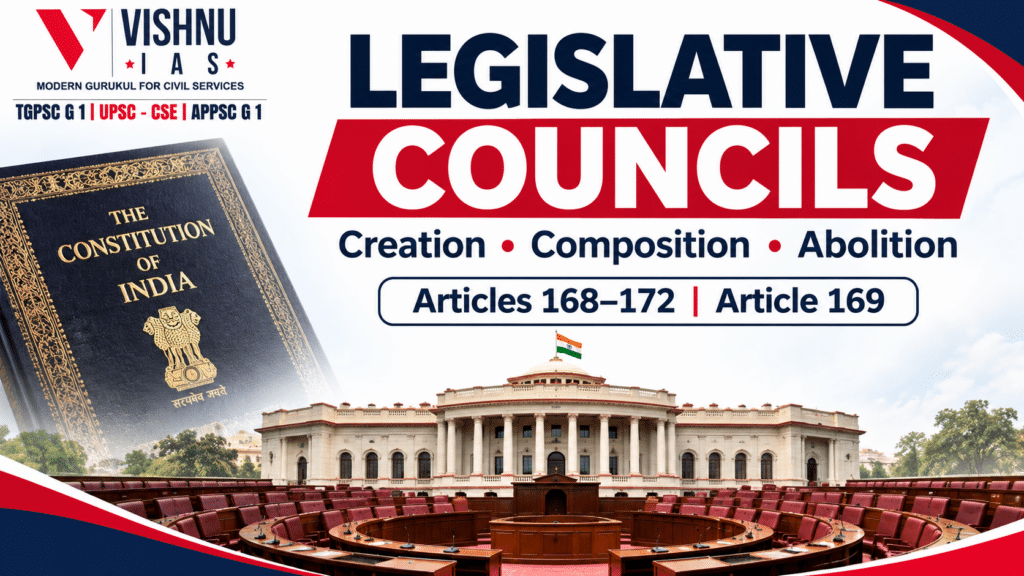
India provides for a bicameral legislature at the Union level, while allowing States the flexibility to adopt either a unicameral or bicameral system. The Legislative Council (Vidhan Parishad) is the upper chamber of a State legislature, intended to act as a revising house, prevent hasty legislation and facilitate representation of diverse interests. Articles 168–172 of the Constitution provide the framework for State legislatures, while Article 169 specifically governs the creation and abolition of Legislative Councils.
I. Constitutional Provisions Governing Legislative Councils
1. Constitutional Status and Creation – Articles 168 and 169
- Article 168 provides that the legislature of a State shall consist of the Governor and either one or two Houses.
- States having two Houses comprise the Legislative Assembly (Vidhan Sabha) and Legislative Council (Vidhan Parishad). Unlike the Rajya Sabha, Legislative Councils are not compulsory for all States.
- Article 169 provides the procedure for the creation or abolition of a Legislative Council.
- The Legislative Assembly of the concerned State must first pass a resolution by a special majority, comprising a majority of its total membership and a majority of not less than two-thirds of members present and voting. Subsequently, Parliament may enact a law to create or abolish the Council through a simple majority. Such legislation is not considered a constitutional amendment under Article 368.
2. Composition of Legislative Councils – Article 171
- Article 171 prescribes the composition and numerical strength of Legislative Councils. Their total membership cannot exceed one-third of the membership of the State Legislative Assembly, subject to a minimum of 40 members.
- One-third of the members are elected by members of local authorities such as municipalities and district boards.
- One-twelfth are elected by graduates who have held a degree for at least three years, while another one-twelfth are elected by teachers with at least three years of teaching experience in institutions not below the secondary-school level.
- Another one-third are elected by members of the Legislative Assembly from among persons who are not members of the Assembly.
- The remaining one-sixth are nominated by the Governor from persons having special knowledge or practical experience in literature, science, art, the cooperative movement and social service.
- Elections are conducted through proportional representation by means of the single transferable vote. This composition provides representation to local governments, educated groups, professionals and individuals with specialised expertise.
3. Duration and Membership – Articles 172 and 173
- Legislative Council is a permanent body and is not subject to dissolution. However, individual members serve a term of six years, with one-third retiring every two years.
- Article 173 prescribes a minimum age of 30 years for membership of the Legislative Council.
II. Powers, Limitations and Reforms Concerning Legislative Councils
1. Legislative and Executive Functions
- Under Article 197, in the case of ordinary Bills, the Council can delay passage by a maximum of four months but cannot permanently obstruct legislation. If disagreements persist, the Bill passed again by the Assembly prevails. Unlike Parliament, there is no provision for a joint sitting to resolve disagreements between the two Houses.
- Under Article 198, Money Bills can originate only in the Legislative Assembly. The Council can make recommendations within 14 days, which the Assembly may accept or reject.
- Under Article 164, the Chief Minister and other Ministers may belong to either House of the State legislature. However, the Council of Ministers is collectively responsible to the Legislative Assembly. Article 177 also enables Ministers to participate in the proceedings of either House.
- Thus, the Legislative Council primarily performs a deliberative and revisory function rather than exercising equal legislative authority.
2. Issues and Challenges
- The creation and abolition of Legislative Councils have frequently been influenced by political considerations.
- Tamil Nadu abolished its Legislative Council in 1986. Although a resolution seeking its revival was passed in 2010, the subsequent government withdrew the proposal in 2011.
- Similarly, Andhra Pradesh abolished its Council in 1985, but revived it in 2007.
- Further, maintaining an additional legislative chamber involves considerable expenditure on salaries, allowances and administrative infrastructure.
- The Council may also become a means of accommodating political leaders who have failed to secure electoral victories.
3. Second Administrative Reforms Commission Recommendations
- The Second Administrative Reforms Commission, in its Sixth Report (2007) on Local Governance, recommended restructuring Legislative Councils as 'Councils of Local Governments'.
- It proposed that Parliament consider creating Legislative Councils in all States to strengthen grassroots democracy.
- The ARC suggested that members should be elected exclusively by representatives of local bodies, including Panchayati Raj Institutions and Urban Local Bodies.
- It also recommended removing the separate constituencies for graduates and teachers, considering the expansion of literacy and changes in educational access.
Conclusion
Legislative Councils represent an important instrument of deliberative democracy and legislative scrutiny within India's parliamentary framework. While their limited legislative powers and financial implications warrant examination, their potential to accommodate diverse interests and strengthen grassroots democracy should not be overlooked. Their continuation must ultimately be justified by their contribution to the quality of governance rather than merely their constitutional existence.