
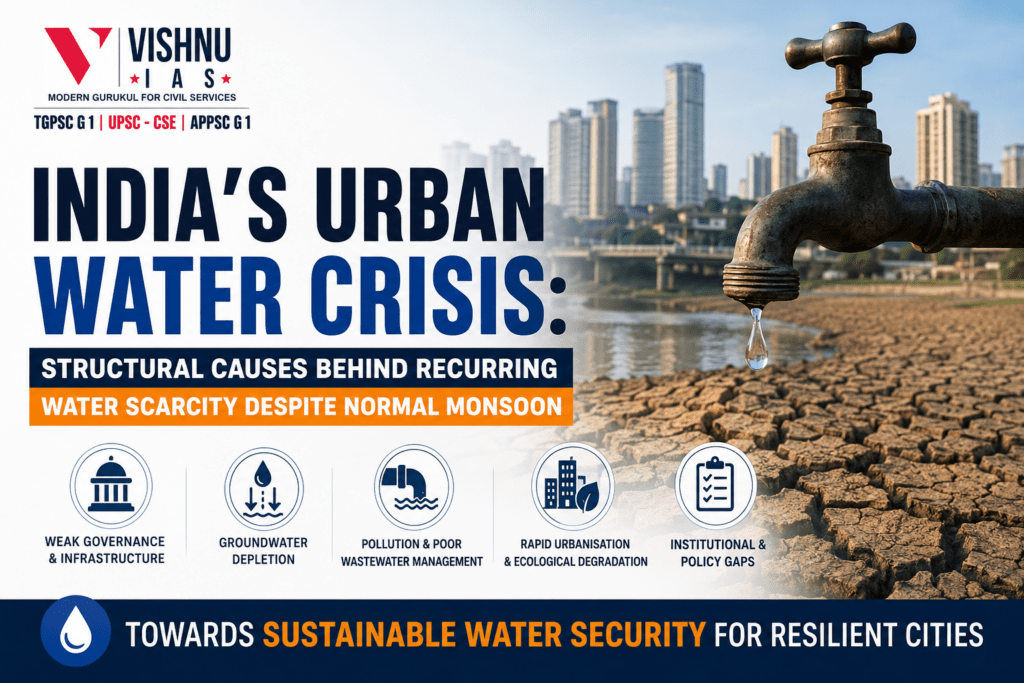
India’s Urban Water Crisis: Structural Causes Behind Recurring Water Scarcity Despite Normal Monsoon

Introduction: Urban water crisis refers to the persistent inability of cities to ensure adequate, equitable, safe and sustainable water supply despite the availability of natural water resources. India’s challenge is increasingly structural rather than seasonal, as 18% of the world’s population depends on only about 4% of global freshwater resources, while 11 of the country’s

India’s Urban Water Crisis: Structural Causes Behind Recurring Water Scarcity Despite Normal Monsoon Read More »

India–Japan FOIP, AI Judiciary, Mission Aagaman & Supreme Court Bail Debate

Today Current Affairs 03/07/2026 1. India–Japan Partnership and the Free & Open Indo-Pacific (FOIP) Context: During the bilateral summit in New Delhi, India and Japan reaffirmed their shared priority for a “free, prosperous, and rules-based Indo-Pacific,” anchoring their discussion on strategic cooperation, defense co-development, and maritime security amid growing regional geopolitical realignments. Free and Open

India–Japan FOIP, AI Judiciary, Mission Aagaman & Supreme Court Bail Debate Read More »

Article 21 Right to Speedy Trial vs UAPA Bail Restrictions: Constitutional Balance Between Liberty and Security

Introduction: The Right to a Speedy Trial is an integral component of the Right to Life and Personal Liberty under Article 21, ensuring that no individual is deprived of liberty except through a fair, just and reasonable procedure. While special legislations such as the Unlawful Activities (Prevention) Act (UAPA) impose stringent statutory restrictions on the

Article 21 Right to Speedy Trial vs UAPA Bail Restrictions: Constitutional Balance Between Liberty and Security Read More »

LPG Price Cut, GST Growth, World Bank Climate Finance, VIJAY Roadmap & CRS 2024

Today Current Affairs 02/07/2026 Introduction UPSC Current Affairs 2 July 2026 covers important developments in the economy, international relations, environment, defence, and governance that are highly relevant for UPSC Prelims and Mains examination. Today’s topics include India’s LPG price reduction, GST revenue trends, the World Bank’s climate finance policy shift, the Indian Army’s VIJAY Roadmap,

LPG Price Cut, GST Growth, World Bank Climate Finance, VIJAY Roadmap & CRS 2024 Read More »

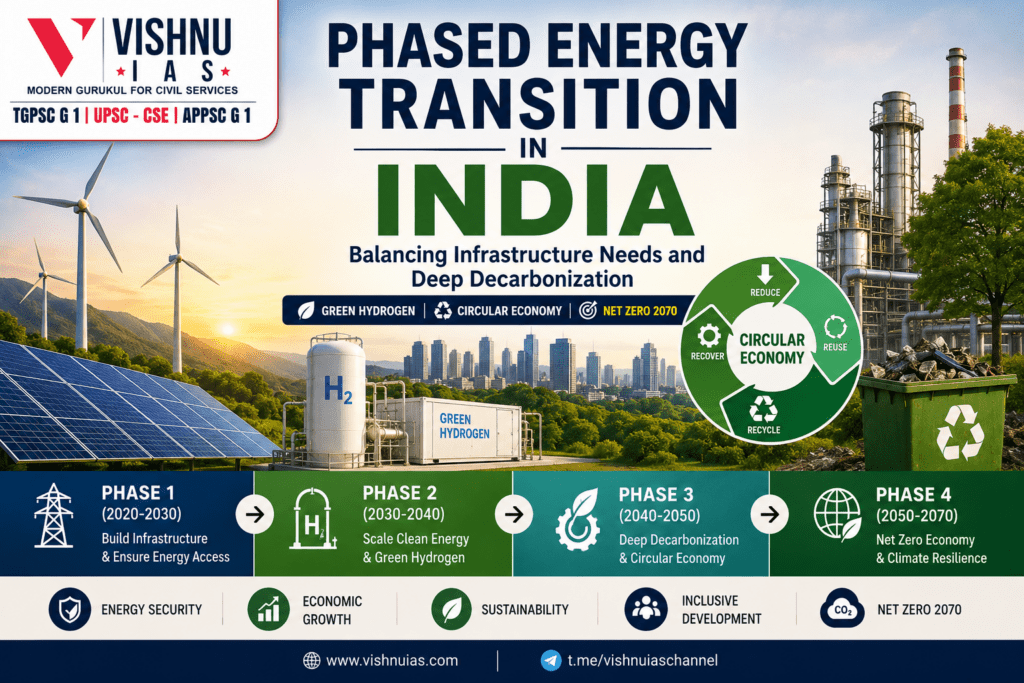
Phased Energy Transition in India: Balancing Infrastructure Needs and Deep Decarbonization

Introduction: A phased energy transition refers to a sequenced and adaptive transformation of the energy system, wherein immediate investments in energy access, infrastructure, reliability and affordability progressively evolve into a low-carbon, resource-efficient and climate-resilient economy. As one of the world’s fastest-growing energy markets, India has expanded its renewable energy capacity from about 40 GW in

Phased Energy Transition in India: Balancing Infrastructure Needs and Deep Decarbonization Read More »

El Niño, FCRA 2.0, Gulf Remittances, India’s Biodiversity & NEP 2020 Three-Language Policy

Today Current Affairs 01/07/2026 1. El Niño and Deficit Monsoons: Challenges to India’s Climate Resilience (GS-I: Geography) Context: The India Meteorological Department (IMD) forecasts below-normal rainfall (<94% of normal) for July following a severe 40% deficit in June. This weak southwest monsoon is attributed to developing El Niño conditions, raising significant agricultural concerns. Monsoon Context

El Niño, FCRA 2.0, Gulf Remittances, India’s Biodiversity & NEP 2020 Three-Language Policy Read More »

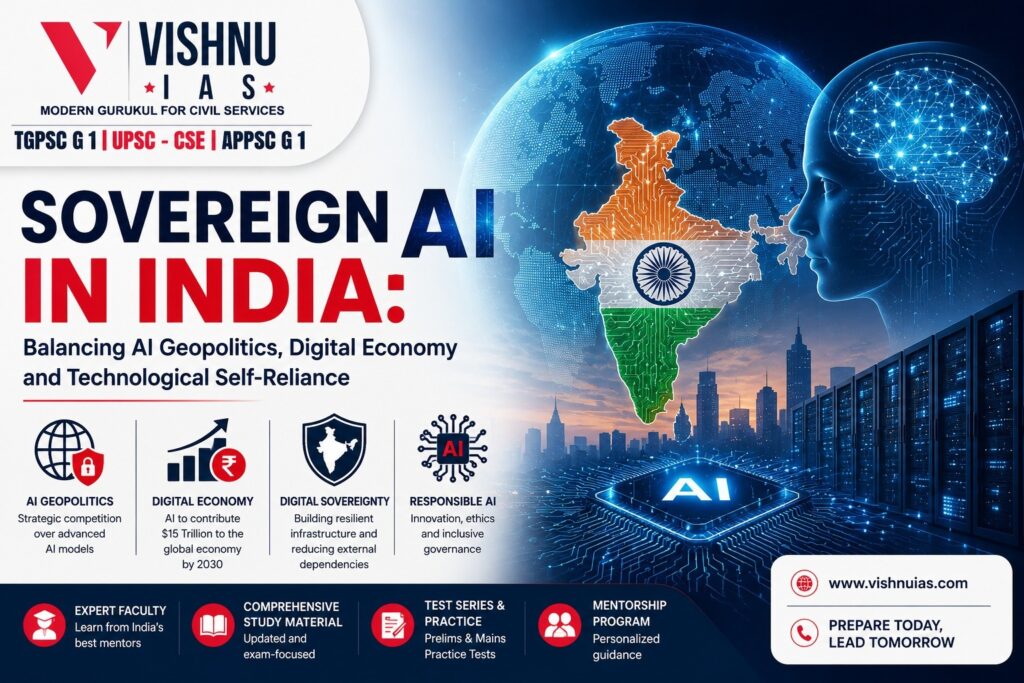
Sovereign AI in India: Balancing AI Geopolitics, Digital Economy, and Technological Self-Reliance

Introduction: Artificial Intelligence (AI) has evolved from a transformative digital technology into a strategic geopolitical asset, with frontier AI models—requiring approximately 10²⁵ floating-point operations (FLOPs) for training—now increasingly treated as instruments of national power, economic competitiveness, and technological sovereignty. As AI-driven sectors are projected to contribute over $15 trillion to the global economy by 2030,

Sovereign AI in India: Balancing AI Geopolitics, Digital Economy, and Technological Self-Reliance Read More »

Industrial Production Growth & IIP Revision in India 2026: Key Changes, Significance and Challenges

Today Current Affairs 29/06/2026 Introduction Daily Current Affairs 30 July 2026 covers some of the most important developments relevant for UPSC, APPSC, and TGPSC aspirants. Today’s current affairs focus on India’s industrial growth, biodiversity conservation, Artificial Intelligence governance, constitutional issues surrounding preventive detention, and infrastructure financing through the National Investment and Infrastructure Fund (NIIF). These

Industrial Production Growth & IIP Revision in India 2026: Key Changes, Significance and Challenges Read More »

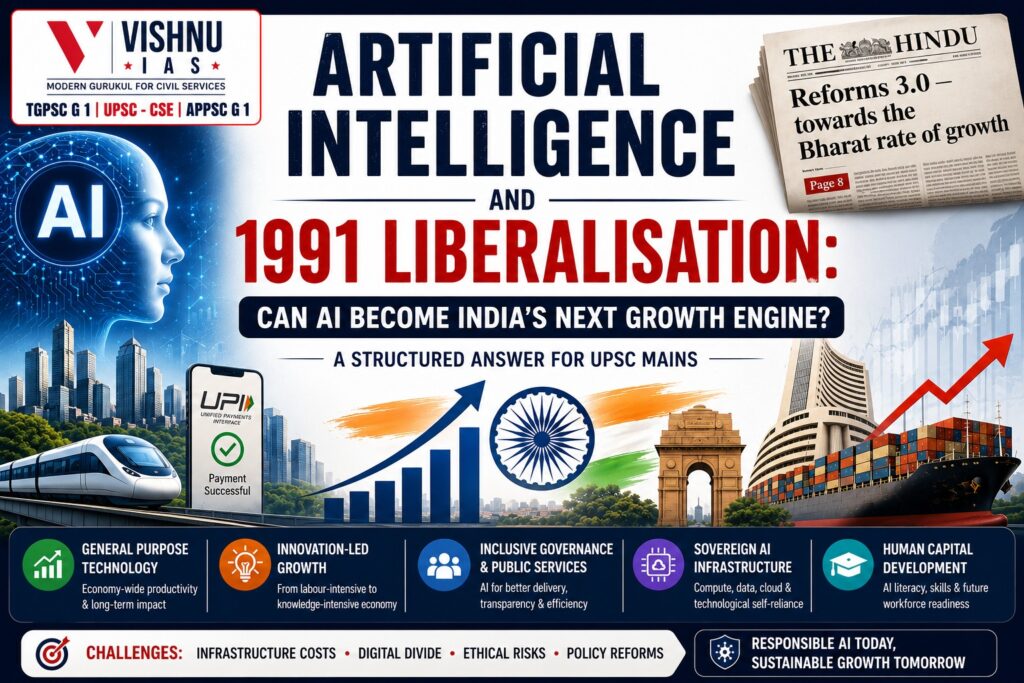
Artificial Intelligence and 1991 Liberalisation: Can AI Become India’s Next Growth Engine?

Introduction: Artificial Intelligence (AI) refers to the capability of machines and computer systems to perform tasks requiring human intelligence such as learning, reasoning, language processing, pattern recognition and decision-making. Just as the 1991 economic liberalisation dismantled structural barriers and integrated India with the global economy, AI represents a General Purpose Technology (GPT) capable of transforming

Artificial Intelligence and 1991 Liberalisation: Can AI Become India’s Next Growth Engine? Read More »

Algorithmic Exploitation and Horizontal Application of Fundamental Rights

Introduction: The traditional architecture of constitutional law operates on a vertical axis, designed to protect citizens from the arbitrary excesses of the State. However, the rise of big tech conglomerates has disrupted this paradigm. Operating as an electronic Curia, these private platforms wield asymmetrical, sovereign-like data capabilities, reducing autonomous citizens to digital components through mass

Algorithmic Exploitation and Horizontal Application of Fundamental Rights Read More »

Scroll to Top