

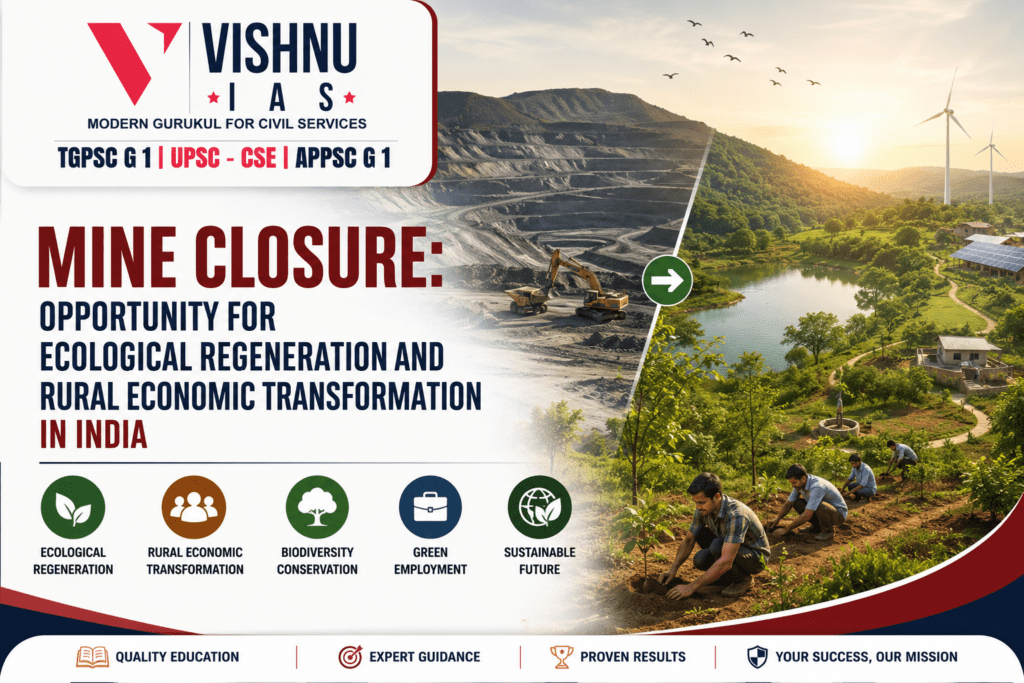
Introduction:
Mining has been indispensable for India’s industrialization, infrastructure development, energy security, and economic growth. However, conventional mining often followed an “extract-and-abandon” approach, leaving behind degraded landscapes, polluted water bodies, biodiversity loss, unsafe abandoned pits, and socio-economic distress in mining-dependent communities.
Scientific mine closure refers to the systematic process of restoring exhausted mines into safe, environmentally sustainable, socially acceptable, and economically productive landscapes through engineering stabilization, ecological restoration, and socio-economic rehabilitation.
With the 2025 Mine Closure Guidelines, the proposed ₹40,000-crore mine closure corpus, and India’s emphasis on circular economy and sustainable mining, mine closure is increasingly being viewed not merely as a statutory environmental obligation but as an opportunity to regenerate ecosystems, diversify rural economies, generate green employment, and strengthen climate resilience.
Body:
Mine closure as an instrument of ecological regeneration
Restoration of degraded ecosystems
Mining significantly alters landforms, removes vegetation, disturbs soil profiles, and fragments ecosystems. Scientific closure seeks to restore ecological functions instead of merely securing abandoned mine sites.
Activities such as slope stabilization, topsoil replacement, afforestation, wetland creation, and habitat restoration help convert degraded landscapes into ecologically functional ecosystems capable of supporting biodiversity and ecosystem services.
Example: Under the 2025 Mine Closure Guidelines, restoration plans emphasize progressive reclamation, whereby ecological restoration begins during the operational phase rather than after mine exhaustion.
Conservation of biodiversity and ecosystem services
Restoration using native vegetation helps revive ecological processes by improving wildlife habitats, strengthening ecological corridors, increasing pollinator populations, and enhancing soil microbial activity.
Reclaimed landscapes contribute to biodiversity conservation while supporting ecosystem services such as nutrient cycling, water purification, and climate regulation.
The Eden Project (United Kingdom) transformed a former China clay mine into one of the world’s largest botanical gardens, demonstrating how degraded mining landscapes can become globally recognized ecological assets.
Soil, water, and environmental rehabilitation
Scientific closure addresses long-term environmental risks such as acid mine drainage, heavy metal contamination, groundwater depletion, soil erosion, and sedimentation of rivers.
Restoration measures include treatment of contaminated water, construction of drainage channels, rainwater harvesting, groundwater recharge structures, and stabilization of waste dumps.
For eg. Former mine pits can be converted into reservoirs supporting irrigation, fisheries, groundwater recharge, and drinking water supply for surrounding villages.
Contribution to climate change mitigation
Ecological restoration increases carbon sequestration through afforestation and vegetation regeneration while reducing land degradation and enhancing resilience against climate-induced disasters.
Reclaimed mine lands also support India’s emerging Voluntary Carbon Market (VCM) by generating carbon credits through afforestation and ecosystem restoration.
The Case Study – Mine restoration initiatives in the Appalachian region (United States) demonstrate how reclaimed mine lands can become significant carbon sinks through large-scale afforestation.
Promoting circular economy and sustainable land use
Scientific mine closure transforms exhausted mines from abandoned wastelands into productive economic assets, ensuring efficient utilization of scarce land resources.
Reclaimed land can support renewable energy parks, agriculture, agroforestry, biodiversity parks, industrial parks, water bodies, tourism infrastructure, and educational institutions.
India’s shift towards a circular mining economy reflects the transition from the traditional “extract-and-abandon” model to the “extract-restore-repurpose” approach.
Mine closure as a catalyst for rural economic transformation
Diversification of rural livelihoods
Mining regions often experience economic stagnation after mineral extraction ceases due to dependence on a single economic activity.
Scientific closure creates alternative livelihood opportunities through eco-tourism, forestry, fisheries, horticulture, renewable energy, environmental services, and agro-based enterprises, thereby reducing mono-sector dependence.
The Government proposes allocating nearly 25% of approved mine closure expenditure (around ₹10,000 crore over the coming decade) towards community development, livelihood creation, public infrastructure, and skill development.
Generation of green employment
Scientific mine closure creates employment throughout the restoration process, including land reclamation, afforestation, ecological monitoring, environmental auditing, GIS mapping, drone-based surveys, hydrological restoration, and landscape management.
The emerging mine restoration economy also stimulates growth in sectors such as MiningTech, ESG consulting, carbon finance, geospatial technologies, environmental consulting, and sustainable construction.
The Ministry of Coal estimates that scientific closure of over 105 mines in the coming years will significantly expand green employment opportunities across mining regions.
Strengthening community welfare and Just Transition
Scientific closure recognizes that mine closure should protect not only ecosystems but also the livelihoods and well-being of mining communities.
Investments in healthcare, education, drinking water, rural infrastructure, skill development, and livelihood diversification facilitate a Just Transition, ensuring that local populations are not adversely affected by the end of mining operations.
The planned, people-centric process (PPP) under the Ministry of Coal integrates ecological restoration with community development to create long-term socio-economic benefits.
Promotion of rural entrepreneurship and MSMEs
Repurposed mine lands create opportunities for local enterprises in tourism, hospitality, transport, fisheries, handicrafts, food processing, adventure sports, and recreational services.
Growth of these sectors strengthens Micro, Small and Medium Enterprises (MSMEs) and enhances rural incomes through diversified economic activities.
The Coal Neer packaged drinking water initiative at the Handidhua underground mine in Odisha demonstrates how abandoned mining infrastructure can generate sustainable local enterprises.
Development of tourism and cultural economy
Abandoned mines possess significant potential for industrial heritage tourism, geological tourism, eco-tourism, water-based recreation, underground tourism, and cultural activities.
Tourism-based repurposing creates long-term employment while preserving industrial heritage and attracting investment into rural regions.
➤ Global Case Studies:
Wieliczka Salt Mine (Poland) – a UNESCO World Heritage Site attracting millions of tourists annually.
Zeche Zollverein (Germany) – Former coal mine transformed into a cultural and creative economy hub.
Salina Turda (Romania) – Salt mine converted into an underground amusement park.
Big Pit National Coal Museum (United Kingdom) – Industrial heritage tourism generating sustained regional employment.
➤ Indian Examples:
Zawar Mines Heritage Tourism Project (Rajasthan)
Sandur Eco-Tourism (Karnataka)
Neyveli Lignite Mine View Point (Tamil Nadu)
Supporting climate finance and ESG investments
Scientific mine closure enhances Environmental, Social and Governance (ESG) performance of mining companies, improving access to sustainable finance and global investment.
Restored mine landscapes can generate carbon credits and biodiversity credits, creating new financial opportunities while supporting India’s climate commitments.
III. Challenges in realizing the transformative potential of mine closure
Institutional and governance challenges
Mine closure requires coordination among the Ministries of Coal, Mines, Environment, Forest and Climate Change, State Governments, Pollution Control Boards, local authorities, and mining companies.
Institutional fragmentation often results in delays in approvals, weak accountability, and inconsistent implementation.
Legacy of abandoned mines
Numerous mines were abandoned before comprehensive mine closure regulations came into force and therefore lack approved closure plans, responsible operators, or adequate financial provisioning.
These legacy mines continue to pose environmental and safety risks.
India had 341 closed or abandoned coal mines as of 31 March 2024, many of which predate modern mine closure regulations.
Technical and capacity constraints
Several states face shortages of environmental auditors, mine closure specialists, ecologists, hydrologists, GIS experts, and monitoring infrastructure.
Scientific restoration requires multidisciplinary expertise that remains unevenly distributed across mining regions.
For example: Weak technical capacity often affects the quality of ecological restoration and long-term monitoring.
Financial and monitoring concerns
Although financial assurance is maintained through escrow mechanisms, mine closure funds remain ring-fenced for individual leases and cannot easily support broader regional restoration initiatives.
Weak monitoring may lead to underutilization of funds, diversion of resources, or exaggerated compliance claims.
The 2025 Mine Closure Guidelines mandate financial assurance, independent monitoring, and post-closure environmental surveillance to improve accountability.
Limited commercialization of reclaimed mines
Most reclaimed mining sites in India remain pilot projects or CSR initiatives rather than commercially viable economic assets.
Absence of a national database on tourist footfall, revenue generation, or socio-economic outcomes limits evidence-based policy formulation.
Despite several successful pilots, India remains significantly behind countries such as Germany, Poland, and the United Kingdom in monetizing reclaimed mining landscapes.
Way Forward
Strengthening scientific governance and monitoring
Independent third-party environmental audits, real-time monitoring through drones, satellite imagery, GIS mapping, and digital dashboards should become integral to mine closure implementation.
Transparent monitoring can reduce greenwashing while improving ecological outcomes.
Mainstreaming mine repurposing into development planning
Mine closure should be integrated with district development plans, tourism policies, renewable energy strategies, and local economic planning to maximize long-term value creation.
Site-specific land-use planning should identify the most suitable post-mining use based on ecological, economic, and community needs.
Reclaimed mines can support solar parks, pumped-storage hydropower, biodiversity parks, logistics hubs, and industrial heritage tourism.
Promoting community participation and Just Transition
Local communities, Panchayati Raj Institutions, Self-Help Groups (SHGs), and civil society organizations should participate in planning, implementation, monitoring, and benefit-sharing.
Skill development and livelihood diversification must accompany ecological restoration to ensure inclusive development.
Community-driven restoration improves long-term sustainability while reducing post-mining socio-economic vulnerabilities.
Leveraging climate finance and international cooperation
India should integrate scientific mine closure with carbon markets, biodiversity credits, ESG finance, and international climate finance mechanisms.
Continued collaboration with international partners can strengthen technical capacity and adoption of global best practices.
The implementation partnership between the Ministry of Coal and Germany’s Deutsche Gesellschaft für Internationale Zusammenarbeit (GIZ) supports scientific mine closure, mine repurposing, capacity building, and knowledge exchange.
Conclusion:
Scientific mine closure represents a paradigm shift from treating exhausted mines as environmental liabilities to recognizing them as opportunities for ecological regeneration, climate action, circular economy, and rural economic transformation.
India’s evolving policy framework including the 2025 Mine Closure Guidelines, the ₹40,000-crore mine closure corpus, and emphasis on community-centric repurposing reflects a transition from regulatory compliance to sustainable landscape management.
The long-term success of this approach will depend upon robust institutional coordination, scientific planning, transparent monitoring, meaningful community participation, and integration of reclaimed mine lands with renewable energy, tourism, climate finance, and local economic development. If implemented effectively, scientific mine closure can become a cornerstone of sustainable mining, Just Transition, and Viksit Bharat 2047, ensuring that the legacy of mining is measured not by abandoned scars but by restored ecosystems and resilient rural economies.