

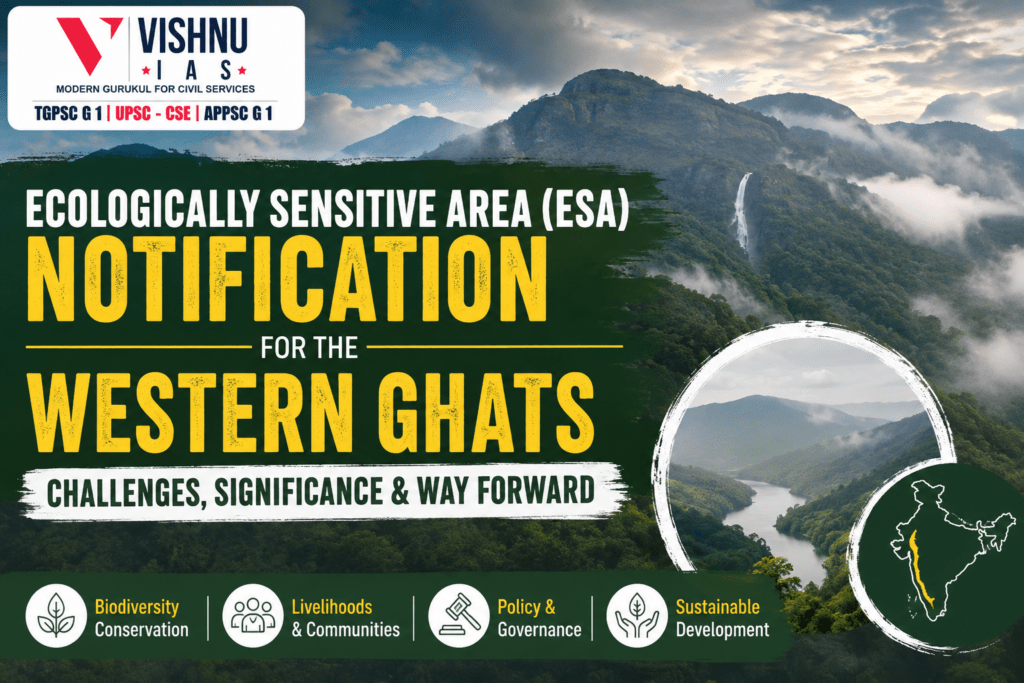
Ecologically Sensitive Area (ESA) Notification for the Western Ghats: Challenges, Significance & Way Forward
Ecologically Sensitive Area (ESA) Notification for the Western Ghats has become one of the most significant environmental governance issues in India. The Western Ghats are among the world's richest biodiversity hotspots, yet implementing the ESA notification has remained challenging due to conflicts between conservation, development, federal cooperation, and livelihood concerns. This UPSC Mains article critically examines the significance of the Western Ghats, challenges in implementing the ESA notification, and the way forward.
Introduction
The Western Ghats, extending over nearly 1,600 km across Gujarat, Maharashtra, Goa, Karnataka, Kerala and Tamil Nadu, constitute one of the world's eight "hottest hotspots" of biodiversity and were recognised as a UNESCO World Heritage Site in 2012. They harbour rich endemic flora and fauna while serving as the source of major peninsular rivers and critical ecosystem services.
To secure this ecological wealth, the Western Ghats Ecology Expert Panel (WGEEP) under Madhav Gadgil (2011) recommended declaring the entire Western Ghats as an Ecologically Sensitive Area (ESA) with graded protection. However, over a decade later, implementation remains stalled due to persistent conflicts between conservation imperatives and livelihood concerns.
Significance of the Western Ghats
- The Western Ghats support nearly one-third of India's plant, fish, bird and mammal diversity despite occupying less than 6% of India's land area.
- They regulate the Indian monsoon, recharge groundwater, prevent soil erosion and sustain river basins such as the Godavari, Krishna, Cauvery and Periyar.
- The Ghats function as a major carbon sink, helping India fulfil its commitments under the Paris Agreement and the Kunming-Montreal Global Biodiversity Framework.
- Escalating threats from quarrying, mining, deforestation, hydropower projects, infrastructure expansion and unregulated tourism have increased landslides and ecological degradation, particularly in Kerala and Karnataka.
- Ecological degradation in the Western Ghats has already contributed to increased frequency of floods, landslides and declining ecosystem resilience.
- The Supreme Court, through the Public Trust Doctrine, has consistently held that natural resources are held by the State in trust for present and future generations.
- Delayed implementation risks irreversible biodiversity loss and weakens India's environmental commitments.
Challenges in Implementing the Ecologically Sensitive Area (ESA) Notification
1. Conservation versus Livelihood Conflict
- The foremost challenge is the perception that ESA notification would adversely affect agriculture, plantations, mining, housing and infrastructure development.
- Karnataka has consistently opposed the proposal, arguing that nearly 20,668 sq. km and around 23% of its population would come under regulatory restrictions.
- Plantation farmers cultivating coffee, arecanut, rubber and coconut fear restrictions on future expansion and developmental activities.
2. Divergent Scientific Approaches
- The Madhav Gadgil Committee adopted a precautionary approach by recommending that almost the entire Western Ghats be notified as ESA through three graded Ecologically Sensitive Zones.
- In contrast, the K. Kasturirangan Committee (2013) significantly reduced the notified area by distinguishing between natural landscapes and cultural landscapes, thereby allowing greater developmental flexibility.
- The differing recommendations generated policy uncertainty and prolonged political negotiations.
3. Federal and Political Disagreements
- Environmental protection falls within the Concurrent List, requiring cooperative action between the Union and States.
- While Gujarat and Goa have broadly accepted the proposal, Maharashtra has sought fresh review, whereas Karnataka, Kerala and Tamil Nadu continue negotiations, reflecting divergent developmental priorities.
- Thus, the Ministry has issued multiple draft notifications without arriving at consensus.
4. Trust Deficit Among Local Communities
- Many villagers believe that ESA declaration would inevitably lead to displacement, eviction or severe restrictions on traditional livelihoods.
- Fear regarding expansion of buffer zones and uncertainty over permissible activities has generated considerable resistance.
- Limited public consultation has reinforced the perception that conservation decisions are being imposed from above.
5. Concerns Regarding Mapping Methodology
- Local stakeholders have criticised reliance on satellite imagery for ESA demarcation.
- They argue that remote sensing often fails to distinguish plantations from natural forests, leading to possible inclusion of long-settled agricultural landscapes within ESA boundaries.
- The absence of extensive field verification has weakened confidence in the proposed boundaries.
6. Forest Rights and Community Concerns
- Communities residing near protected areas continue to face restrictions relating to collection of minor forest produce and agricultural activities despite recognition of rights under the Forest Rights Act, 2006.
- Non-tribal forest-dependent communities with generations of residence have also raised concerns regarding rejection of their claims.
- Such experiences reinforce apprehensions that conservation may come at the cost of social justice.
7. Conservation Without Adequate Incentives
- Restrictions on economic activities are often proposed without adequate livelihood diversification, compensation or rehabilitation mechanisms.
- Conservation therefore appears as an economic burden rather than a shared developmental objective.
Way Forward
- ESA implementation should adopt participatory environmental governance, involving Gram Sabhas, local communities, scientists and State governments from the planning stage.
- Satellite-based mapping should be supplemented with ground-truthing, socio-economic surveys and transparent public consultation before final demarcation.
- The Union Government may operationalise the proposed State-wise or phased implementation, allowing flexibility while preserving ecological integrity.
- Conservation measures should distinguish between environmentally destructive activities such as mining, quarrying and indiscriminate tourism, and sustainable agriculture and plantations.
- Indigenous communities should be recognised as partners in conservation by ensuring effective implementation of the Forest Rights Act, 2006, and supporting community-led forest governance.
- Financial incentives through Payments for Ecosystem Services, eco-tourism, green livelihoods and compensation mechanisms can reduce local resistance.
- Scientific monitoring using GIS, biodiversity audits and periodic ecological assessments should guide adaptive management rather than one-time regulatory interventions.
Conclusion
As Madhav Gadgil observed, "Ecology is the permanent economy." The Western Ghats are not merely a repository of biodiversity but constitute India's ecological life-support system. Protecting them requires moving beyond the false binary of conservation versus development towards inclusive environmental governance, where ecological sustainability, federal cooperation and livelihood security reinforce rather than undermine one another. Such an approach alone can fulfil the constitutional vision embodied in Articles 48A and 51A(g) while advancing the principle of sustainable development.