
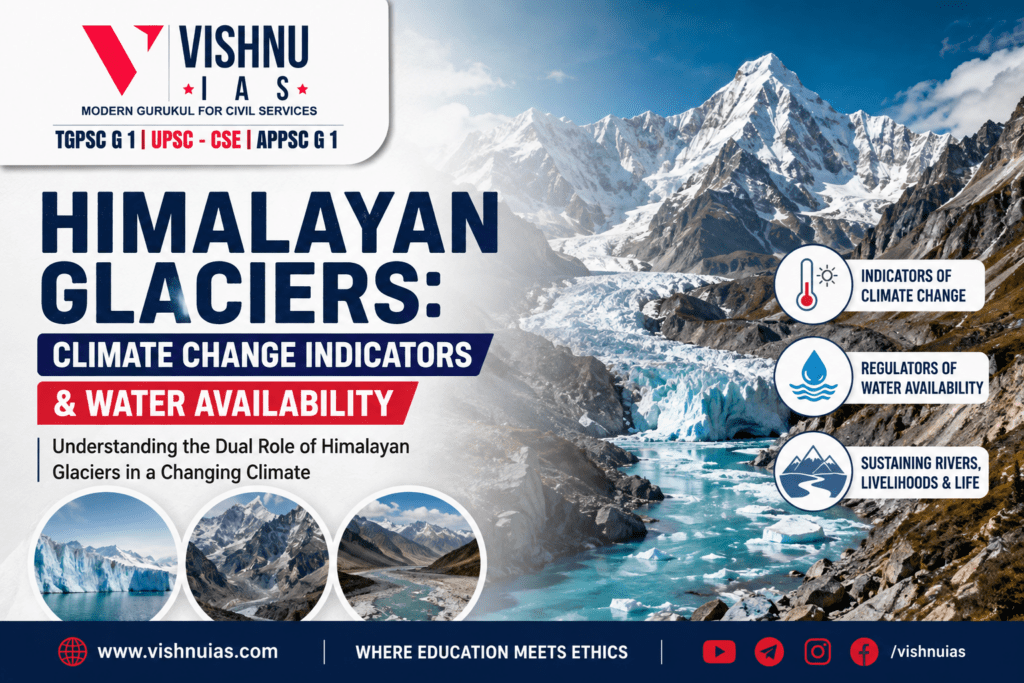
Himalayan Glaciers: Climate Change Indicators & Water Availability
Himalayan glaciers constitute one of the world's major high-altitude freshwater stores and are often described as the “Water Towers of Asia.” They perform a dual function: they act as indicators of climate change through changes in mass, thickness and velocity, while also regulating downstream river discharge through the seasonal release of stored snow and ice. This role is particularly important for the Indus, Ganga and Brahmaputra basins, which support hundreds of millions of people. Recent evidence from the Zanskar Himalaya illustrates this changing cryospheric regime.
Body
I. Glaciers as indicators of climate change
1. Changes in glacier mass balance
- A glacier remains relatively stable when accumulation ≈ ablation. Rising temperatures increase melting and can alter snowfall from snow to rain, producing a negative mass balance.
- The 2026 ICIMOD assessment found that HKH glaciers lost about 12% of their area between 1990 and 2020, with ice loss accelerating after 2000.
2. Glacier thinning and retreat
- Persistent negative mass balance causes glaciers to become thinner and their termini to retreat. ICIMOD's 2023 assessment reported that HKH glaciers lost ice 65% faster during 2011–2020 than during 2001–2010.
- Examples include the Gangotri Glacier in Uttarakhand and Zemu Glacier in Sikkim, which have shown long-term mass loss.
3. Glacier velocity as a climate indicator
- Glacier movement depends partly on its thickness and driving stress. The recent Zanskar study, covering 12 glaciers from 1992–2023, found an average slowdown of approximately 2.4 m/year per decade.
- Surface thinning accelerated from around 0.22 m/year during 2000–05 to 0.57 m/year during 2015–20. Thus, glacier velocity provides an additional indicator of internal glacier change beyond visible retreat.
4. Spatially differentiated response
- Himalayan glaciers do not respond uniformly to warming. Their behaviour depends on altitude, aspect, precipitation regime, debris cover, geometry and terminus conditions.
- For example, the Zanskar–Ladakh region is strongly influenced by winter westerly disturbances, unlike the monsoon-dominated eastern Himalaya.
- The Karakoram Anomaly, where some glaciers have historically shown relative stability or advance, further demonstrates this spatial heterogeneity.
II. Glaciers as regulators of downstream water availability
1. Natural long-term freshwater reservoirs
- Glaciers store precipitation accumulated over long periods as snow and ice. This storage is particularly significant in the trans-Himalayan regions of Ladakh and the upper Indus, where precipitation is relatively limited.
- The Himalaya and adjoining mountain ranges provide water to more than one-quarter of the world's population through major river systems.
2. Seasonal regulation of river discharge
- Glacier melt increases during summer when temperatures rise. This produces meltwater precisely when agricultural and ecological water demand is high. Thus, glaciers act as a seasonal regulator, maintaining downstream flows during relatively dry periods.
3. Importance for the Indus basin
- The upper Indus basin receives substantial contributions from snow and glacier melt, making the cryosphere particularly important for downstream water security. This is especially significant because parts of the Indus basin are arid or semi-arid, including Ladakh and large parts of Pakistan. Glacier-fed flows support irrigation, drinking water, ecosystems and hydropower.
4. Buffer against precipitation variability
- Glacier storage can partly compensate for fluctuations in rainfall and snowfall. Therefore, glaciers provide a buffer against short-term climatic variability, particularly in high-altitude basins.
5. “Peak water” phenomenon
- Accelerated warming initially causes greater glacier melt and can increase downstream runoff. This may temporarily create higher water availability, known as the peak-water effect. However, continued mass loss reduces the volume of ice available for future melting.
6. Long-term decline in water storage
- Warming → enhanced ablation → glacier thinning → increased short-term runoff → peak water → declining ice reserves → reduced long-term meltwater contribution
- Hence, more melt today does not necessarily mean more water tomorrow.
- The 2026 ICIMOD assessment notes that smaller glaciers are particularly vulnerable and that glacier change is simultaneously increasing risks of localised water shortages and cryospheric hazards.
III. Challenges in assessing the future role of glaciers
Complex glacier–climate relationship
- Glacier discharge depends not only on temperature but also on snowfall, rainfall, albedo, debris cover and glacier geometry. Westerly disturbances are especially important for the western Himalaya, while the monsoon dominates precipitation in much of the central and eastern Himalaya.
Limited ground observations
- Satellite imagery provides valuable information on glacier area and surface velocity, but cannot fully capture basal sliding, subglacial hydrology and bed conditions. Long-term measurements of mass balance, ice thickness, temperature and meltwater discharge therefore remain essential.
Basin-specific response
- It would be misleading to assume that all Himalayan river basins will experience identical impacts. The Indus, Ganga and Brahmaputra differ in their relative dependence on rainfall, snowmelt and glacier melt. Therefore, water-security planning must be basin-specific rather than based on a single Himalayan-wide projection.
VI. Way Forward
Strengthen cryosphere monitoring
- Combining remote sensing, satellite altimetry, GNSS and field-based mass-balance measurements.
Integrate cryosphere into water governance
- Glacier projections should be incorporated into river-basin planning, irrigation management, reservoir operations and hydropower planning.
Build climate-resilient water systems
- Promote rainwater harvesting, groundwater recharge, efficient irrigation and watershed management to reduce excessive dependence on glacier-derived water.
Strengthen regional cooperation
- Since Himalayan rivers are transboundary, countries sharing the Indus, Ganga and Brahmaputra systems need greater cooperation in cryosphere monitoring, hydrological data sharing and disaster preparedness.
Conclusion
Himalayan glaciers are therefore both climate sentinels and hydrological regulators. Their retreat and thinning reveal a warming climate, while their seasonal melt regulates downstream river flows and supports agriculture, ecosystems and hydropower. The emerging peak-water paradox shows that accelerated melting may temporarily increase runoff but ultimately diminish the cryosphere's capacity to store and regulate freshwater. The challenge is consequently not merely to prevent glacier loss, but to prepare Himalayan river basins for a transition from ice-regulated hydrology to increasingly precipitation-dependent hydrology through scientific monitoring, climate adaptation and integrated basin management.