

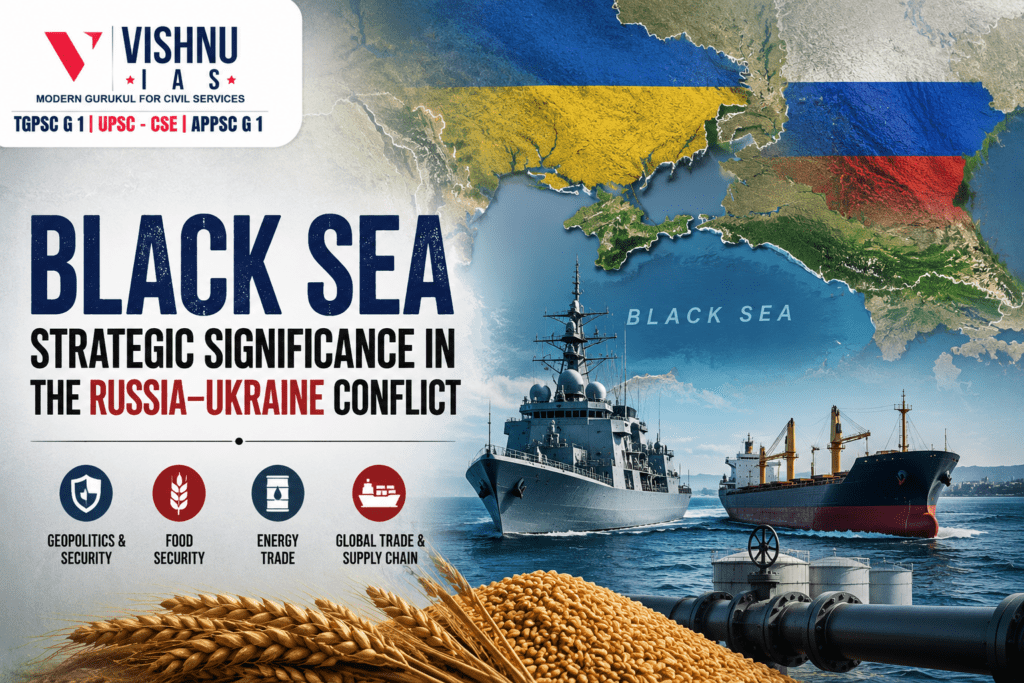
Black Sea Strategic Significance in the Russia–Ukraine Conflict
The Black Sea is a semi-enclosed strategic water body linking Eastern Europe, the Caucasus and the Mediterranean through the Turkish Straits. Its significance has grown amid the Russia–Ukraine conflict, as it has become simultaneously a military theatre, an energy corridor, a grain-export route and a strategic maritime space. The disruption of Ukrainian Black Sea exports has demonstrated that control over maritime routes can have consequences far beyond the immediate conflict zone.
Strategic significance of the Black Sea
1. Geopolitical and military significance
- The Black Sea provides Russia with access towards the Mediterranean and the wider maritime space, making it strategically important for Russian naval power.
- Russia's control of Crimea gives it a major military position overlooking the Black Sea and has enabled the projection of naval and missile capabilities.
- For Ukraine, maintaining access to the Black Sea is essential for territorial sovereignty, economic survival and maritime connectivity.
- The region is also strategically important for NATO, particularly because Türkiye, Romania and Bulgaria are NATO members.
2. Global food-security significance
- Ukraine is among the world's major producers and exporters of wheat, corn and sunflower products. A substantial proportion of Ukrainian agricultural exports traditionally moved through Black Sea ports.
- Disruption of these exports affects not only Ukraine but also food-importing countries in Africa and the Middle East. The conflict therefore demonstrates the link between regional military conflicts and global food security.
- Case Study: The earlier Black Sea Grain Initiative, brokered by the UN and Türkiye, sought to maintain Ukrainian grain exports despite the war. After Russia withdrew from the arrangement in 2023, Ukraine established its own maritime grain corridor.
3. Energy and commercial significance
- The Black Sea is an important route for transporting crude oil and refined petroleum products, apart from agricultural commodities.
- Disruptions can increase freight costs, insurance premiums and transportation risks, thereby affecting international commodity prices.
- Consequently, the Black Sea is not merely a regional maritime space but an important component of global trade and supply-chain security.
4. Strategic maritime geography
- The Black Sea is bordered by Russia, Ukraine, Türkiye, Bulgaria, Romania and Georgia, giving it an unusual combination of geopolitical and economic importance.
- Türkiye's control over the Bosporus and Dardanelles gives it a pivotal position between the Black Sea and Mediterranean. The Turkish Straits therefore constitute an important maritime chokepoint.
Russia–Ukraine conflict and Black Sea
1. Militarisation of maritime space
- Russian attacks have targeted Ukrainian port infrastructure and vessels. Ukraine has also expanded attacks against Russian maritime assets. Thus, commercial shipping increasingly operates within a high-risk security environment.
2. Weaponisation of trade and food
- Control over ports has become an instrument of economic pressure. Ukraine's agricultural economy depends heavily on the ability to export its harvest. When exports are blocked, farmers face falling domestic prices, storage shortages, reduced revenues, inability to purchase fuel and inputs, and difficulty in financing the next agricultural cycle.
- A recent report stated that Ukraine's shortage of storage capacity could reach 11 million tonnes. Thus, maritime warfare can generate a second-order economic crisis within the agricultural sector.
3. Emergence of alternative corridors
- Ukraine has attempted to reduce its dependence on vulnerable Black Sea ports through rail and road routes through western borders, the Danube and its own maritime grain corridor along the western Black Sea coast.
- However, these alternatives face constraints such as lower Danube water levels, railway attacks, tighter EU trade arrangements and tensions with neighbouring countries.
Other Implications
1. Global commodity-price volatility
Disruption of Ukrainian grain exports can reduce global grain availability; increase international prices; raise food-import bills; aggravate inflation in vulnerable economies. The impact becomes particularly serious when combined with climate-related production shocks and conflicts elsewhere.
2. European security architecture
The Black Sea connects the security interests of Russia, Ukraine, Türkiye, NATO, the European Union. Hence, the conflict has strengthened the importance of NATO's eastern and southeastern flank and increased European attention to maritime security.
3. Erosion of predictable maritime commerce
The conflict illustrates how commercial shipping can become vulnerable to military competition. This creates a broader challenge for freedom of navigation, maritime insurance, port infrastructure, international trade, global supply chains.
Conclusion
The Russia–Ukraine conflict has transformed the Black Sea from a regional maritime space into a critical node of global geopolitics, food security, energy trade and supply-chain resilience. The disruption of Ukrainian grain exports demonstrates that maritime insecurity can transmit the consequences of war to distant economies and vulnerable populations. As geopolitical stability and economic security are increasingly inseparable from the security of maritime commons, securing the Black Sea requires a combination of maritime security, resilient trade corridors, food-supply diversification and sustained diplomacy.