

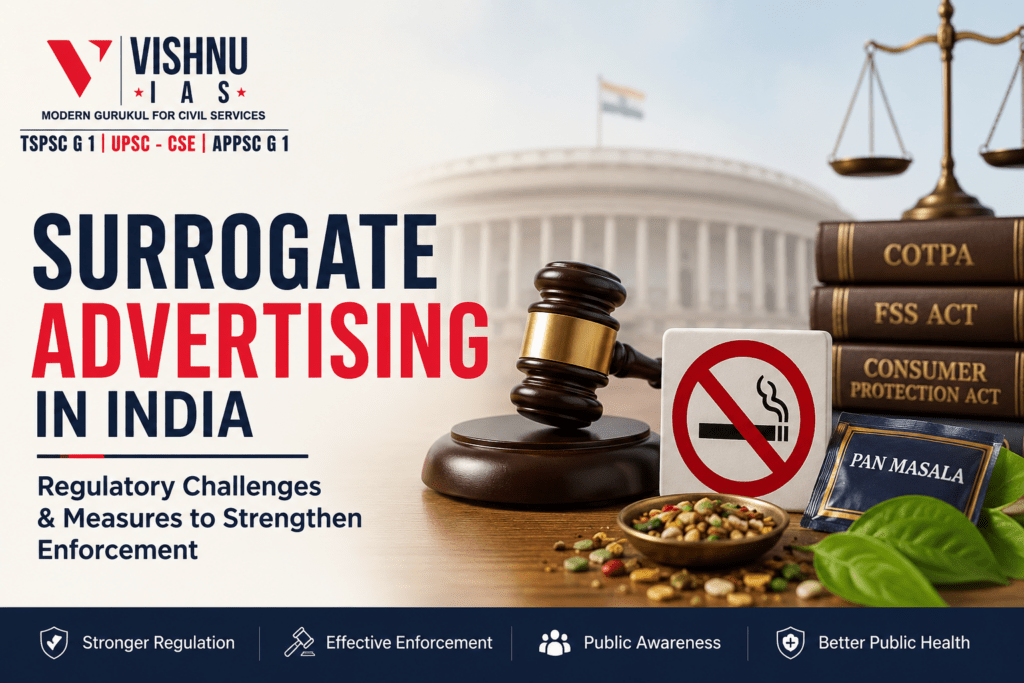
Surrogate Advertising in India: Regulatory Challenges & Measures
Introduction
Surrogate advertising in India refers to the promotion of a prohibited or restricted product through another apparently permissible product that uses the same or closely associated brand name, logo, imagery or brand identity. In India, this issue is particularly significant in the context of tobacco and pan masala, where direct advertising is restricted but brand visibility can be sustained through products such as elaichi, mouth fresheners or other permitted goods. The recent action by the Maharashtra FDA against advertisements featuring celebrities highlights the regulatory challenge of distinguishing genuine product advertising from indirect promotion of tobacco-related products.
Body
I. Surrogate advertising - concern
1. Circumvention of tobacco-control objectives
- Surrogate advertising can allow companies to maintain consumer awareness and brand recall of products whose direct advertisement is prohibited.
- Even when the advertisement ostensibly promotes an independent product such as elaichi, the repeated use of the same brand identity may reinforce its association with pan masala or tobacco products.
- Eg: The use of a common brand name and visual identity for an ostensibly permissible product may indirectly promote the prohibited product.
2. Influence on consumer behaviour
- Advertising and celebrity endorsements possess substantial social influence and visibility. Such advertising can normalise brands associated with tobacco consumption, particularly among younger audiences, despite restrictions on direct tobacco advertising.
3. Difficulty in establishing surrogate intent
- The central regulatory challenge is determining whether the advertised product is a genuine independent product or merely a vehicle for promoting a restricted product.
- Factors such as brand identity, product name, visual presentation, dialogue, market presence and consumer association become relevant in determining whether an advertisement is genuinely independent or surrogate.
II. India's legal and institutional framework
1. Food Safety and Standards Act, 2006
- Section 24 regulates advertisements relating to food and prohibits advertisements that are misleading or that amount to unfair trade practices.
- The Food Safety and Standards (Advertising and Claims) Regulations, 2018 require advertisements to be truthful, unambiguous and non-misleading. Thus, an advertisement cannot use a food product merely as a means of creating misleading associations with another regulated product.
2. COTPA, 2003
- The Cigarettes and Other Tobacco Products Act, 2003 (COTPA) prohibits direct and indirect advertising of tobacco products.
- Its significance lies in preventing companies from circumventing tobacco-control objectives through alternative forms of promotion.
3. Consumer Protection Act, 2019
- The Central Consumer Protection Authority (CCPA) can act against false or misleading advertisements and impose penalties on manufacturers, advertisers and endorsers.
- Under Section 21, penalties can be imposed on endorsers, while repeat violations can attract higher penalties and restrictions on future endorsements.
4. CCPA Guidelines, 2022
- The guidelines on prevention of misleading advertisements and endorsements seek to ensure that endorsements are based on adequate information and do not mislead consumers.
- They are particularly relevant where celebrities lend their credibility to products whose broader brand identity is associated with restricted goods.
5. Role of State Food and Drug Administrations
- State-level authorities play an important enforcement role by investigating advertisements, issuing notices, seeking explanations and directing removal of potentially unlawful promotional content.
- Eg: The Maharashtra FDA's notices to Shah Rukh Khan, Ajay Devgn and Tiger Shroff demonstrate whether an apparently permissible advertisement constitutes surrogate promotion.
III. Challenges in regulating surrogate advertising
1. Distinguishing legitimate advertising from surrogate promotion
A company may genuinely manufacture and market an independent product under a particular brand, making it difficult to establish that its advertisement is merely a proxy for a prohibited product.
2. Fragmented regulatory architecture
Regulation involves multiple institutions including FSSAI, CCPA, State FDAs and tobacco-control authorities, creating possibilities of overlapping jurisdiction and inconsistent enforcement. Greater inter-agency coordination is therefore required.
3. Celebrity accountability
Celebrities often have limited involvement in the actual manufacture or marketing of products. However, their endorsement can significantly expand the reach and credibility of advertisements. A balanced framework should therefore distinguish between negligent endorsement, informed endorsement and deliberate participation in prohibited promotion.
4. Digital and cross-platform advertising
Social media, influencer marketing, short-form videos and digital campaigns make indirect promotion more difficult to monitor. Advertisements can also be rapidly modified, replicated and circulated across jurisdictions.
IV. Measures to strengthen regulation
1. Adopt a brand-identity-based approach
Regulators should examine not merely the product explicitly mentioned in an advertisement but also whether the advertisement reinforces the identity of a prohibited product.
2. Strengthen inter-agency coordination
FSSAI, CCPA, State FDAs and tobacco-control authorities should develop common enforcement protocols and information-sharing mechanisms.
3. Increase accountability of endorsers
Celebrities should undertake reasonable due diligence regarding the legal status and broader market identity of products before endorsing them. Repeated or knowing violations should attract proportionate penalties.
4. Strengthen digital monitoring
AI-assisted monitoring, social-media surveillance and rapid takedown mechanisms can help identify surrogate advertisements circulating across digital platforms.
5. Public awareness
Consumers should be made aware that apparently innocuous products may sometimes be used to sustain the visibility of restricted brands.
Conclusion
Surrogate advertising represents a regulatory loophole through which the commercial visibility of prohibited products can survive despite formal advertising bans. India's framework comprising COTPA, the Food Safety and Standards Act, the Consumer Protection Act and CCPA guidelines provides multiple legal tools to address this challenge. However, effective enforcement requires a shift from examining merely the literal product advertised to assessing its brand association, market context and likely consumer impact. A coordinated, technology-enabled and proportionate regulatory approach can therefore protect consumer interests and strengthen India's broader public-health objectives without unnecessarily restricting legitimate commercial communication.