
Industrial Heat Electrification in India: Opportunities and Challenges for MSMEs
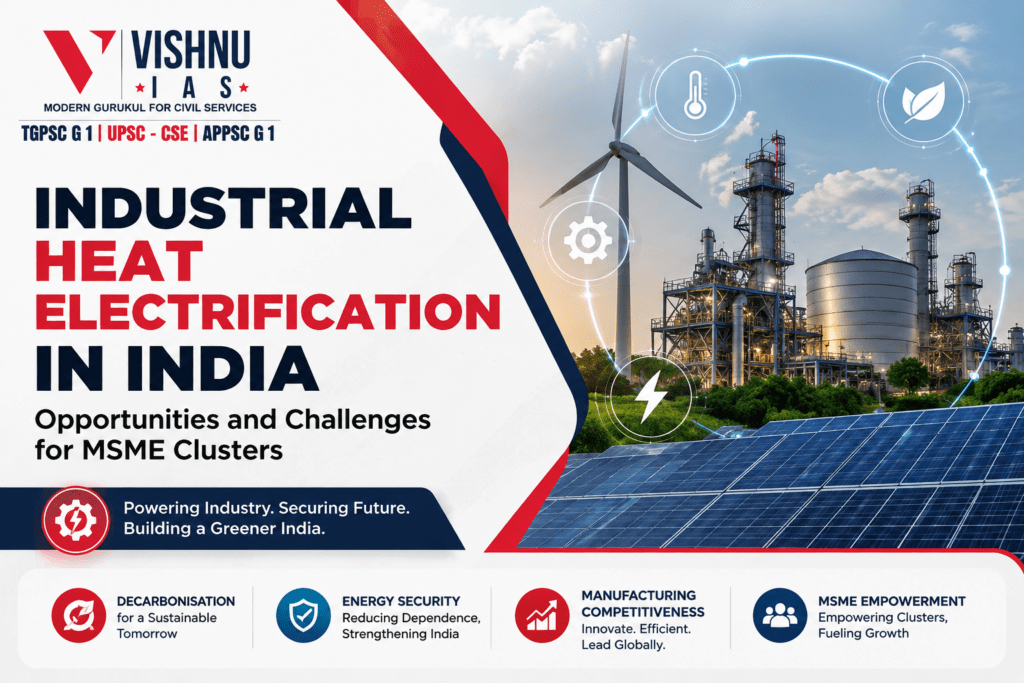
Industrial Heat Electrification in India can simultaneously advance India’s goals of decarbonisation, energy security and manufacturing competitiveness. Industrial heat refers to the thermal energy required for processes such as heating, drying, boiling, melting, curing and steam generation, which remains substantially dependent on fossil fuels in several industrial sectors. India’s energy transition has already mainstreamed renewable electricity, electric mobility and solar-powered agriculture, but industrial process heat remains a relatively difficult-to-decarbonise segment.
Electrifying suitable industrial heat applications through renewable electricity, heat pumps, electric boilers, mechanical vapour recompression and thermal energy storage can simultaneously reduce fossil-fuel dependence, improve energy efficiency and strengthen manufacturing competitiveness. This is particularly significant for MSMEs, which contribute around 30% of India’s GDP and nearly 45% of exports, making their energy transition important for both economic growth and India's climate objectives.
I. Significance of Industrial Heat Electrification for India
1. Advancing Industrial Decarbonisation
Industrial heat is still substantially dependent on coal, furnace oil, diesel and natural gas, making it an important source of industrial greenhouse-gas emissions. Replacing fossil-fuel-based heating with renewable-powered electric systems can significantly reduce emissions and complement India's long-term commitment to achieve Net Zero emissions by 2070.
Example: Textile processing, food processing, pharmaceuticals and several chemical processes involve low- and medium-temperature heat requirements that can potentially be electrified using heat pumps and electric boilers.
2. Strengthening Energy Security
Greater electrification of industrial heat can reduce dependence on imported fossil fuels and consequently reduce India's exposure to international oil and gas price volatility. India imports more than 85% of its crude-oil requirements, making external energy shocks an important macroeconomic vulnerability.
Example: The Russia-Ukraine conflict demonstrated how geopolitical disruptions can rapidly increase international fossil-fuel prices and consequently raise energy costs for industries.
3. Improving Manufacturing Competitiveness
Electric heating technologies can provide greater temperature control, automation, energy efficiency and operational flexibility, particularly when integrated with modern digital control systems. Reduced dependence on volatile fossil-fuel prices can provide greater predictability in production costs and improve the competitiveness of Indian manufacturers. Cleaner production can also become increasingly important as global markets introduce carbon-related standards and supply-chain requirements.
II. Opportunities for Scaling Industrial Heat Electrification
1. Falling Renewable-Energy Costs Provide a Favourable Foundation
- India's experience with solar photovoltaics demonstrates how policy support, competitive procurement, technological innovation, private investment and economies of scale can transform the economics of renewable energy.
- Solar tariffs in India have declined by more than 85% over roughly the past decade, creating a stronger economic foundation for using renewable electricity in industrial applications.
- The Green Energy Open Access Rules, 2022 sought to facilitate easier procurement of renewable electricity by commercial and industrial consumers.
2. Availability of Multiple Electrification Technologies
- Industrial processes differ considerably in terms of temperature requirements, operating schedules and thermal loads, making a technology-neutral approach essential.
- Heat pumps can efficiently provide low- and medium-temperature heat, particularly where waste heat is available, while electric boilers can provide a practical pathway for steam generation in suitable applications.
- Mechanical Vapour Recompression can recover and reuse process vapour in evaporation-intensive industries, while thermal energy storage can store surplus heat and release it according to industrial demand.
- Example: A food-processing facility may use a heat pump for low-temperature heating, while a textile-processing unit requiring steam may adopt an electric boiler combined with renewable electricity.
3. Integration of Energy Efficiency and Waste-Heat Recovery
- Electrification should not simply involve replacing a fossil-fuel boiler with an electric boiler without examining the efficiency of the underlying industrial process.
- Facility-level engineering assessments can identify inefficient boilers, unmetered steam flows, recoverable waste heat and opportunities for direct heating, thereby reducing the amount of energy that ultimately needs to be electrified.
- Pinch analysis can identify opportunities to recover heat internally before additional energy is supplied through electrification.
- Example: Waste heat generated during one stage of a chemical, textile or food-processing operation can potentially be recovered and reused in another process, reducing both energy consumption and operating costs.
4. MSME Clusters Can Generate Economies of Scale
- India's MSME manufacturing sector is heavily concentrated in industrial clusters, creating opportunities for collective energy-transition planning and demand aggregation.
- Cluster-level planning can also enable governments and financial institutions to create investment pipelines rather than financing individual small projects separately.
- Examples: Tiruppur's textile cluster, Morbi's ceramic cluster, Surat's textile industry and Rajkot's engineering MSMEs provide potential settings for cluster-based industrial heat transition strategies.
III. Major Challenges in Scaling Industrial Heat Electrification
1. High Upfront Investment and Limited Access to Finance
- The principal challenge for MSMEs is often not the availability of technology but the financial and investment risk associated with adopting unfamiliar technologies.
- Electrification may require expenditure on heating equipment as well as transformers, electrical connections, control systems, storage and process modifications.
- Smaller enterprises frequently have limited access to affordable long-term finance and may prioritise investments with shorter and more certain payback periods.
- Implication: Even where an electric heating system has lower lifetime operating costs, high initial capital expenditure can discourage MSME adoption.
2. Diverse Industrial Temperature Requirements
- Industrial heat cannot be electrified through a single technological solution because different industries require substantially different temperature ranges.
- Heat pumps are highly effective for low- and medium-temperature applications but are not a universal substitute for very high-temperature industrial processes.
- Sectors such as steel, cement, glass and certain chemical industries present greater technical challenges because some processes require extremely high temperatures.
3. Electricity Infrastructure and Delivered-Cost Constraints
- Although renewable generation costs have declined, the actual cost paid by an industrial consumer also depends on network charges, wheeling charges, banking provisions, open-access procedures and other transaction costs.
- Industrial clusters with inadequate distribution infrastructure may also face constraints when large numbers of units simultaneously increase their electricity demand.
4. Intermittency and Reliability of Renewable Electricity
- Industrial production often requires continuous and predictable thermal energy, whereas solar and wind generation are inherently variable.
- Direct dependence on intermittent renewable electricity without adequate flexibility could therefore create operational difficulties for industries requiring uninterrupted heat.
- Thermal energy storage, grid connectivity, hybrid power systems and demand-response mechanisms can help reconcile renewable intermittency with industrial requirements.
5. Shortage of Technical and Engineering Capacity
- Many MSMEs have limited technical capacity to undertake thermal audits, process integration, waste-heat recovery and electrification feasibility assessments.
- Conventional industrial training programmes often focus on routine operation and maintenance rather than the engineering skills required for integrated thermal and electrical systems.
IV. Strategy for Accelerating Industrial Heat Electrification
1. Adopt Facility-Level Assessments
India should institutionalise facility-level engineering assessments to evaluate boiler efficiency, thermal demand, waste heat and process temperatures before electrification. This will ensure “efficiency first, electrification next” and prevent unsuitable investments.
2. Develop Cluster-Level Transition Plans
Facility-level assessments should be aggregated into district and industrial-cluster-level energy transition plans based on local thermal profiles, renewable potential and grid capacity. Demand aggregation can enable MSMEs to collectively procure technologies and renewable electricity at lower costs.
3. Promote Innovative Financing
Heat-as-a-Service, Technology-as-a-Service, ESCO models, technology leasing and blended finance can reduce upfront capital requirements and technology risks for MSMEs. Such models can convert large capital expenditure into predictable operating expenditure.
4. Strengthen Renewable Electricity Access
India should streamline green open access, banking provisions and transaction costs while strengthening grid infrastructure in industrial clusters. The Green Energy Open Access Rules, 2022 provide an important policy foundation for this transition.
5. Establish Demonstration Projects
India should establish first-of-a-kind demonstration projects across representative sectors, temperature ranges and MSME clusters to generate evidence on costs, performance and business models. Successful models can subsequently be replicated across similar industrial clusters.
6. Build a Skilled Industrial Workforce
ITIs, Skill India and industry partnerships should develop skills in energy auditing, process integration, system design, automation and energy management. This will ensure that industrial electrification becomes an engineering transition rather than merely an equipment-replacement exercise.
Conclusion
Industrial heat electrification represents the next frontier of India's energy transition. However, the transition cannot be reduced to a simple replacement of fossil-fuel boilers with electric equipment. Its success depends on integrating energy efficiency, waste-heat recovery, renewable electricity, thermal storage, suitable technologies, innovative financing, skilled manpower and reliable infrastructure.
For India's MSME sector, the most sustainable model would therefore be a “facility-level assessment → cluster-level aggregation → national-level policy support” approach, allowing solutions to reflect the specific thermal and economic characteristics of different industrial clusters.