

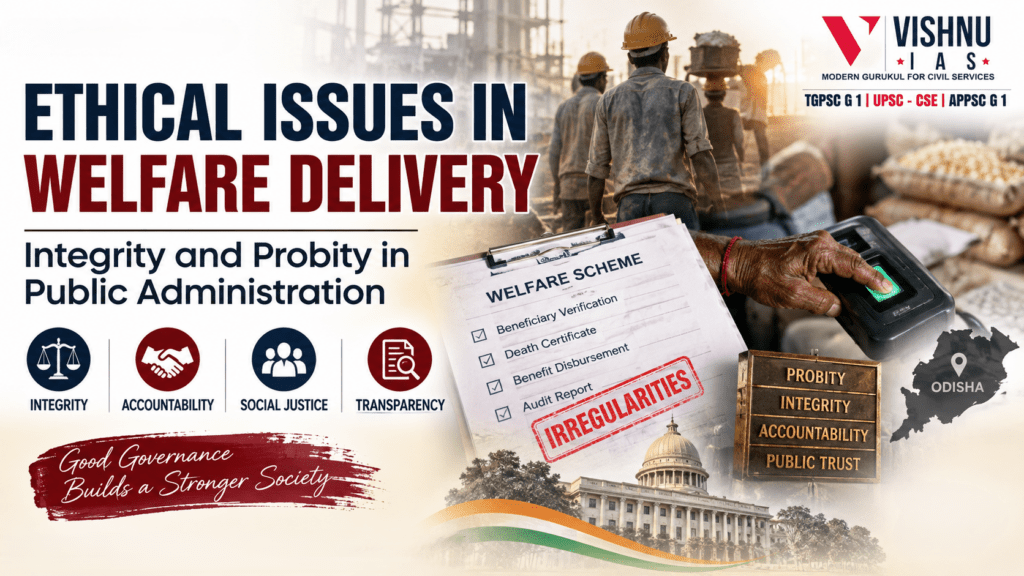
Ethical Issues in Welfare Delivery: Integrity and Probity in Public Administration
A recent audit of a welfare scheme for construction workers in Odisha revealed serious discrepancies in the identification of beneficiaries and disbursement of benefits. In several cases, persons recorded as deceased continued to authenticate their identity biometrically and receive subsidised food grains, while death benefits had already been released to their nominees. The audit also pointed to possible lapses in the issuance of death certificates and verification mechanisms.
What ethical issues does the above case raise? How does integrity among public officials contribute to ensuring probity in the delivery of welfare benefits.
Introduction
The case reflects a serious ethical failure in the administration of welfare benefits. When persons recorded as dead continue to receive benefits while death assistance is released to their nominees, it raises questions not merely of financial irregularity but also of integrity, probity, accountability, fairness and public trust in welfare administration.
Ethical Issues Involved
1. Violation of integrity and honesty:
The apparent manipulation or failure to properly verify beneficiary records indicates a departure from honesty and integrity, which require public officials to act truthfully and uphold established rules even in the absence of external supervision.
2. Breach of probity in public life:
Public funds are held in trust for citizens. Irregular disbursement of welfare benefits violates probity, as officials have an ethical obligation to ensure that public resources are used only for legitimate purposes.
3. Failure of accountability:
The existence of contradictory records points to deficiencies at different stages, including beneficiary verification, issuance of death certificates and release of benefits. This raises questions of individual as well as institutional accountability.
4. Negligence and lack of due diligence:
The contradiction between official death records and subsequent biometric authentication indicates inadequate scrutiny and verification. Public officials have a duty of care, diligence and professional responsibility while implementing welfare programmes.
5. Inclusion and exclusion errors:
Welfare administration faces two major ethical risks - inclusion errors, where ineligible persons receive benefits, and exclusion errors, where eligible persons are denied benefits. In the present case, fraudulent inclusion diverts scarce resources from genuine beneficiaries and can indirectly contribute to the exclusion or reduced access of deserving workers.
6. Violation of fairness and social justice:
Welfare schemes are designed to support vulnerable sections. When benefits are fraudulently obtained, deserving beneficiaries may be deprived of resources, violating the principles of equity, fairness and distributive justice. This may also motivate individuals to obtain welfare benefits through unfair means.
7. Erosion of public trust:
Citizens expect public institutions to administer welfare schemes honestly and fairly. Such irregularities weaken trust in government institutions and may reduce citizens' confidence in welfare programmes.
Integrity for Probity in Welfare Delivery
- Honest verification - Officials would carefully verify eligibility, death records, supporting documents and beneficiary status before authorising benefits.
- Objectivity in decision-making - Eligibility would be determined according to prescribed criteria rather than favouritism, personal relationships, pressure or other extraneous considerations.
- Impartiality and fairness - Officials would apply the same rules to all beneficiaries and ensure that both genuine applicants and existing beneficiaries are treated fairly.
- Accountability for decisions - An ethical official would maintain proper records, accept responsibility for decisions and report discrepancies instead of ignoring them.
- Transparency - Accurate documentation, clear procedures and effective audit trails make administrative decisions open to scrutiny and reduce opportunities for manipulation.
- Dedication to public service - Integrity ensures that officials remain conscious that welfare schemes exist to serve vulnerable citizens. Their primary commitment therefore remains public interest rather than private gain.
- Moral courage - Integrity also requires officials to resist undue influence, refuse participation in fraudulent practices and report wrongdoing even when doing so may be inconvenient or personally difficult.
- Responsible use of technology - Officials with integrity would use Aadhaar authentication, beneficiary databases and interlinked government records not merely as procedural requirements but also for verification and prevention of leakages.
Way Forward
Institutional mechanisms should reinforce individual integrity. Regular social and financial audits, reconciliation of welfare databases, cross-verification of death and beneficiary records, grievance-redress mechanisms, clear responsibility fixing and prompt disciplinary action can strengthen probity.
Conclusion
The case demonstrates that welfare governance requires more than efficient delivery mechanisms. It requires integrity, objectivity, accountability and transparency. When these values guide officials, welfare resources are more likely to reach their intended beneficiaries, inclusion and exclusion errors are reduced, social justice is protected, and citizens' trust in public institutions is strengthened.