

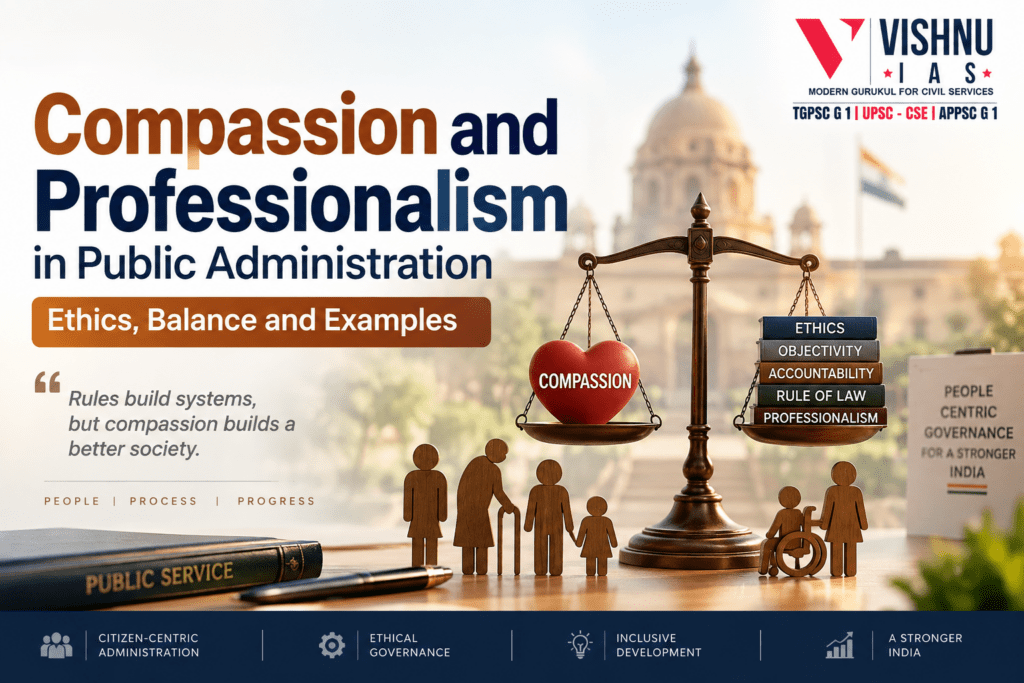
Compassion and Professionalism in Public Administration: Ethics, Balance and Examples
Compassion and professionalism in public administration are complementary rather than contradictory values. Public administration operates at the intersection of rules and human needs. Professionalism provides competence, objectivity, impartiality, accountability and adherence to law, while compassion enables an administrator to understand human suffering and respond with dignity. The two are therefore not competing values. Professionalism makes compassion fair and effective, while compassion prevents professionalism from becoming mechanical and insensitive.
Compassion and Professionalism as Complementary Values
1. Compassion Makes Administration Citizen-Centric
Professional competence may ensure that a procedure is correctly implemented, but compassion helps the administrator understand how that procedure affects people. Empathy enables the civil servant to look beyond files and statistics and understand the lived realities of citizens, particularly weaker sections.
Examples:
- An official planning the worktime for VB GRAM G from early morning to avoid scorching heat during summers, ensuring work alongside appropriate working conditions.
- IAS officer Sandeep G.R. used bicycles during inspections to experience public services from the citizens’ perspective. This helped him identify practical problems in hospitals, sanitation and accessibility that might not have been evident from an office-based assessment.
2. Objective Framework
Compassion without impartiality can become favouritism. A civil servant cannot selectively relax rules because of personal sympathy. Professionalism ensures that compassion is exercised through lawful discretion, transparent criteria and equal treatment of similarly placed persons.
Example:
- Compassionate appointment in govt. services is not an automatic right merely because the family is sympathetic or deserving.
- In State of Haryana v. Ankur Gupta (2003), the Supreme Court emphasised that compassionate appointment is meant to provide relief from the financial crisis caused by the employee's death and cannot be treated as a general mode of recruitment.
- The Tamil Nadu government's decision in 2026 to provide government employment to eligible dependants of the Karur stampede victims was quashed by Madras High Court (Art. 14 and 16) illustrates the tension between compassion and professional impartiality.
3. Compassion Improves Professional Decision-Making
Complex administrative problems cannot always be solved through data alone. Understanding the perspective of affected communities allows administrators to identify implementation gaps and design more appropriate solutions.
IAS officer Saumya Jha, as District Magistrate of Tonk, Rajasthan, identified foundational mathematics as a barrier preventing many government-school students from pursuing science streams. She introduced an AI-based personalised learning intervention, which reportedly raised the Class 10 mathematics pass percentage to 96.4% after six weeks.
4. Professional Competence Converts Compassion into Sustainable Outcomes
Compassion creates the motivation to alleviate suffering, but professionalism determines how that objective can be achieved effectively.
During the 2025 Punjab floods, IAS officer Sakshi Sawhney coordinated the Army, NDRF, SDRF and Red Cross while being directly involved in rescue operations; more than 900 people were rescued within 24 hours.
5. Compassion Strengthens Crisis Administration
Disasters require emotional sensitivity as well as professional coordination. Administrators have to reassure affected citizens while simultaneously mobilising resources, coordinating agencies and making rapid decisions.
During the recent Bihar floods 2026, senior authorities directly visited affected villages and interacted with victims to know the ground-level issues, while government teams undertook systematic assessments of damage to crops, houses, roads, bridges and livestock. The example illustrates the combination of human sensitivity with institutional coordination.
6. Compassion Must Ultimately Be Institutionalised
The highest form of administrative compassion is not individual benevolence but the creation of systems that protect dignity consistently.
IAS officer Swapneel Paul led a coordinated effort to address legacy waste across five municipal boards in Assam's Tinsukia district. The district used bio-mining to process approximately 1.53 lakh metric tonnes of legacy waste and became the first legacy-waste-free district in Northeast India.
Ethical Balance
Compassion without professionalism may produce paternalism, favouritism or arbitrary discretion. Conversely, professionalism without compassion may produce procedural rigidity and “efficient indifference”, where rules are followed but human suffering is ignored.
Conclusion
Compassion and professionalism represent the human and institutional dimensions of public service. Professionalism ensures that compassion does not become arbitrary; compassion ensures that professionalism remains connected to the purpose of governance. Thus, compassion does not weaken professionalism, it gives professionalism its human purpose, while professionalism gives compassion an ethical and sustainable form.