
International Law in Contemporary World Order: Relevance and Resilience of Global Legal Norms
International Law in Contemporary World Order continues to shape global governance despite recurring geopolitical conflicts and criticisms of failure. The perceived failure of international law in preventing major conflicts often arises from comparing it to domestic legal systems that possess centralized enforcement and coercive authority. However, such comparisons overlook the decentralized and consent-based nature of international law and its broader resilience.
Introduction
International law refers to the body of rules, norms, and legal principles governing relations between sovereign states, international organizations, and other global actors, derived from treaties, customary practices, and general legal principles. Unlike domestic law, it operates in a decentralized international system without a single enforcement authority, relying on consent, reciprocity, and legitimacy.
Despite criticisms, its scale and reach remain unprecedented: over 560 multilateral treaties are deposited with the United Nations, institutions like the International Criminal Court (124 member states), and the International Court of Justice adjudicating disputes demonstrate continued institutional vitality. Furthermore, global trade worth over $30 trillion annually is governed by legal frameworks under the World Trade Organization, reflecting deep penetration of legal norms into international relations.
The perception that international law has “failed” largely arises from comparing it to domestic legal systems with centralized enforcement and compulsory jurisdiction. However, such comparisons ignore the fundamentally different structure of international society and the strong evidence of international law’s resilience.
I. Why the Perception of Failure Arises When Judged Against Domestic Legal Standards
1. Absence of Centralized Enforcement Authority and the Principle of Sovereignty
International law operates in a decentralized system defined by state sovereignty. There is no global police force or legislature comparable to domestic systems, making enforcement dependent on state consent rather than coercion.
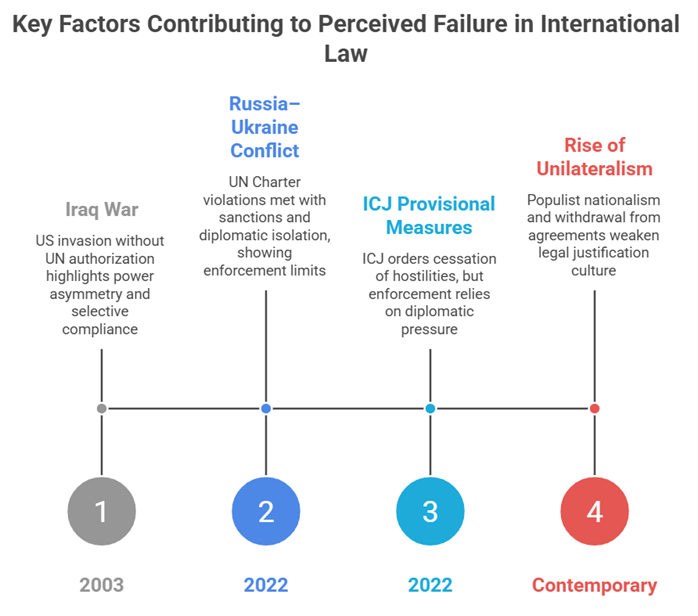
Example – Russia–Ukraine Conflict (2022): Violations of Article 2(4) of the UN Charter prohibiting use of force led to sanctions and diplomatic isolation, but enforcement limitations highlighted structural constraints rather than irrelevance of law.
Case Study – ICJ Provisional Measures (2022): The ICJ ordered cessation of military operations, reinforcing legal norms. Enforcement depended on diplomatic pressure, illustrating how law shapes legitimacy even without coercion.
2. Power Asymmetry and Selective Compliance by Major Powers
International law functions within a hierarchical geopolitical environment where powerful states may reinterpret or resist legal norms, creating perceptions of double standards.
Example – Iraq War (2003): The invasion without explicit UN Security Council authorization raised concerns regarding compliance and enforcement limitations against powerful states.
Example – Venezuelan Sanctions: Unilateral sanctions justified under domestic interpretations illustrate bypassing of multilateral frameworks.
3. Rise of Unilateralism and Erosion of Legal Justification Culture
Earlier decades witnessed powerful states justifying military actions under legal doctrines such as self-defence under Article 51 of the UN Charter. Contemporary populism and unilateralism have weakened this culture of justification.
Example – Withdrawal from International Agreements: Temporary exits from global climate and health agreements reinforced perceptions of declining legal authority.
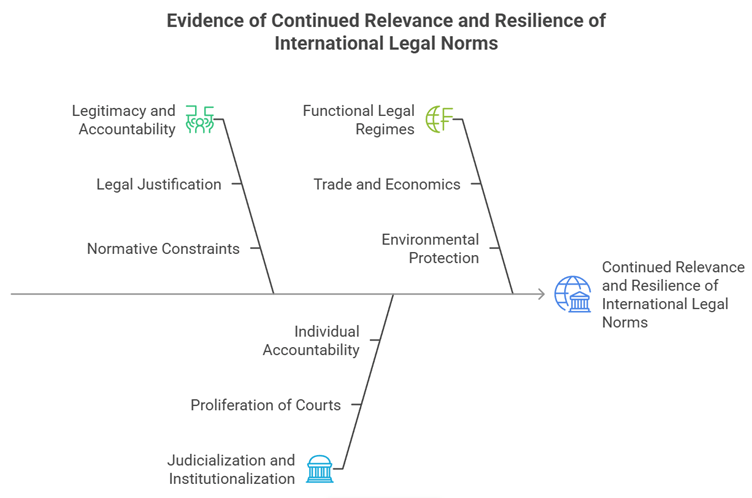
II. Evidence of Continued Relevance and Resilience of International Legal Norms
1. Legitimacy, Accountability, and Normative Constraints
Even when violated, international law shapes global discourse by compelling states to justify actions legally.
Example – NATO invoking collective self-defence after 9/11: Legal justification under Article 51 demonstrated continued reliance on international law.
Case Study – South China Sea Arbitration (2016): Although China rejected the ruling, participation in legal argumentation reflects enduring normative influence.
2. Judicialization and Institutionalisation of Global Dispute Resolution
The proliferation of international courts and tribunals has strengthened peaceful dispute resolution mechanisms.
The International Criminal Court’s arrest warrants against leaders such as Omar al-Bashir reinforced individual criminal accountability beyond sovereignty.
Case Study – Kulbhushan Jadhav Case (2019): The ICJ ruled Pakistan violated consular access obligations, demonstrating effectiveness in resolving sensitive disputes peacefully.
3. Functional Legal Regimes Enabling Global Cooperation
International law governs trade, climate, aviation, maritime navigation, and telecommunications, enabling global stability.
Example – Montreal Protocol (1987): Phased out over 99% of ozone-depleting substances, reflecting effective compliance.
Example – High Seas Treaty (2023): Strengthens biodiversity protection beyond national jurisdiction.
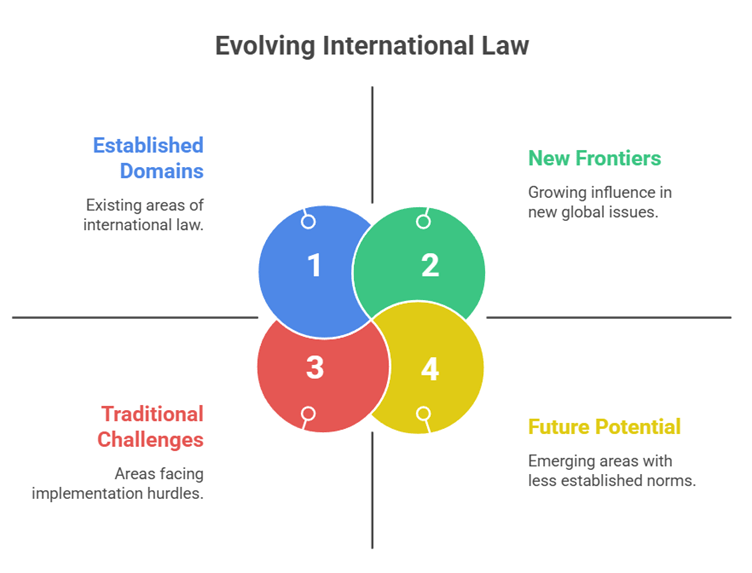
III. Contemporary Evolution and Strategic Importance
1. Expansion into Emerging Domains
International law adapts to climate change, cyber governance, AI, and outer space regulation.
The Paris climate framework demonstrates collective commitment despite implementation challenges.
Example – Artemis Accords: Frameworks for peaceful outer space exploration reflect proactive norm-building.
2. Empowerment of Weaker States
International law provides weaker states with platforms to challenge powerful actors.
Case Study – Gambia v. Myanmar: Demonstrated legal empowerment beyond economic or military strength.
Example – Small Island States Climate Litigation: Strengthening climate justice accountability.
3. Strategic Use by Emerging Powers
States increasingly use international law strategically for economic and security interests.
Case Study – India–Bangladesh Maritime Arbitration (2014): Peaceful resolution enhanced maritime stability.
Example – India–EU Free Trade Negotiations: Continued reliance on treaty-based frameworks for economic integration.
Conclusion
The perceived failure of international law arises primarily from measuring it against domestic legal standards with centralized authority and coercive enforcement. However, International Law in Contemporary World Order demonstrates resilience through widespread treaty participation, global trade regulation, judicial activity, and normative influence.
Strengthening institutional reforms, enhancing compliance mechanisms, and democratizing global governance can reinforce effectiveness. Like constitutional systems, international law endures despite violations, remaining an indispensable pillar of global order and cooperation.
Recap: