
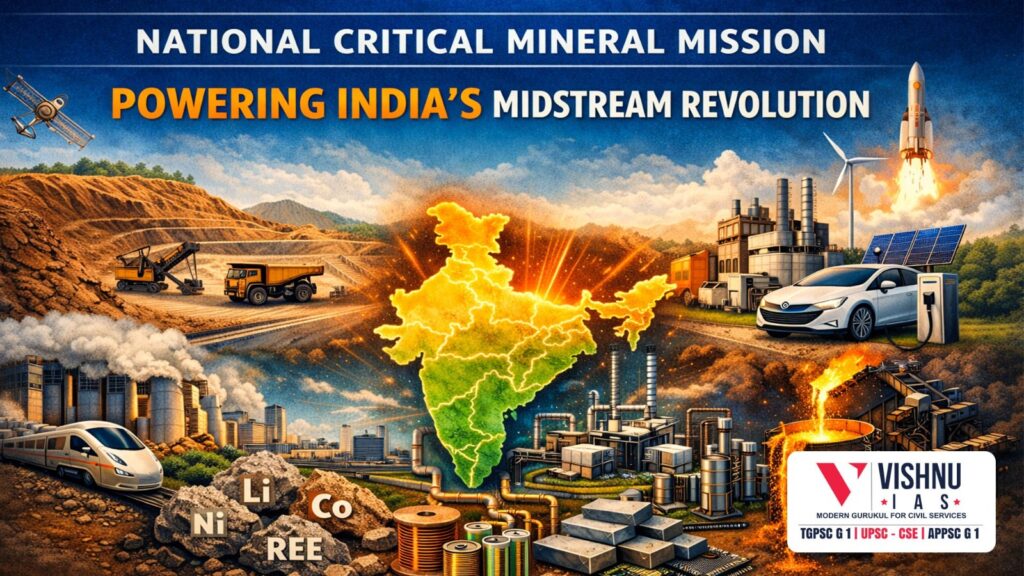
National Critical Mineral Mission (NCMM): Transforming India into a Global Midstream Processing Hub
Introduction
- Critical minerals are mineral resources that are essential for economic development, clean energy technologies, national security, and industrial growth, but are vulnerable to supply disruptions due to geological scarcity or geopolitical concentration.
- According to the International Energy Agency, achieving global clean energy goals could increase demand for lithium by over 40 times, cobalt by 20–25 times, and rare earth elements by nearly 7 times by 2040, highlighting their strategic importance. Historically, India has been heavily dependent on imports, sourcing over 85–90% of lithium, cobalt, and nickel requirements from foreign markets, exposing vulnerabilities in supply chains dominated by countries such as China.
- In this context, the launch of the National Critical Mineral Mission with an outlay of ₹16,300 crore in 2025, combined with policy reforms, tax incentives, and exploration targets of 1,200 projects by FY2031, represents a decisive shift toward transforming India into a global midstream processing hub, reducing import dependence while enhancing technological and industrial sovereignty.
Body
I. Strategic Significance of NCMM in Reducing Resource Dependence
1. Strengthening Domestic Exploration and Resource Security
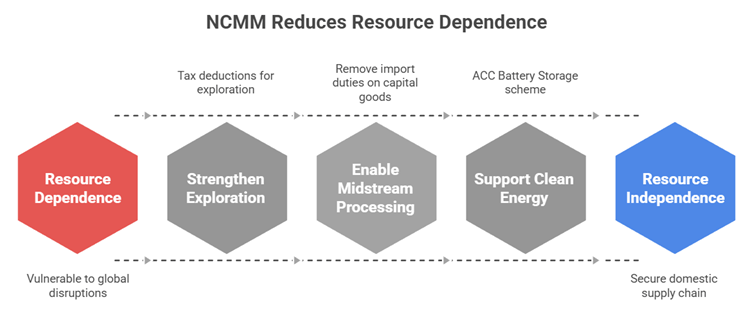
- The Mission incentivizes exploration by providing tax deductions for exploration expenditure on critical minerals such as lithium, niobium, and tantalum, thereby reducing financial risk and encouraging private participation alongside agencies like the Geological Survey of India, which has expanded nationwide mineral mapping and digital geological databases.
- Example: The discovery of 5.9 million tonnes of inferred lithium reserves in Reasi district of Jammu and Kashmir marked India’s first major domestic lithium find, demonstrating the potential for indigenous supply chain development.
- Case Study: Khanij Bidesh India Limited secured lithium and cobalt assets in Argentina through overseas acquisition partnerships, ensuring long-term supply security and reducing vulnerability to global disruptions.
2. Enabling Domestic Midstream Processing and Value Addition
- Policy measures such as removal of import duties on capital goods used for mineral refining, royalty rationalisation, and incentives under manufacturing promotion schemes have made domestic processing more competitive and economically viable.
- Example: Indian Rare Earths Limited processes monazite sands to produce rare earth oxides used in electronics, magnets, and defence systems, demonstrating India's existing midstream capabilities.
- Case Study: Tata Chemicals is investing in lithium-ion battery material production and recycling, integrating upstream mineral supply with midstream refining and downstream manufacturing.
3. Supporting Clean Energy Transition and Strategic Industrial Growth
- The Mission complements clean energy expansion programmes such as the Advanced Chemistry Cell (ACC) Battery Storage scheme, which allocated ₹18,100 crore to domestic battery manufacturing, ensuring future demand for processed minerals.
- Example: India’s renewable capacity expansion toward 500 GW non-fossil fuel capacity target by 2030 requires large-scale availability of lithium, cobalt, and rare earth elements, linking mineral security directly with energy transition.
- Case Study: Reliance New Energy’s gigafactory initiative integrates battery production with mineral processing, demonstrating how domestic midstream processing strengthens industrial self-reliance.
II. Role of NCMM in Transforming India into a Global Midstream Processing Hub
1. Leveraging Existing Industrial and Technological Capabilities
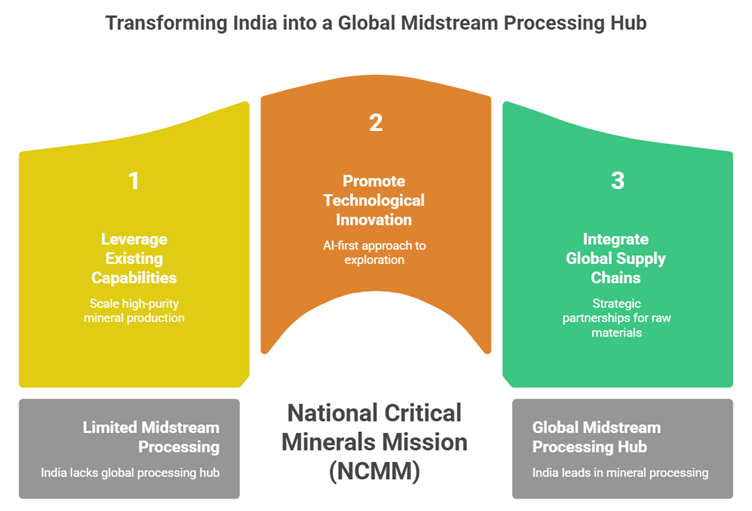
- India already produces high-purity copper, graphite, rare earth oxides, and titanium exceeding 99.9% purity, reflecting strong metallurgical expertise that can be scaled for advanced applications such as semiconductors, aerospace, and renewable energy.
- Example: Hindustan Zinc Limited operates one of the world’s largest zinc-lead smelters, demonstrating India’s ability to operate large-scale mineral refining infrastructure efficiently.
- Case Study: ISRO uses indigenously processed titanium alloys and rare earth materials in rocket engines and satellite components, showcasing strategic domestic processing capabilities.
2. Promoting Technological Innovation through AI and Geospatial Integration
- The Mission promotes an AI-first approach to exploration, integrating datasets under initiatives such as the IndiaAI Mission and expanding the scope of AI-driven exploration under Mission Anveshan to include critical mineral identification and prospectivity modelling.
- Example: Satellite remote sensing, seismic AI, and machine learning models enable identification of mineral-rich geological formations, significantly reducing exploration time and improving discovery success rates.
- Case Study: Integration of geoscience databases with predictive analytics has improved identification of potential mineral zones in Rajasthan and Odisha, accelerating exploration and investment readiness.
3. Integrating India into Global Mineral Supply Chains through Partnerships
- Strategic agreements with resource-rich countries such as Australia and technology leaders such as Japan and the United States enhance India’s access to raw materials while strengthening domestic refining capabilities.
- Example: India’s participation in the Minerals Security Partnership enables access to technology, financing, and international mineral supply chains.
- Case Study: Collaboration with the European Union through trade agreements and mineral supply chain initiatives is enabling establishment of joint mineral processing facilities and technology transfer frameworks.
III. Challenges and Limitations Affecting India’s Transformation into a Midstream Hub
1. Technological and Infrastructure Gaps in Advanced Mineral Processing
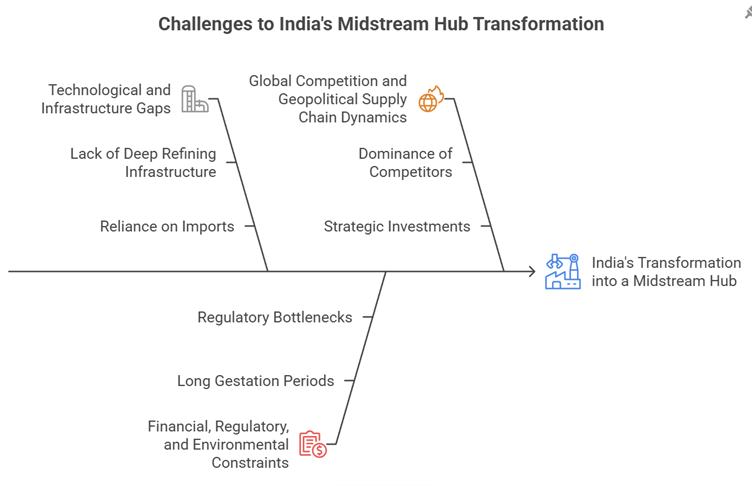
- Despite strong base capabilities, India lacks large-scale infrastructure for deep refining of rare earth elements and advanced battery materials, which remain technologically complex and capital-intensive.
- Example: Over 80–90% of rare earth magnet processing remains concentrated in China, forcing Indian EV and electronics manufacturers to rely on imports.
- Case Study: Supply disruptions caused by export restrictions on rare earth magnets affected EV motor production timelines, exposing technological vulnerabilities.
2. Financial, Regulatory, and Environmental Constraints
- Mineral exploration and processing involve long gestation periods ranging from 10 to 20 years, high capital expenditure, and regulatory clearances, discouraging private sector participation without sustained policy support.
- Example: Mining projects in Odisha and Jharkhand have faced delays due to environmental clearances and land acquisition challenges, slowing resource development.
- Case Study: Vedanta’s mining expansion projects experienced delays due to environmental approvals, demonstrating regulatory bottlenecks affecting mineral ecosystem growth.
3. Global Competition and Geopolitical Supply Chain Dynamics
- Competing countries such as Indonesia have established dominance in nickel processing through export restrictions and domestic value addition policies, capturing global midstream market share.
- Example: Indonesia’s nickel processing policy helped it become the world’s largest refined nickel producer within a decade, highlighting the importance of integrated policy support.
- Case Study: Strategic investments by European and American companies in alternative mineral supply chains highlight intense global competition for midstream processing leadership.
Conclusion
- The National Critical Mineral Mission represents a transformative policy shift, enabling India to transition from a resource-dependent importer to a technologically capable midstream processing hub, strengthening industrial resilience, energy security, and geopolitical leverage.
- With global clean energy mineral markets projected by the International Energy Agency to exceed $400 billion by 2040, India’s investments in exploration, refining, technology integration, and international partnerships position it to capture a significant share of the value chain.
- By strengthening domestic processing capabilities, accelerating AI-driven exploration, promoting industrial demand, and deepening strategic partnerships, India can emerge as a globally competitive and technologically sovereign critical mineral processing hub, supporting sustainable economic growth and strategic autonomy in an increasingly resource-constrained world.
I. Strategic Significance of NCMM in Reducing Resource Dependence
1. Strengthening Domestic Exploration and Resource Security
- The Mission incentivizes exploration by providing tax deductions for exploration expenditure on critical minerals such as lithium, niobium, and tantalum, thereby reducing financial risk and encouraging private participation alongside agencies like the Geological Survey of India, which has expanded nationwide mineral mapping and digital geological databases.
- Example: The discovery of 5.9 million tonnes of inferred lithium reserves in Reasi district of Jammu and Kashmir marked India’s first major domestic lithium find, demonstrating the potential for indigenous supply chain development.
- Case Study: Khanij Bidesh India Limited secured lithium and cobalt assets in Argentina through overseas acquisition partnerships, ensuring long-term supply security and reducing vulnerability to global disruptions.
2. Enabling Domestic Midstream Processing and Value Addition
- Policy measures such as removal of import duties on capital goods used for mineral refining, royalty rationalisation, and incentives under manufacturing promotion schemes have made domestic processing more competitive and economically viable.
- Example: Indian Rare Earths Limited processes monazite sands to produce rare earth oxides used in electronics, magnets, and defence systems, demonstrating India's existing midstream capabilities.
- Case Study: Tata Chemicals is investing in lithium-ion battery material production and recycling, integrating upstream mineral supply with midstream refining and downstream manufacturing.
3. Supporting Clean Energy Transition and Strategic Industrial Growth
- The Mission complements clean energy expansion programmes such as the Advanced Chemistry Cell (ACC) Battery Storage scheme, which allocated ₹18,100 crore to domestic battery manufacturing, ensuring future demand for processed minerals.
- Example: India’s renewable capacity expansion toward 500 GW non-fossil fuel capacity target by 2030 requires large-scale availability of lithium, cobalt, and rare earth elements, linking mineral security directly with energy transition.
- Case Study: Reliance New Energy’s gigafactory initiative integrates battery production with mineral processing, demonstrating how domestic midstream processing strengthens industrial self-reliance.
II. Role of NCMM in Transforming India into a Global Midstream Processing Hub
1. Leveraging Existing Industrial and Technological Capabilities
- India already produces high-purity copper, graphite, rare earth oxides, and titanium exceeding 99.9% purity, reflecting strong metallurgical expertise that can be scaled for advanced applications such as semiconductors, aerospace, and renewable energy.
- Example: Hindustan Zinc Limited operates one of the world’s largest zinc-lead smelters, demonstrating India’s ability to operate large-scale mineral refining infrastructure efficiently.
- Case Study: ISRO uses indigenously processed titanium alloys and rare earth materials in rocket engines and satellite components, showcasing strategic domestic processing capabilities.
2. Promoting Technological Innovation through AI and Geospatial Integration
- The Mission promotes an AI-first approach to exploration, integrating datasets under initiatives such as the IndiaAI Mission and expanding the scope of AI-driven exploration under Mission Anveshan to include critical mineral identification and prospectivity modelling.
- Example: Satellite remote sensing, seismic AI, and machine learning models enable identification of mineral-rich geological formations, significantly reducing exploration time and improving discovery success rates.
- Case Study: Integration of geoscience databases with predictive analytics has improved identification of potential mineral zones in Rajasthan and Odisha, accelerating exploration and investment readiness.
3. Integrating India into Global Mineral Supply Chains through Partnerships
- Strategic agreements with resource-rich countries such as Australia and technology leaders such as Japan and the United States enhance India’s access to raw materials while strengthening domestic refining capabilities.
- Example: India’s participation in the Minerals Security Partnership enables access to technology, financing, and international mineral supply chains.
- Case Study: Collaboration with the European Union through trade agreements and mineral supply chain initiatives is enabling establishment of joint mineral processing facilities and technology transfer frameworks.
III. Challenges and Limitations Affecting India’s Transformation into a Midstream Hub
1. Technological and Infrastructure Gaps in Advanced Mineral Processing
- Despite strong base capabilities, India lacks large-scale infrastructure for deep refining of rare earth elements and advanced battery materials, which remain technologically complex and capital-intensive.
- Example: Over 80–90% of rare earth magnet processing remains concentrated in China, forcing Indian EV and electronics manufacturers to rely on imports.
- Case Study: Supply disruptions caused by export restrictions on rare earth magnets affected EV motor production timelines, exposing technological vulnerabilities.
2. Financial, Regulatory, and Environmental Constraints
- Mineral exploration and processing involve long gestation periods ranging from 10 to 20 years, high capital expenditure, and regulatory clearances, discouraging private sector participation without sustained policy support.
- Example: Mining projects in Odisha and Jharkhand have faced delays due to environmental clearances and land acquisition challenges, slowing resource development.
- Case Study: Vedanta’s mining expansion projects experienced delays due to environmental approvals, demonstrating regulatory bottlenecks affecting mineral ecosystem growth.
3. Global Competition and Geopolitical Supply Chain Dynamics
- Competing countries such as Indonesia have established dominance in nickel processing through export restrictions and domestic value addition policies, capturing global midstream market share.
- Example: Indonesia’s nickel processing policy helped it become the world’s largest refined nickel producer within a decade, highlighting the importance of integrated policy support.
- Case Study: Strategic investments by European and American companies in alternative mineral supply chains highlight intense global competition for midstream processing leadership.
Conclusion
- The National Critical Mineral Mission represents a transformative policy shift, enabling India to transition from a resource-dependent importer to a technologically capable midstream processing hub, strengthening industrial resilience, energy security, and geopolitical leverage.
- With global clean energy mineral markets projected by the International Energy Agency to exceed $400 billion by 2040, India’s investments in exploration, refining, technology integration, and international partnerships position it to capture a significant share of the value chain.
- By strengthening domestic processing capabilities, accelerating AI-driven exploration, promoting industrial demand, and deepening strategic partnerships, India can emerge as a globally competitive and technologically sovereign critical mineral processing hub, supporting sustainable economic growth and strategic autonomy in an increasingly resource-constrained world.
Recap: