

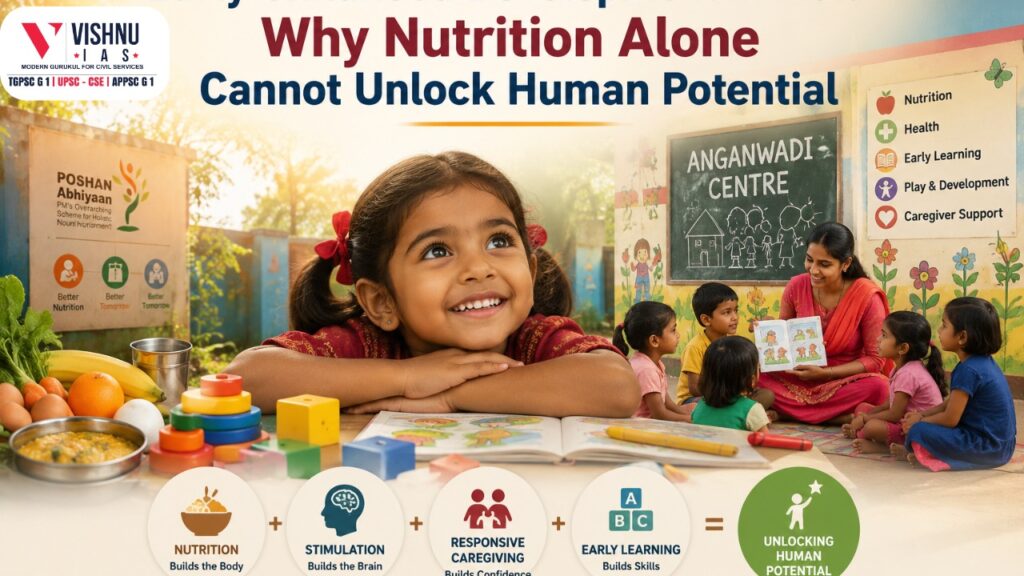
Introduction:
- Early Childhood Development (ECD) refers to the holistic development of children from conception to eight years of age encompassing nutrition, health, cognitive stimulation, socio-emotional development, language acquisition and early learning. Contemporary developmental neuroscience shows that nearly 90% of brain development occurs before the age of six, making early childhood the most critical phase for building human capital.
- While India has significantly reduced child mortality and expanded nutritional support through the Integrated Child Development Services (ICDS) and Anganwadi network serving millions of children, evidence increasingly suggests that nutrition alone cannot maximize developmental outcomes.
- The realization of India’s demographic dividend depends not merely on raising healthy children, but on nurturing children who are healthy, cognitively capable, emotionally resilient and learning-ready.
Body:
1. Why nutrition alone is insufficient for unlocking human potential
A. Brain development depends on both nourishment and stimulation
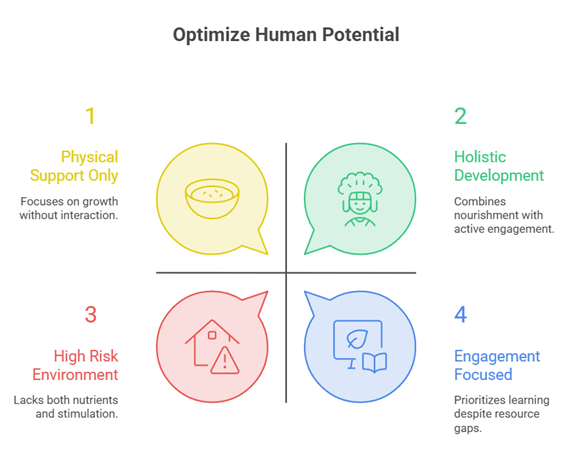
- The developing brain is highly energy-intensive and requires not only adequate nutrition but also responsive caregiving, language exposure and play-based learning for optimal neural connectivity.
- Scientific evidence demonstrates that while nutritional supplementation improves physical growth, cognitive gains are substantially higher when accompanied by psychosocial stimulation and interactive learning.
- Example – Jamaica Early Childhood Intervention Study: Children receiving nutrition along with structured stimulation showed significantly better cognitive and educational outcomes than those receiving nutrition alone.
B. Environmental factors influence nutritional outcomes
- Nutritional intake does not automatically translate into developmental gains because infection, poor sanitation, environmental toxins and chronic stress affect nutrient absorption and brain development.
- Conditions such as Environmental Enteric Dysfunction (EED), recurrent diarrheal diseases and micronutrient deficiencies reduce the developmental benefits of food supplementation.
- Case Study – Vellore Birth Cohort: Children exposed to iron deficiency and lead contamination in early life exhibited lower cognitive performance despite normal growth indicators.
C. Home learning environment shapes lifelong capabilities
- Research consistently shows that the quality of parent-child interaction, storytelling, communication and emotional support strongly influences language development and executive functioning.
- Children who are regularly spoken to, read to and engaged through play acquire stronger foundational literacy and numeracy skills.
- Example – Harvard Center on the Developing Child Findings: “Serve-and-return” interactions between caregivers and children significantly strengthen neural architecture during the first thousand days.
2. Why integrating structured early childhood education with nutrition is essential
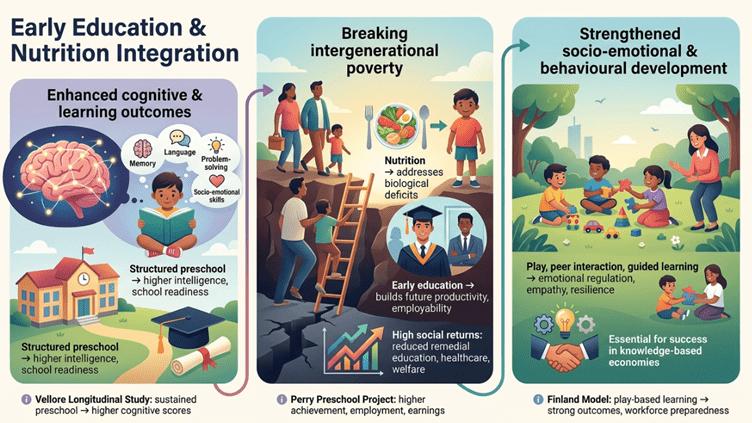
A. Enhances cognitive and learning outcomes
- Early childhood education complements nutrition by stimulating memory, language acquisition, problem-solving and socio-emotional skills during periods of maximum brain plasticity.
- Structured preschool exposure can substantially improve intelligence measures, school readiness and later educational attainment.
- Case Study – Vellore Longitudinal Study: Children attending preschool for sustained periods demonstrated significantly higher cognitive scores compared to non-attendees even after controlling for poverty and stunting.
B. Breaks intergenerational cycles of poverty and deprivation
- Nutrition addresses immediate biological deficits, whereas early education builds capabilities that influence future productivity, employability and income.
- Investments in early childhood generate among the highest social returns by reducing future expenditure on remedial education, healthcare and welfare support.
- Example – Perry Preschool Project (USA): Participants experienced higher educational achievement, employment rates and earnings decades later, illustrating long-term benefits of early learning interventions.
C. Strengthens socio-emotional and behavioural development
- Structured play, peer interaction and guided learning foster emotional regulation, cooperation, empathy and resilience.
- These skills are increasingly recognized as essential for success in modern knowledge-based economies.
- Example – Finland’s Early Childhood Education Model: Emphasis on play-based learning and socio-emotional development has contributed to strong educational outcomes and workforce preparedness.
3. Role of integrated Anganwadi-centred interventions in realizing the demographic dividend
A. Transforming Anganwadis into comprehensive ECD centres
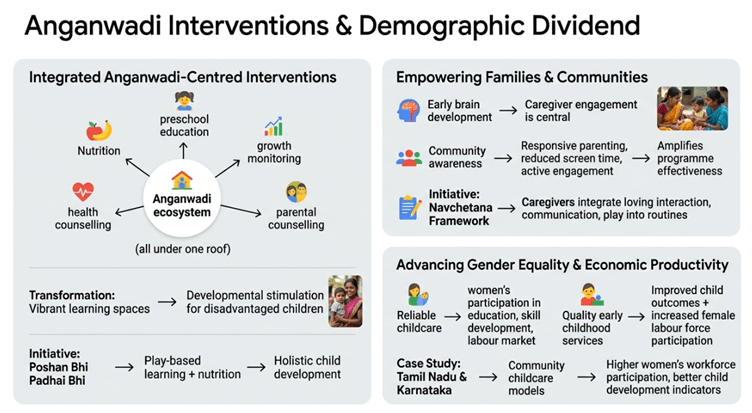
- The Anganwadi ecosystem provides a unique platform for delivering nutrition, preschool education, growth monitoring, health services and parental counselling under one roof.
- Converting centres into vibrant learning spaces can ensure that developmental stimulation reaches children from disadvantaged households.
- Government Initiative – Poshan Bhi Padhai Bhi: Promotes play-based learning alongside nutritional interventions to support holistic child development.
B. Empowering families and communities as developmental partners
- Since a large proportion of brain development occurs before formal schooling, caregiver engagement becomes central to developmental outcomes.
- Community awareness regarding responsive parenting, reduced screen exposure and active engagement can amplify programme effectiveness.
- Government Initiative – Navchetana Framework: Encourages caregivers to integrate loving interaction, communication and play into daily routines to enhance early childhood development.
C. Advancing gender equality and economic productivity
- Reliable childcare services enable women to participate more actively in education, skill development and the labour market.
- Quality early childhood services simultaneously improve child outcomes and increase female labour force participation, generating a dual developmental dividend.
- Case Study – Community Childcare Models in Tamil Nadu and Karnataka: Expansion of childcare services has improved women’s workforce participation while enhancing child development indicators.
Conclusion:
- India’s demographic dividend will be determined not by the number of young people alone, but by the quality of human capital it creates during the earliest years of life. A child who receives adequate nutrition but lacks cognitive stimulation may survive and grow, yet fail to achieve full developmental potential.
- Conversely, when nutrition, healthcare, responsive caregiving and structured early learning operate together, they create a powerful multiplier effect on human capability. Strengthening the Anganwadi ecosystem through initiatives such as Saksham Anganwadi, Poshan 2.0, Poshan Bhi Padhai Bhi, Aadharshila and Navchetana, while deepening community participation and parental engagement, can transform early childhood investments into long-term gains in productivity, innovation and social well-being.
- As evidence increasingly demonstrates that quality preschool exposure can significantly enhance cognitive outcomes, integrating learning with nutrition is not merely a welfare measure but a strategic investment in building a prosperous, inclusive and developed India by 2047.