
Introduction:
- Disability refers to long-term physical, mental, intellectual or sensory impairments which, in interaction with barriers, hinder full and effective participation in society. While India has emerged as a global leader in Digital Public Infrastructure (DPI) through Digital India, Aadhaar, DBT, UPI, and large-scale welfare delivery mechanisms, the promise of inclusive social protection remains uneven for Persons with Disabilities (PwDs).
- Although the 2011 Census recorded about 68 crore PwDs, contemporary estimates place the number between 4.5–6 crore, reflecting demographic growth and changing disease profiles. Despite constitutional guarantees, the Rights of Persons with Disabilities Act, 2016, and expanding digital governance, disability pensions remain fragmented, inadequate and highly dependent on domicile, resulting in the absence of a uniform national safety net.
Body:
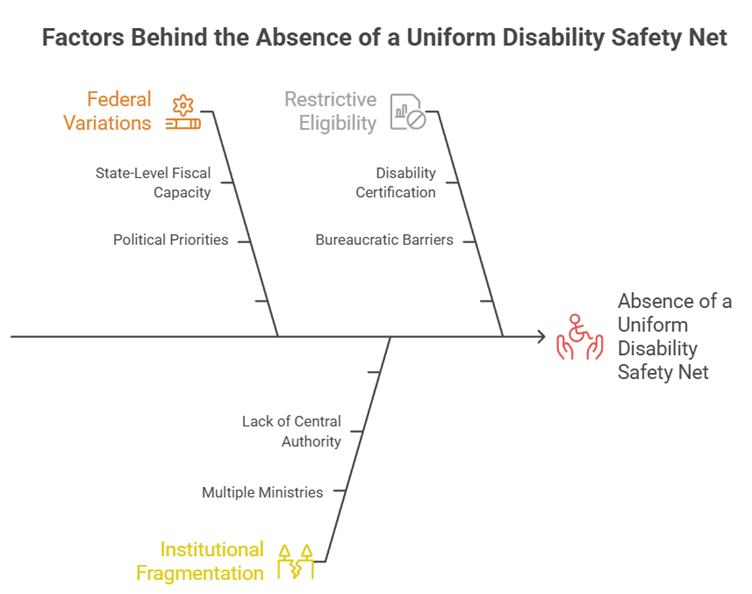
I. Structural and Institutional Factors Behind the Absence of a Uniform Disability Safety Net
1. Federal Variations and Fragmented Welfare Design
- Disability pensions are largely determined by State-level fiscal capacity, political priorities and administrative discretion, resulting in substantial interstate disparities in eligibility criteria and benefit amounts.
- Unlike nationally standardized welfare programmes such as PM-KISAN, National Food Security Act, or Ayushman Bharat, disability support lacks a universally applicable entitlement framework.
- Example: Pension amounts vary widely across States, creating a situation where the level of support received by a disabled citizen depends significantly on geographical location rather than uniform citizenship rights.
2. Institutional Fragmentation and Diffused Accountability
- Responsibility for disability welfare is divided among multiple ministries and departments, creating overlaps, delays and weak coordination.
- Absence of a dedicated national authority limits uniform beneficiary identification, grievance redressal, portability and monitoring.
- Case Study: South African Social Security Agency (SASSA) demonstrates how a centralized institution can ensure nationally consistent disability grants and streamlined administration.
3. Restrictive Eligibility and Bureaucratic Barriers
- Access often depends on disability certification, income thresholds, domicile requirements and repeated documentation processes.
- Many persons with severe disabilities face difficulties in obtaining certificates due to inaccessible healthcare facilities and procedural complexities.
- Example: Rural beneficiaries frequently encounter challenges in reaching designated medical boards, resulting in exclusion despite genuine eligibility.
II. Socio-Economic and Governance Challenges Limiting Disability Inclusion
1. Historical Underinvestment in Disability Welfare
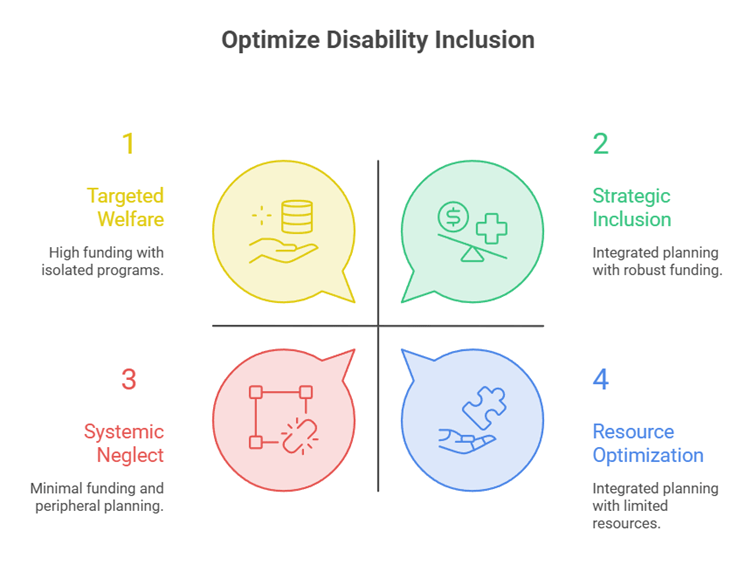
- Public expenditure on disability-related welfare remains a small fraction of total social sector spending, reflecting the relatively low policy salience of disability issues.
- Disability support is often viewed through a welfare or charity lens rather than as a rights-based developmental investment.
- Example: Several middle-income countries devote significantly higher proportions of public resources to disability support, enabling stronger income security systems.
2. Weak Integration of Disability within Development Planning
- Policy discourse has traditionally prioritized poverty, food security, health and employment, while disability concerns often remain peripheral.
- Disability intersects with poverty, education, gender, ageing and employment, yet welfare programmes frequently address these dimensions in isolation.
- Case Study: Brazil’s Benefício de Prestação Continuada (BPC) integrates disability income support within broader social protection architecture, reducing exclusion risks.
3. Persistent Socio-Economic Vulnerabilities of PwDs
- Persons with disabilities face lower educational attainment, higher unemployment and greater healthcare expenditures, increasing dependence on social security.
- Families often experience reduced earning capacity because caregivers must devote substantial time to care responsibilities.
- Example: Households with severely disabled members frequently incur recurring expenditure on assistive devices, rehabilitation and transportation, intensifying economic vulnerability.
III. Why Technological Capability Alone Has Not Delivered a Uniform National Safety Net
1. Technology Solves Delivery Problems, Not Policy Gaps
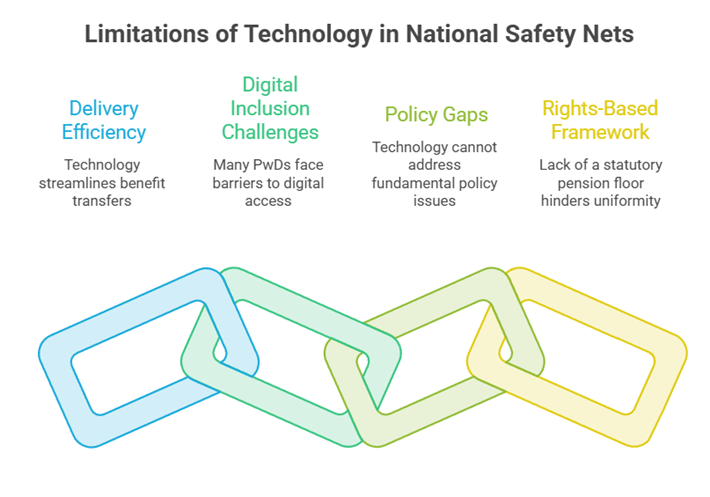
- Platforms such as Aadhaar-enabled DBT, Jan Dhan accounts, and UPI efficiently transfer benefits once beneficiaries are identified and entitlements are defined.
- However, digital infrastructure cannot compensate for the absence of a nationally guaranteed pension floor or harmonized eligibility standards.
- Example: India successfully delivers subsidies and welfare payments at scale, yet disability pensions remain inconsistent because the underlying entitlement framework itself is fragmented.
2. Digital Inclusion Does Not Automatically Ensure Disability Inclusion
- Many PwDs continue to face barriers related to accessibility, digital literacy, assistive technologies and physical access to service centres.
- The digital divide is often compounded by educational disadvantages, poverty and rural isolation.
- Case Study: Accessible India Campaign (Sugamya Bharat Abhiyan) highlighted the importance of combining digital accessibility with physical and institutional accessibility for meaningful inclusion.
3. Absence of a Rights-Based National Disability Income Framework
- While technology enables efficient welfare delivery, the lack of a statutory Minimum Universal Disability Pension Floor Rate (MUDPFR) prevents uniform protection.
- Existing arrangements provide support as a discretionary welfare measure rather than a guaranteed social protection entitlement.
- Example: Countries such as Australia, New Zealand and South Africa combine nationwide disability pension frameworks with digital administration, ensuring both efficiency and uniformity.
Conclusion:
- India possesses one of the world’s most sophisticated welfare delivery ecosystems, capable of reaching hundreds of millions of beneficiaries through digital platforms. Yet the challenge facing persons with disabilities is not primarily technological but institutional, fiscal and normative.
- Establishing a national disability pension floor, creating a National Disability Pension Authority, ensuring portability, strengthening employment-linked support, and embedding disability within a rights-based social protection framework would transform welfare from fragmented assistance into a guarantee of dignity.
- As global evidence increasingly demonstrates that investments in disability inclusion generate substantial social and economic returns, a uniform national safety net would not only advance equality and constitutional justice but also contribute to broader human development and inclusive growth.