


Introduction:
- Gig and platform workers are individuals who earn livelihoods through digital intermediaries that connect service providers with consumers on a task-by-task basis. India has emerged as one of the world’s largest gig economies, with government estimates projecting the gig workforce to expand from around 7 million workers in 2020-21 to over 23 million by 2029-30, accounting for a significant share of non-agricultural employment.
- While the Code on Social Security, 2020 was the first legislation to formally recognize gig workers and platform workers, the accompanying Rules continue to exhibit important administrative and legal shortcomings, leaving a large segment of workers vulnerable within the broader unorganized sector.
Body:
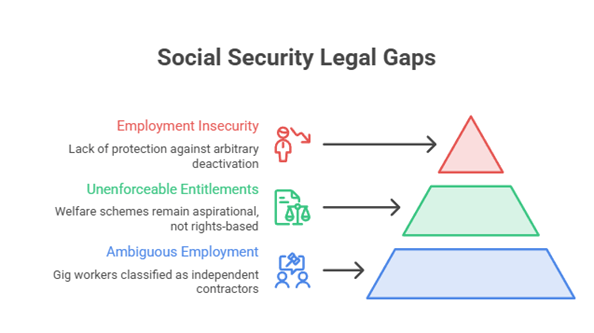
I. Legal Gaps in the Social Security Framework
1. Ambiguous Employment Relationship and Worker Classification
- The Code recognizes gig and platform workers but does not clearly define the nature of the employment relationship, thereby continuing to classify them largely outside the ambit of formal employer-employee arrangements.
- This ambiguity allows digital platforms to treat workers as independent contractors, limiting access to benefits such as provident fund, paid leave, maternity protection, compensation for workplace injuries, and collective bargaining rights.
- Example: Delivery personnel associated with food-delivery and e-commerce platforms often face account deactivation and algorithmic penalties without the protections available to regular employees.
2. Absence of Enforceable Social Security Entitlements
- While the Code envisages welfare schemes relating to life insurance, disability cover, health benefits and old-age protection, the Rules do not establish legally enforceable minimum entitlements.
- Most benefits remain dependent on future scheme notifications, resulting in a welfare framework that is largely aspirational rather than rights-based.
- Case Study: Several platform workers affected during the COVID-19 pandemic lacked income security despite performing essential services, highlighting the consequences of inadequate statutory protection.
3. Weak Protection Against Employment Insecurity
- The Rules do not address issues such as arbitrary deactivation of worker accounts, unfair algorithmic ratings, income volatility, or platform-driven work allocation practices.
- There is no comprehensive grievance redress mechanism specifically designed for digital labour platforms.
- Example: Ride-hailing drivers frequently report sudden changes in incentive structures and commissions, affecting earnings without prior consultation or legal recourse.
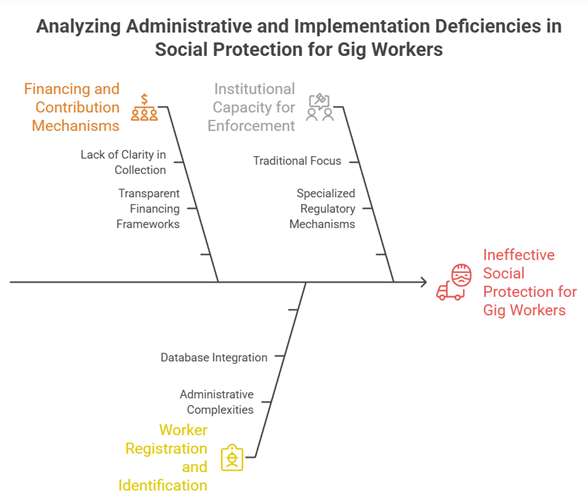
II. Administrative and Implementation Deficiencies
1. Inadequate Financing and Contribution Mechanisms
- Although the Code provides for contributions from aggregators, the Rules lack clarity regarding collection mechanisms, fund management structures, and benefit distribution procedures.
- Absence of transparent financing frameworks creates uncertainty regarding the sustainability of social security schemes.
- Government Initiative: The proposed National Social Security Board for Gig and Platform Workers is expected to play a coordinating role, but operational details remain limited.
2. Challenges in Worker Registration and Identification
- Effective social protection requires accurate identification of beneficiaries; however, many workers operate across multiple platforms and locations, creating administrative complexities.
- The Rules provide limited guidance on integrating databases, updating employment records, and ensuring portability of benefits across platforms.
- Example: A worker simultaneously engaged with ride-sharing, food delivery, and freelance services may face difficulties in establishing contribution histories and eligibility for benefits.
3. Limited Institutional Capacity for Enforcement
- Labour administration in India has traditionally focused on conventional employer-employee relationships, whereas platform work requires specialized regulatory mechanisms.
- The Rules do not adequately specify inspection systems, compliance monitoring frameworks, or digital auditing procedures for platform companies.
- Case Study: International experiences in jurisdictions such as the European Union demonstrate that effective platform regulation requires dedicated oversight mechanisms and algorithmic transparency standards.
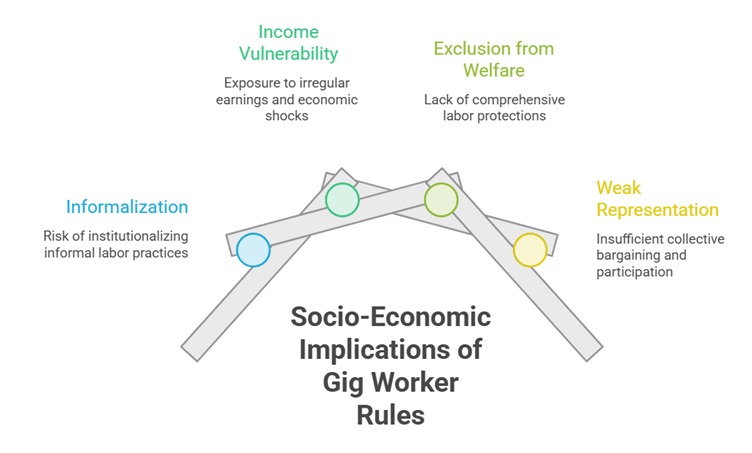
III. Socio-Economic Implications and Need for Stronger Safeguards
1. Persistence of Informalization and Income Vulnerability
- By continuing to treat gig workers as part of the unorganized workforce, the Rules risk institutionalizing labour market informality rather than facilitating formalization.
- Workers remain exposed to irregular incomes, absence of pension coverage, and limited protection against economic shocks.
- Example: Seasonal fluctuations in demand significantly affect earnings of delivery personnel and app-based drivers, often without any minimum income guarantee.
2. Exclusion from Comprehensive Labour Welfare Protections
- Existing protections concerning occupational safety, maternity benefits, disability compensation, and retirement security remain fragmented.
- Platform workers engaged in physically demanding occupations face substantial occupational risks without adequate insurance coverage.
- Case Study: Road accidents involving app-based delivery workers have highlighted the need for universal accident insurance and compensation mechanisms independent of platform discretion.
3. Weak Collective Representation and Voice Mechanisms
- The Rules do not sufficiently strengthen collective bargaining rights or worker participation in decision-making processes affecting remuneration and working conditions.
- Digital labour platforms often operate through algorithmic management systems that reduce opportunities for worker consultation.
- Government Initiative: The e-Shram Portal, which has registered hundreds of millions of unorganized workers, provides an important database foundation but requires integration with platform-specific welfare mechanisms to become truly effective.
- Example: Emerging associations of app-based workers in major metropolitan cities have repeatedly demanded transparent fare-setting and social security protections, reflecting the growing need for institutionalized worker representation.
Conclusion:
- The Code on Social Security, 2020 marked a significant shift by formally recognizing gig and platform workers within India’s labour law architecture. However, the accompanying Rules continue to suffer from ambiguities in worker classification, weak enforcement mechanisms, absence of guaranteed entitlements, inadequate financing structures, and limited protection against algorithmic and contractual vulnerabilities.
- As India’s gig workforce is expected to exceed 23 million workers by the end of the decade, a robust framework incorporating universal social protection, portable benefits, contributory welfare funds, algorithmic accountability, effective grievance redressal, and stronger worker representation will be essential for ensuring inclusive growth and realizing the objective of decent work in the digital economy.