
Introduction:
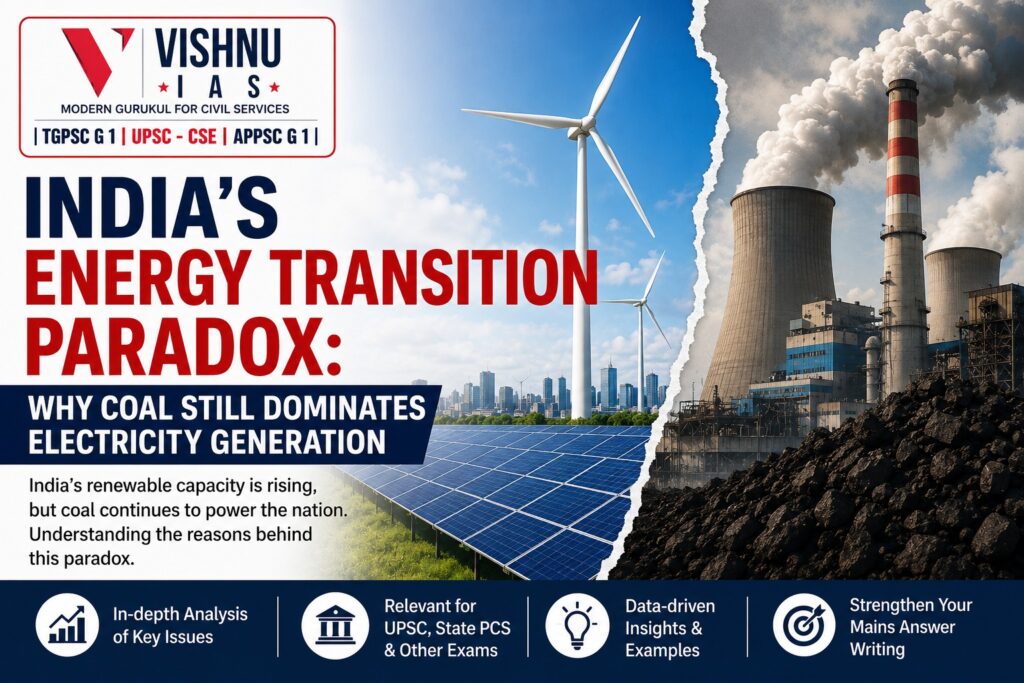
- India’s energy transition presents a striking paradox: while the country has emerged as one of the world’s fastest-growing renewable energy markets, coal continues to dominate actual electricity generation. By March 2026, renewable energy accounted for nearly 42% of installed power capacity, compared to coal’s 42.2%, reflecting major expansion in solar and wind infrastructure.
- However, in real electricity generation, coal still contributes nearly 72% of power output, whereas renewables account for only around 16%, revealing a significant gap between installed capacity and effective generation.
- This contradiction highlights the structural reality of India’s energy system, where concerns of energy security, baseload reliability, industrial demand, grid stability and affordability continue to sustain coal dependence despite rapid renewable expansion. The paradox therefore reflects not a failure of transition, but the complexity of transforming a large developing economy’s power architecture.
Body:
1. Structural and Technical Reasons Behind Continued Coal Dominance
(a) Intermittency of Renewable Energy and Baseload Dependence
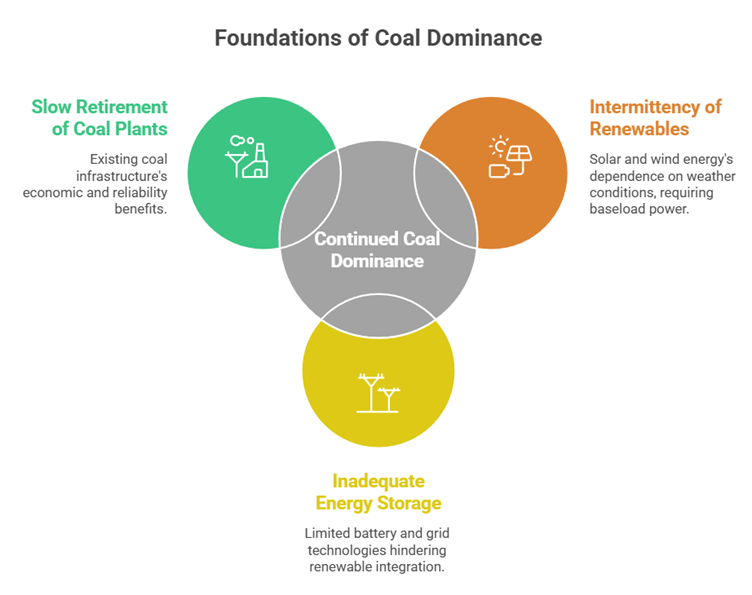
- Solar and wind energy are intermittent sources, dependent on sunlight intensity, seasonal variation and wind speeds, whereas electricity demand remains continuous across households, industries and services.
- Coal plants continue to provide baseload power, ensuring uninterrupted supply during evenings, monsoon periods and peak demand hours when renewable output declines sharply.
- Example – Rajasthan and Gujarat Solar Corridors: Despite massive solar generation during daytime, coal-based plants in Chhattisgarh and Odisha continue operating to stabilise the national grid during non-solar hours.
(b) Inadequate Energy Storage and Grid Flexibility
- India’s transition remains constrained by the limited availability of large-scale battery storage systems, pumped hydro storage and smart grid technologies required for renewable integration.
- Without adequate storage, surplus renewable electricity generated during peak solar hours cannot be efficiently stored for later use, forcing reliance on thermal plants.
- Government Initiative – National Green Hydrogen Mission: The mission seeks long-term storage and balancing solutions through green hydrogen production, but commercial scalability remains at an early stage.
- Case Study – California Energy Crisis Lessons: Global experiences show that rapid renewable addition without sufficient storage and grid balancing can increase vulnerability to power disruptions.
(c) Slow Retirement of Existing Coal Infrastructure
- India has added very little new fossil fuel capacity since 2018, yet older coal plants remain operational because they represent massive sunk investments and continue supplying affordable electricity.
- Public sector utilities and state distribution companies depend heavily on coal-based infrastructure due to concerns regarding energy reliability and financial viability.
- Coal also supports India’s broader industrial ecosystem, including rail freight revenue, mining employment, steel and cement production, making abrupt phase-out economically disruptive.
- Example – Singrauli Coal Belt: Thermal power complexes continue functioning as critical industrial-energy hubs despite renewable expansion elsewhere.
2. Economic and Developmental Drivers Sustaining Coal Dependence
(a) Rising Energy Demand from Rapid Economic Growth
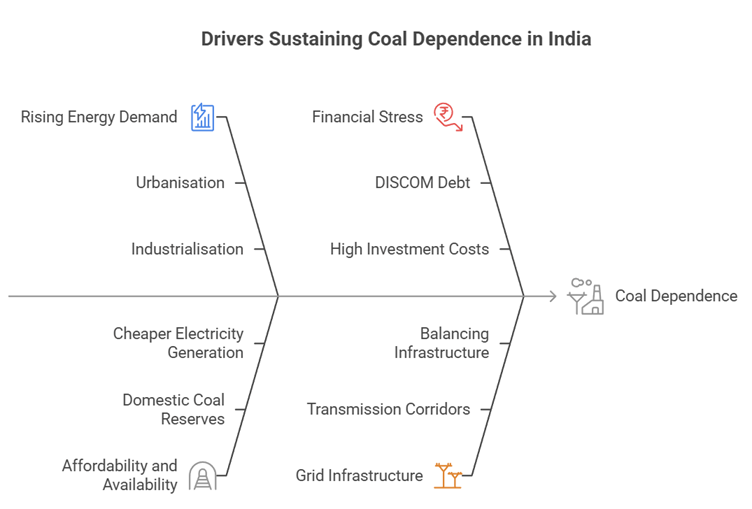
- India’s electricity demand continues to rise due to urbanisation, industrialisation, digitalisation, electric mobility and rising household consumption, making energy transition more complex than in mature economies with stagnant demand.
- Renewables are currently being added alongside coal rather than replacing it, because total energy demand is expanding faster than renewable substitution capacity.
- Example – Data Centres and Manufacturing Corridors: Growth in semiconductor manufacturing, AI infrastructure and industrial corridors under schemes like Make in India requires continuous high-quality electricity supply that coal currently guarantees.
(b) Coal Remains Relatively Affordable and Domestically Available
- India possesses the world’s fourth-largest coal reserves, making coal strategically important for reducing excessive dependence on imported fuels.
- Domestic coal continues to offer relatively cheaper electricity generation compared to imported LNG-based generation, particularly during periods of geopolitical instability and fuel price spikes.
- Example – Russia-Ukraine Conflict and West Asian Tensions: Global fossil fuel price volatility sharply increased LNG and crude prices, reinforcing India’s preference for domestically sourced coal for energy security.
(c) Financial Stress in the Power Sector
- State electricity distribution companies (DISCOMs) continue facing high debt burdens, limiting investments in advanced renewable integration technologies and grid modernisation.
- Coal plants already connected to the grid often remain economically preferable because renewable transition requires major investments in transmission corridors, balancing infrastructure and storage systems.
- Renewable curtailment also occurs when grid operators prioritise stable thermal generation to avoid voltage instability.
- Scheme – Revamped Distribution Sector Scheme (RDSS): Aims to improve DISCOM efficiency, smart metering and financial sustainability to support cleaner power integration.
3. Policy, Geopolitical and Institutional Dimensions of the Paradox
(a) Installed Capacity Metrics versus Actual Generation Reality
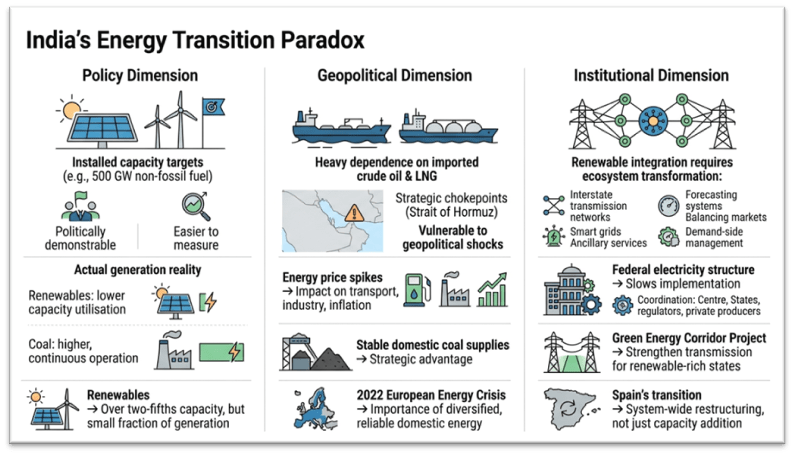
- Policy discourse has often focused on headline renewable capacity targets, such as achieving 500 GW non-fossil fuel capacity, because capacity addition is easier to measure and politically demonstrable.
- However, installed capacity does not necessarily translate into actual electricity generation because renewable plants operate at lower capacity utilisation factors (CUF) compared to coal plants.
- Coal plants may run continuously for long durations, while solar operates only during daylight hours and wind generation fluctuates seasonally.
- Example – Capacity-Generation Gap: Renewables may constitute over two-fifths of installed capacity but contribute only a fraction of total generated electricity.
(b) Energy Security Concerns and External Vulnerabilities
- India remains heavily dependent on imported crude oil and LNG, with a substantial portion transiting through strategic chokepoints such as the Strait of Hormuz, exposing the economy to geopolitical shocks.
- Energy price spikes directly affect transportation costs, fertiliser production, industrial output, inflation and fiscal balances, making stable domestic coal supplies strategically attractive.
- Case Study – 2022 European Energy Crisis: Europe’s overdependence on imported gas highlighted the importance of diversified and reliable domestic energy systems.
(c) Institutional and Infrastructure Transition Challenges
- Renewable integration requires transformation of the entire electricity ecosystem, including:
- interstate transmission networks,
- smart grids,
- forecasting systems,
- balancing markets,
- ancillary services and
- demand-side management.
- India’s federal electricity structure, involving coordination among the Centre, States, regulators and private producers, slows implementation.
- Government Initiative – Green Energy Corridor Project: Designed to strengthen transmission infrastructure for renewable-rich States like Rajasthan, Gujarat and Tamil Nadu.
- Example – Spain’s Renewable Transition: Spain successfully reduced dependence on gas-linked electricity pricing through integrated storage, transmission reforms and market redesign, illustrating that renewable transition requires system-wide restructuring rather than only capacity addition.
Conclusion:
- India’s energy transition is real but remains structurally incomplete. The persistence of coal dominance despite rapid renewable expansion reflects the fundamental distinction between capacity creation and system transformation. Coal continues to provide reliability, affordability and grid stability in an economy experiencing one of the world’s fastest-growing energy demands.
- The next phase of transition must therefore move beyond symbolic capacity targets toward building a resilient low-carbon electricity architecture through battery storage expansion, smart grids, flexible thermal operations, green hydrogen, transmission modernisation and DISCOM reforms. India’s long-term objective is not merely adding green energy, but enabling renewables to reliably substitute fossil fuels in actual generation.
- With sustained investment and institutional coordination, India can gradually reconcile its developmental needs with climate commitments while enhancing both energy security and economic resilience in an increasingly volatile geopolitical environment.