

Introduction:
- Cyber warfare refers to the use of digital technologies, malicious cyber operations, and information systems to disrupt, damage, manipulate, or gain strategic advantage over another state or entity. In contemporary conflicts, cyber operations increasingly operate alongside conventional military force, targeting communication systems, energy grids, financial infrastructure, defence networks, satellite systems, and public information ecosystems before or during kinetic attacks.
- According to recent global cybersecurity assessments, cyberattacks on critical infrastructure and state institutions have risen sharply, with sectors such as healthcare, energy, banking, and governance becoming primary targets during geopolitical conflicts.
- The World Economic Forum’s Global Risks Report has identified cyber insecurity among the most severe global risks over the coming decade, while the UN Open-Ended Working Group on ICT Security has acknowledged cyberspace as a domain increasingly linked to international peace and security. Conflicts involving the Russia–Ukraine war, the Israel–Iran confrontation, and cyber operations attributed to state-backed groups demonstrate how digital disruption has become an integral component of modern warfare.
Body:
1. Interlinkage Between Cyber Warfare and Conventional Military Force
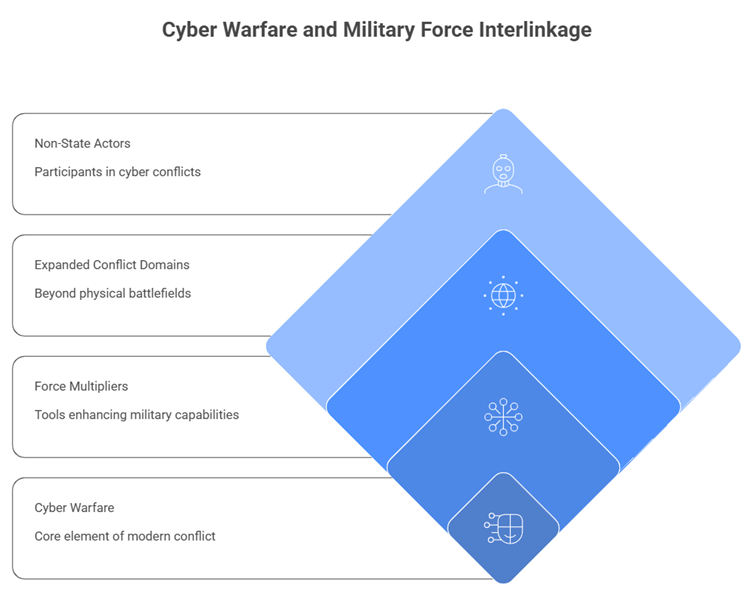
(a) Cyber Operations as Force Multipliers in Modern Warfare
- Modern militaries increasingly use cyber tools to weaken adversaries before conventional strikes by disrupting air defence systems, military communications, GPS networks, logistics chains, and surveillance systems, thereby creating tactical advantages on the battlefield.
- The emergence of hybrid warfare has blurred the distinction between peace and war, where cyberattacks, disinformation campaigns, economic coercion, and military operations occur simultaneously without formal declarations of war.
- Example – Russia–Ukraine Conflict: Cyberattacks on Ukrainian government portals, power infrastructure, and satellite communication systems preceded or accompanied conventional military operations, illustrating the integration of cyberspace into strategic warfare.
(b) Expansion of Conflict Beyond Physical Battlefields
- Cyber warfare enables conflicts to extend into civilian and transnational domains, affecting banks, hospitals, media organisations, transport systems, and public utilities, thereby increasing civilian vulnerability without direct physical confrontation.
- State and non-state actors use ransomware, malware, phishing, and data manipulation to influence public morale, create panic, and destabilise governance systems.
- Case Study – Colonial Pipeline Attack (United States): A ransomware attack disrupted fuel supplies across major U.S. regions, highlighting how cyber operations can create economic and social disruption comparable to traditional attacks on infrastructure.
(c) Rise of Non-State and Proxy Actors in Cyber Conflicts
- Unlike traditional warfare dominated by state militaries, cyberspace enables participation by hacktivist groups, proxy networks, cyber mercenaries, and anonymous hacker collectives, complicating accountability and escalation control.
- States increasingly rely on plausible deniability, covert support, or indirect sponsorship of cyber groups to achieve strategic objectives while avoiding direct legal responsibility.
- Example – Stuxnet Operation: The cyber sabotage of Iran’s Natanz nuclear facility demonstrated how covert cyber tools can achieve strategic military objectives without overt armed conflict.
2. Challenges Posed to International Law by Cyber Warfare
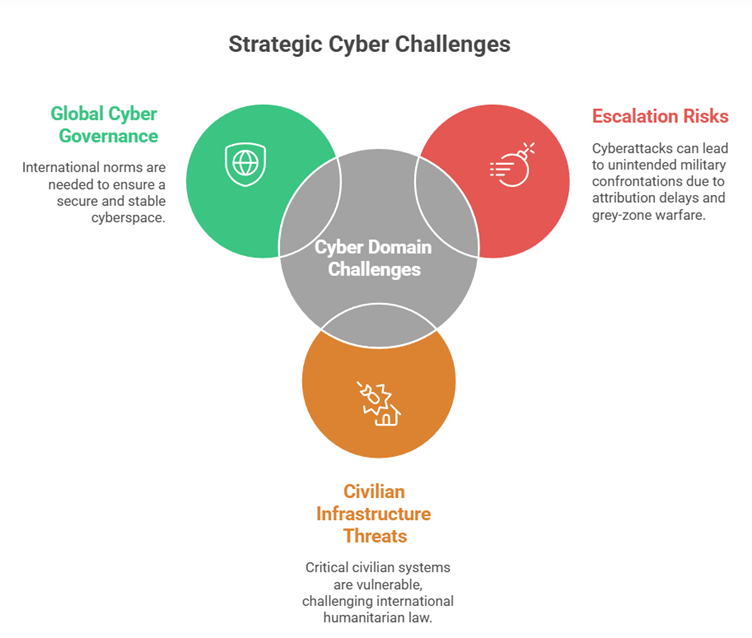
(a) Difficulty in Applying Existing Legal Principles
- International law, particularly Article 2(4) of the United Nations Charter, prohibits the use of force against the territorial integrity or political independence of states. However, determining whether a cyberattack qualifies as a “use of force” remains legally ambiguous.
- Cyber operations may cause severe disruption without physical destruction, making it difficult to establish whether they amount to an armed attack warranting self-defence under Article 51 of the UN Charter.
(b) Attribution and Evidentiary Challenges
- Cyber operations are often routed through multiple servers, jurisdictions, and anonymised networks, making technical attribution highly difficult even when intelligence agencies suspect state involvement.
- International legal accountability requires a high standard of evidence, but cyber operations involve: encrypted communication, hidden malware signatures, proxy actors, covert intelligence sources.
- This creates a gap between political attribution and legal attribution, limiting the ability of states to seek remedies through international judicial mechanisms.
- Example – Sony Pictures Cyberattack (2014): Although the United States attributed the attack to North Korea, establishing internationally admissible proof remained contentious.
(c) Inadequacy of Existing International Legal Institutions
- Current international legal mechanisms were largely designed for conventional interstate conflicts and are poorly adapted to cyber warfare’s speed, anonymity, and transnational character.
- International courts such as the International Court of Justice require state consent, limiting adjudication of cyber disputes.
- Existing frameworks such as the Budapest Convention on Cybercrime primarily address cybercrime and law enforcement cooperation rather than interstate cyber warfare and geopolitical cyber operations.
3. Strategic, Ethical and Governance Challenges in the Cyber Domain
(a) Escalation Risks and Strategic Instability
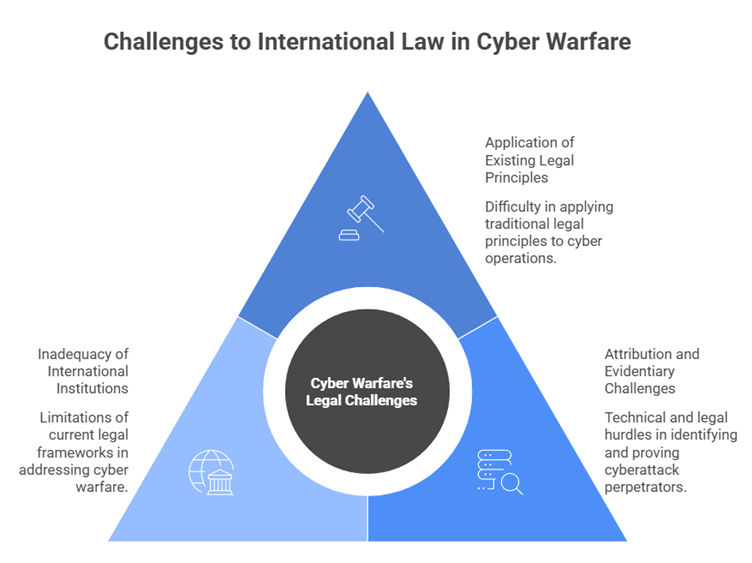
- Cyberattacks can unintentionally escalate into broader military confrontations because attribution delays and uncertainty may trigger retaliatory responses based on incomplete information.
- The low cost and high deniability of cyber operations encourage states to engage in grey-zone warfare, operating below the threshold of conventional armed conflict while still inflicting strategic damage.
- Cyber operations targeting nuclear command systems, satellites, or military communications raise concerns regarding accidental escalation and strategic miscalculation.
- Example – Israel–Iran Cyber Exchanges: Cyber operations targeting infrastructure and communication systems have increasingly accompanied regional military tensions, reflecting the fusion of cyber and conventional deterrence strategies.
(b) Threats to Civilian Infrastructure and Human Security
- Critical civilian infrastructure has become highly vulnerable due to growing digital dependence across sectors such as: energy, healthcare, transport, finance, governance.
- Cyberattacks on civilian systems challenge principles of international humanitarian law, particularly: distinction between civilian and military targets, proportionality, protection of non-combatants.
- Case Study – WannaCry Ransomware Attack: The attack disrupted healthcare systems globally, including hospitals and emergency services, demonstrating how cyber operations can directly threaten human security.
- The increasing weaponisation of misinformation, deepfakes, and information warfare further undermines democratic institutions and public trust.
(c) Need for Global Cyber Governance and India’s Role
- The evolving cyber threat landscape requires development of internationally accepted norms regarding: responsible state behaviour, cyber deterrence, attribution standards, protection of critical infrastructure.
- India’s rapid digital transformation through initiatives such as: Digital India, Unified Payments Interface (UPI), Aadhaar-enabled governance, expanding digital public infrastructure, has increased both strategic opportunities and vulnerabilities.
- India has strengthened cyber governance through: the Indian Computer Emergency Response Team, the National Cyber Security Policy, establishment of the Defence Cyber Agency, cyber audit and data protection measures.
- India increasingly advocates for a secure, open, stable, accessible, and rules-based cyberspace while participating in UN-led discussions on cyber norms and responsible state conduct.
- Example – AIIMS Cyberattack (2022): The attack on critical health databases highlighted vulnerabilities in public digital infrastructure and the importance of cyber resilience for national security.
Conclusion:
- The growing convergence of cyber warfare and conventional military force marks a profound transformation in the nature of conflict, where battles are increasingly fought simultaneously across physical and digital domains. While existing international legal principles technically extend to cyberspace, practical challenges involving attribution, jurisdiction, evidentiary standards, state responsibility, and enforcement have created a widening gap between legal norms and operational realities.
- As global dependence on digital infrastructure deepens, the need for credible international cyber governance frameworks has become urgent. Strengthening international cooperation, developing universally accepted cyber norms, enhancing resilience of critical infrastructure, and improving mechanisms for accountability will be essential to preserving international peace and stability.
- With one of the world’s fastest-growing digital ecosystems and expanding strategic influence, India is well positioned to play a constructive role in shaping an equitable, secure, and rules-based cyber order capable of addressing the complexities of twenty-first century conflict