
Introduction:
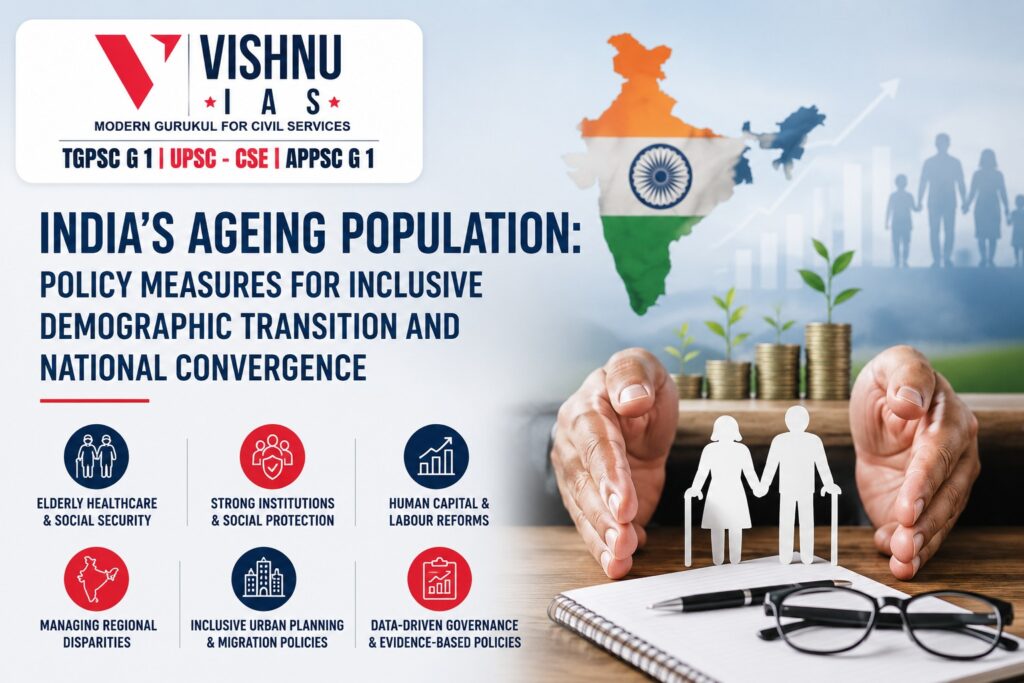
- Population ageing refers to the increasing proportion of elderly persons (60+ years) in the total population due to sustained decline in fertility, falling mortality, and rising life expectancy. India has entered an advanced stage of the demographic transition, marked by a Total Fertility Rate (TFR) of 1.9, below the replacement level of 2.1, a declining Crude Birth Rate, and rising life expectancy (~72 years).
- Simultaneously, India still retains a significant demographic dividend, with nearly 65% of its population below 35 years and a median age of about 29 years, creating a narrow but critical policy window. The challenge, therefore, is dual: preparing for a future ageing society while addressing regional and socio-economic disparities to ensure national convergence and balanced development.
Body:
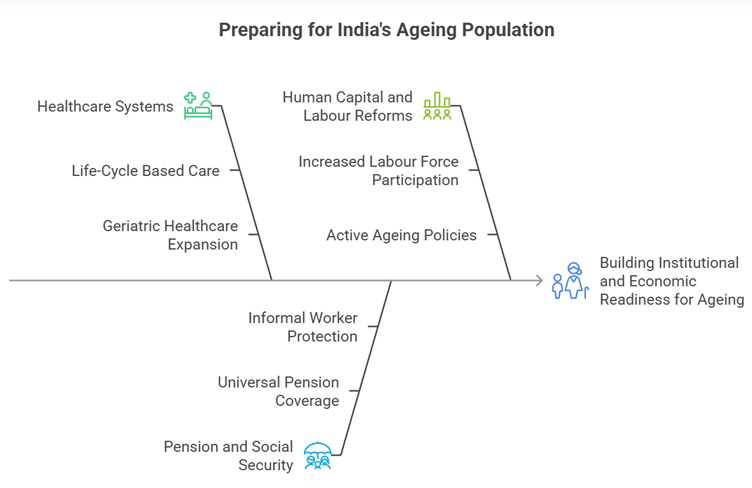
I. Preparing for a Future Ageing Population: Building Institutional and Economic Readiness
1. Strengthening elder-care systems and healthcare infrastructure
- India must transition from a disease-focused health model to a life-cycle based care model, emphasizing geriatric healthcare, preventive screening, and long-term care services. Expansion of geriatric wards under Ayushman Bharat Health and Wellness Centres can improve elderly access, especially in underserved districts.
- Example: Japan’s Long-Term Care Insurance (LTCI) model demonstrates how publicly financed eldercare can reduce household burdens while ensuring dignity in ageing.
- Government initiative: The National Programme for Health Care of the Elderly (NPHCE) needs wider district-level coverage, with trained geriatric specialists and digital telemedicine support.
2. Reforming pension and social security systems
- A shrinking working-age population will increase the old-age dependency ratio, demanding robust universal pension coverage, especially for informal workers who constitute nearly 90% of India’s workforce.
- Expansion of contributory and portable pension models such as Atal Pension Yojana and wider integration with e-Shram can protect vulnerable elderly populations.
- Case Study: Kerala’s relatively strong social pension ecosystem has helped reduce elderly poverty and can inform broader national replication.
3. Extending the demographic dividend through human capital and labour reforms
- India must avoid “growing old before becoming rich” by increasing labour force participation, especially among women, whose participation remains significantly below global averages.
- Policies should promote active ageing, including phased retirement, re-skilling older workers, and silver economy sectors such as eldercare technology and wellness services.
- Example: Singapore’s SkillsFuture model incentivizes lifelong learning and could inform India’s strategy for ageing workers.
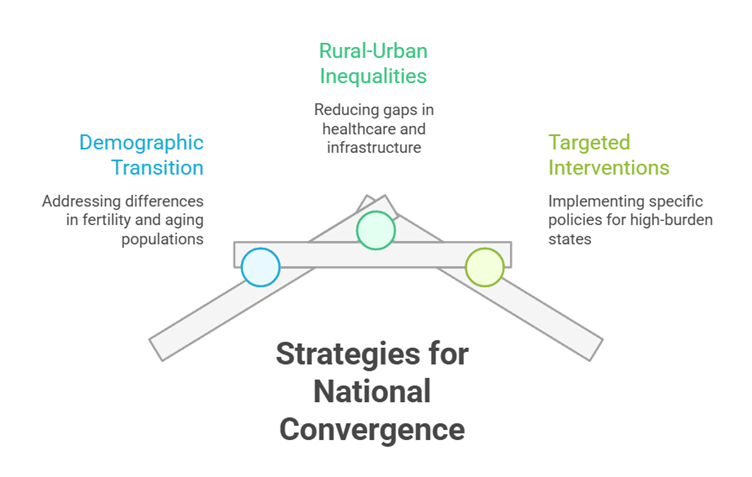
II. Managing Regional Disparities for National Convergence
1. Addressing north-south demographic divergence
- Southern states have entered advanced demographic transition with low fertility and ageing populations, while several northern states still face relatively high fertility and weaker human development indicators.
- This creates risks of inter-state economic imbalance, political tensions over resource allocation, and labour migration stress.
- Case Study: Tamil Nadu’s fertility decline combined with strong public health investment contrasts with Bihar’s higher fertility and weaker health outcomes, illustrating unequal transition stages.
2. Reducing rural-urban inequalities
- Rural India continues to face gaps in maternal health, child survival, and healthcare access, despite overall national improvements.
- Strengthening primary healthcare, transport connectivity, and digital health access through telemedicine platforms can reduce service deficits.
- Government initiative: Expansion of PM Ayushman Bharat Digital Mission can help bridge urban-rural healthcare asymmetry.
3. Targeted interventions in high-burden states
- States with higher Infant Mortality Rate (IMR) and weaker social indicators require differentiated policy design rather than uniform national schemes.
- Focus areas include maternal nutrition, girls’ education, reproductive health awareness, and local health workforce expansion.
- Example: Odisha’s focused maternal-child health interventions significantly reduced infant mortality over the past decade, showing the value of state-specific policy targeting.
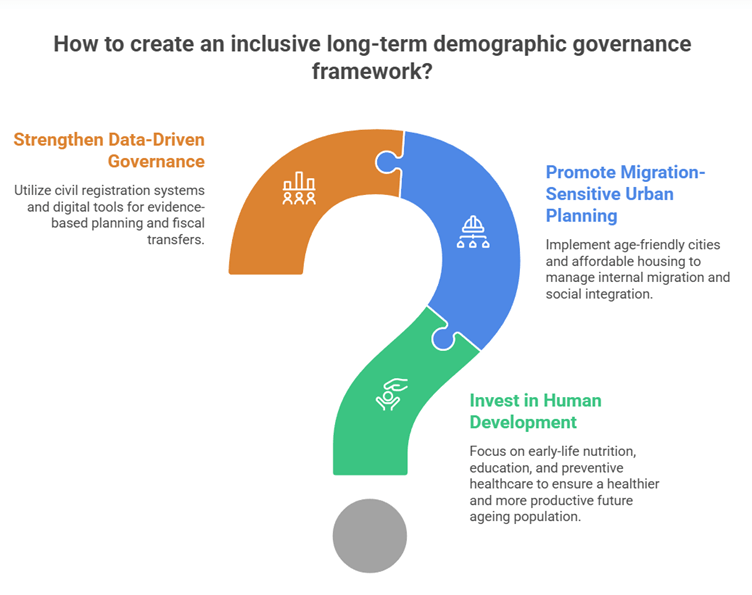
III. Creating an Inclusive Long-Term Demographic Governance Framework
1. Investing in human development from early life to old age
- Demographic transition must be managed through a life-course approach, beginning with child nutrition and education and extending to healthy ageing.
- Continued investment in Poshan 2.0, school education quality, and preventive healthcare ensures that future ageing populations remain healthier and more productive.
- Case Study: Nordic countries demonstrate that early-life investments reduce long-term welfare burdens in ageing societies.
2. Promoting migration-sensitive and urban planning policies
- Internal migration from younger northern states to ageing southern states can partly offset labour shortages but requires better urban planning, affordable housing, and social integration mechanisms.
- Planned urbanisation must include age-friendly cities, barrier-free infrastructure, and accessible public transport.
- Example: WHO’s Age-Friendly Cities Framework provides a useful template for Indian urban centres.
3. Strengthening data-driven federal governance
- Dynamic demographic change requires regular evidence-based planning through better use of civil registration systems, district-level demographic data, and interoperable digital governance tools.
- States should be incentivised through outcome-based fiscal transfers linked to health and demographic performance.
- Government initiative: Greater integration of Sample Registration System, NFHS, and digital population databases can support anticipatory governance
Conclusion:
- India’s demographic story is shifting from one of population expansion to one of population management. While the country still possesses a substantial youth advantage, the window to convert it into sustained prosperity is narrowing.
- A calibrated strategy combining productive youth investment, elderly welfare preparedness, and targeted support for lagging regions can transform demographic transition into demographic resilience. If India acts now with cooperative federalism, human-capital investment, and inclusive social protection it can ensure that an ageing future becomes not a crisis, but an opportunity for equitable and sustainable national development.