

Introduction:
- The emergence of external carbon-compliance regimes such as the European Union’s Carbon Border Adjustment Mechanism (CBAM) marks a structural transformation in global trade governance, where market access is increasingly linked to the carbon intensity of production rather than tariff competitiveness alone.
- CBAM, operational in its definitive phase from January 2026, imposes carbon-linked costs on imports of emission-intensive products such as steel, aluminium, cement, fertilizers, electricity and hydrogen. While the mechanism aims to reduce carbon leakage and advance global climate goals, it creates significant indirect vulnerabilities for developing economies such as India, particularly for the agricultural sector through global price transmission, input inflation, trade disruptions and supply-chain pressures.
- India’s agriculture remains highly sensitive to fertilizer and energy costs, with nearly half of the workforce dependent on agriculture, while fertilizer subsidies continue to constitute a major component of public expenditure. In this context, external carbon-compliance frameworks can influence not only exports but also domestic food prices, farm profitability and long-term food security.
Body:
1. Indirect vulnerabilities faced by India’s agricultural sector under global carbon-compliance regimes
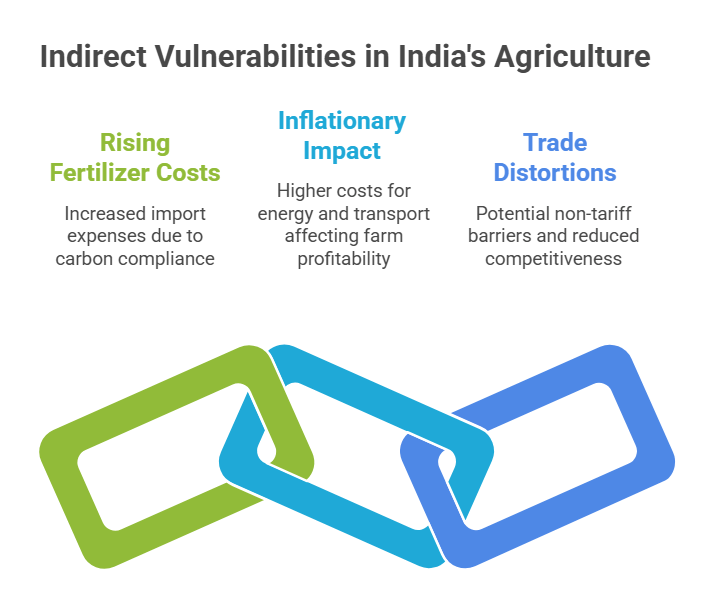
A. Rising fertilizer costs through global price transmission
- India is among the world’s largest importers of urea, DAP and potash, depending heavily on countries such as Russia, Morocco, China and Egypt, many of which are exposed to carbon-compliance costs under CBAM-like frameworks. As exporters incur higher carbon-adjustment expenses, these costs are likely to be transferred globally through higher fertilizer prices, indirectly increasing India’s agricultural input costs.
- Increased fertilizer prices can worsen the already existing imbalance in fertilizer usage, where excessive dependence on subsidized urea and inadequate application of micronutrients have reduced soil productivity. Higher import costs may force reductions in subsidy allocations or increase fiscal stress, ultimately affecting small and marginal farmers disproportionately.
- Example – Global Fertilizer Crisis after the Russia–Ukraine Conflict: The sharp rise in global fertilizer prices during 2022 demonstrated how external geopolitical and regulatory shocks rapidly transmitted into India’s agricultural economy, compelling emergency subsidy increases exceeding ₹2 lakh crore and raising concerns regarding food inflation.
B. Inflationary impact on food prices and farm profitability
- Carbon-compliance measures raise costs not only for fertilizers but also for energy-intensive sectors such as steel, aluminium and transport, which indirectly affect irrigation systems, farm machinery, warehousing and logistics infrastructure. Rising diesel, electricity and transportation costs increase the overall cost of cultivation.
- Since Indian farmers often possess limited bargaining power within agricultural value chains, they may be unable to fully pass increased production costs to consumers. This can compress farm incomes even while retail food inflation rises, producing a dual burden of reduced profitability and declining food affordability.
- Case Study – Impact on Greenhouse and Mechanized Farming: Horticulture clusters dependent on cold chains, greenhouse structures and mechanized irrigation are especially vulnerable because these sectors rely heavily on steel, electricity and energy-intensive inputs likely to become costlier under carbon-linked trade systems.
C. Trade distortions and risks to agricultural competitiveness
- As developed countries increasingly integrate climate standards into trade policy, agricultural exports may also face indirect scrutiny through embedded carbon footprints in supply chains. Products processed using carbon-intensive electricity, transport or fertilizer systems may gradually encounter non-tariff barriers.
- Countries with advanced green technologies and established carbon markets may gain a comparative advantage over developing economies. This could reduce competitiveness for Indian agri-processing industries such as sugar, marine products, processed foods and textiles linked to agriculture.
- Example – Emerging Global Green Standards: Several economies including the United Kingdom and Canada are exploring carbon-border frameworks similar to CBAM, indicating that climate-linked trade regulations may gradually expand beyond industrial sectors into wider supply chains including food systems.
2. Structural challenges for India in balancing green trade transition with food security
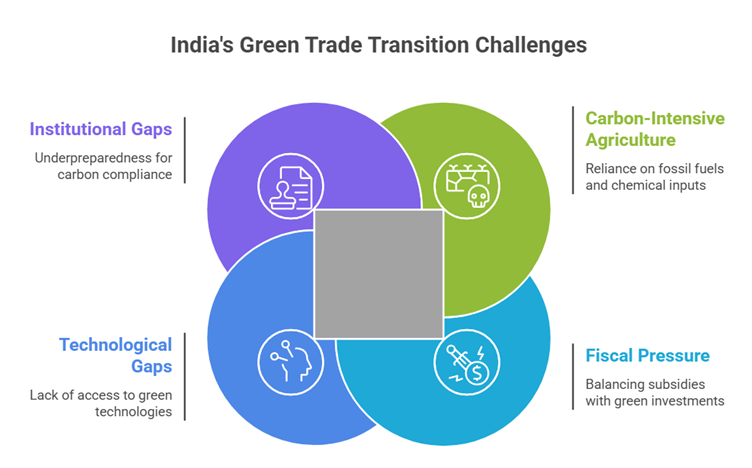
A. High dependence on carbon-intensive agricultural systems
- Indian agriculture remains significantly dependent on chemical fertilizers, groundwater extraction, diesel-powered irrigation and thermal-power-based electricity, making rapid decarbonization economically difficult. Transitioning to low-carbon agriculture requires substantial investments in renewable energy, precision farming and sustainable inputs.
- Small and marginal farmers, constituting nearly 85% of operational holdings, often lack access to affordable green technologies, climate finance and carbon-efficient infrastructure. Without adequate support, compliance pressures may deepen rural inequalities.
- Government Initiative – PM-KUSUM Scheme: The promotion of solar-powered irrigation pumps under the scheme represents an important attempt to reduce fossil-fuel dependence in agriculture while lowering long-term energy costs for farmers.
B. Fiscal pressure on subsidies and welfare systems
- Rising global prices for fertilizers and energy can significantly expand India’s subsidy burden. Maintaining affordable fertilizer access while investing simultaneously in green transitions creates competing fiscal priorities for the government.
- Excessive subsidy expenditure may crowd out investments in agricultural research, irrigation modernization, storage infrastructure and climate-resilient farming systems. This creates a long-term developmental trade-off between immediate affordability and structural sustainability.
- Example – Fertilizer Subsidy Expansion: During periods of global commodity inflation, India has repeatedly increased fertilizer subsidies to shield farmers from price shocks, demonstrating the vulnerability of food systems to external market disruptions.
C. Technological and institutional gaps in green transition
- Carbon-compliance systems require sophisticated carbon accounting, traceability systems, emission reporting and sustainability certification, areas where many Indian MSMEs and agricultural supply chains remain underprepared.
- Lack of access to affordable green technologies such as low-carbon fertilizers, bio-based alternatives and carbon-efficient logistics can constrain India’s ability to transition smoothly without productivity losses.
Case Study – Green Hydrogen Mission: India’s push toward green hydrogen-based fertilizer production seeks to reduce dependence on imported fossil fuels and carbon-intensive ammonia production, but scaling such technologies requires substantial infrastructure and financial support
3. Measures to ensure that India’s green trade transition does not undermine food security
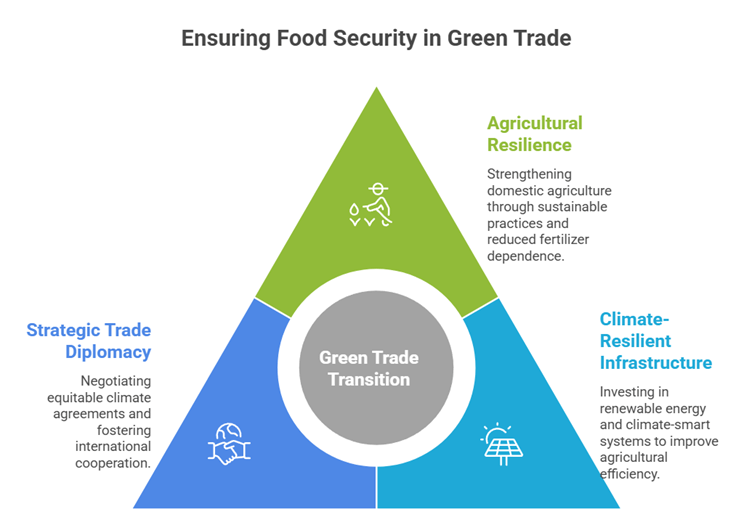
A. Strengthening domestic agricultural resilience and sustainable input systems
- India must reduce excessive dependence on imported fertilizers through expansion of domestic production capacities, promotion of nano urea, biofertilizers and organic nutrient management, and diversification of fertilizer sources. This can reduce exposure to volatile global carbon-compliance costs.
- Improving Soil Health Card Scheme implementation and encouraging balanced nutrient application can reduce fertilizer overuse while maintaining productivity. Precision agriculture and micro-irrigation can further optimize resource efficiency.
- Government Initiative – PM-PRANAM Scheme: The scheme incentivizes States to reduce chemical fertilizer consumption and promote sustainable agricultural practices, helping align agricultural productivity with environmental sustainability.
B. Building climate-resilient and low-carbon agricultural infrastructure
- Accelerated investment in renewable-energy-powered cold chains, climate-smart irrigation systems, decentralized storage and green logistics can reduce embedded carbon emissions while improving agricultural efficiency.
- Expansion of natural farming, agroecology and regenerative agriculture can lower dependence on imported synthetic inputs while improving soil health, water retention and resilience against climate shocks.
- Example – Andhra Pradesh Community Managed Natural Farming: The initiative has demonstrated reduced input costs, improved soil fertility and lower dependence on chemical fertilizers, offering a scalable pathway toward sustainable agriculture.
C. Strategic trade diplomacy and equitable climate negotiations
- India must actively negotiate for differentiated responsibilities, phased compliance timelines and transitional support mechanisms in climate-linked trade agreements to ensure that developing economies are not disproportionately burdened.
- Technology transfer, concessional climate finance and international cooperation on green industrialization are essential to enable developing countries to comply with carbon standards without compromising developmental priorities.
- India can also strengthen South-South cooperation through platforms such as the International Solar Alliance and the Global Biofuels Alliance to create alternative sustainable supply chains and reduce vulnerability to restrictive trade regimes.
Conclusion:
- The rise of carbon-compliance regimes such as CBAM reflects the growing integration of climate governance with international trade architecture. While these mechanisms may accelerate global decarbonization, they also create complex indirect vulnerabilities for India’s agricultural sector through fertilizer inflation, input-cost escalation, supply-chain disruptions and competitive disadvantages.
- For a country where food security, rural livelihoods and agricultural sustainability remain deeply interconnected, the transition toward green trade cannot be pursued through environmental objectives alone.
- India’s response must therefore combine domestic green transformation, resilient agricultural systems, strategic industrial policy and equitable international climate diplomacy. With expanding renewable-energy capacity, increasing investments in sustainable agriculture and growing emphasis on climate-resilient development, India possesses the opportunity to transform carbon-related trade challenges into a pathway for long-term food security, rural resilience and sustainable economic growth