
Introduction:
- Energy resilience refers to the capacity of an economy to withstand, adapt to, and recover from disruptions in energy supply and price volatility while ensuring uninterrupted economic and social functioning. The ongoing instability around the Strait of Hormuz, through which nearly one-fifth of globally traded crude oil passes, has reinforced the reality that energy security is inseparable from geopolitics. For India, which imports nearly 85% of its crude oil requirement and more than half of its natural gas demand, disruptions in West Asia expose structural vulnerabilities across transport, fertilizers, logistics, aviation, manufacturing, and household energy consumption.
- Despite sharp increases in global crude prices, freight costs, marine insurance premiums, and disruptions in LNG trade, India has managed to maintain relative domestic fuel stability through a combination of energy diversification, strategic petroleum reserves, diplomatic engagement, and financial intervention by public sector oil companies. India’s ability to avoid panic and sustain refinery throughput during the crisis demonstrates the growing importance of diversified sourcing and strategic reserves in strengthening national energy resilience.
Body:
· I. Role of Diversification in Strengthening India’s Energy Resilience
1. Diversification of Crude Oil Import Sources Reduces Geopolitical Dependence
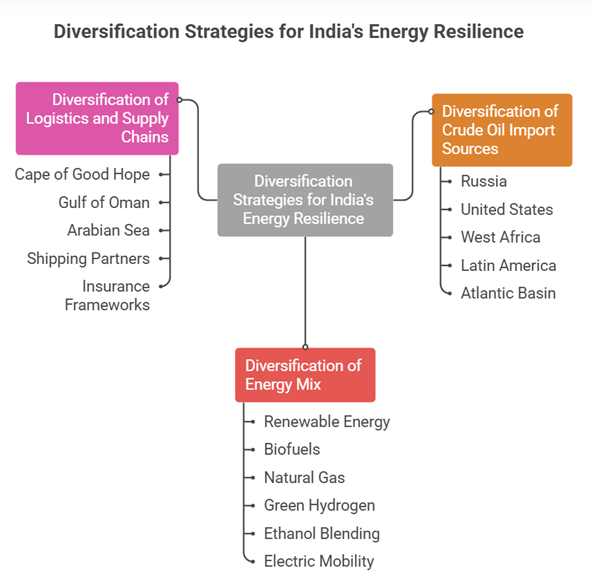
- India has gradually reduced excessive dependence on the Gulf region by expanding crude imports from Russia, the United States, West Africa, Latin America, and the Atlantic Basin, thereby reducing exposure to chokepoints such as the Strait of Hormuz.
- Following disruptions in West Asia, Indian refiners aggressively diversified procurement strategies, enabling continued refinery operations despite volatility in Gulf supplies. This flexibility prevented large-scale domestic shortages even when global shipping routes faced severe disruption.
- Example: After sanctions and disruptions altered global energy flows, India significantly increased discounted crude imports from Russia while simultaneously strengthening ties with suppliers such as the UAE, Saudi Arabia, Iraq, the United States, and Nigeria, thereby creating a more balanced sourcing basket.
2. Diversification of Energy Mix Enhances Long-Term Energy Security
- India has increasingly recognised that resilience cannot depend solely on crude oil imports. Expansion of renewable energy, biofuels, natural gas, green hydrogen, ethanol blending, and electric mobility seeks to reduce structural dependence on imported fossil fuels.
- Programmes such as the National Green Hydrogen Mission, E20 ethanol blending target, and rapid expansion of solar capacity under the PM-KUSUM Scheme aim to diversify the domestic energy basket and reduce vulnerability to external shocks.
- Case Study: India achieved one of the world’s fastest renewable energy expansions, crossing over 200 GW of installed non-fossil fuel capacity, enabling gradual reduction in long-term hydrocarbon dependence while improving climate commitments and energy autonomy.
3. Diversification of Logistics and Supply Chains Strengthens Operational Flexibility
- During the Hormuz crisis, several shipping routes were diverted through the Cape of Good Hope, increasing transit time and freight costs. India’s diversified shipping arrangements and diplomatic coordination helped avoid severe disruptions in domestic fuel availability.
- Indian naval deployments in the Gulf of Oman and Arabian Sea strengthened maritime security and ensured continuity of commercial shipping, highlighting the strategic linkage between naval preparedness and energy resilience.
- Example: India’s collaboration with multiple shipping partners, insurance frameworks, and strategic maritime diplomacy enabled uninterrupted crude transportation even amid elevated geopolitical tensions and rising insurance premiums.
II. Importance of Strategic Petroleum Reserves and Government Intervention
1. Strategic Petroleum Reserves Provide Emergency Supply Cushion
- Strategic Petroleum Reserves (SPRs) act as national emergency stockpiles that help countries absorb temporary supply shocks and stabilise domestic markets during geopolitical crises.
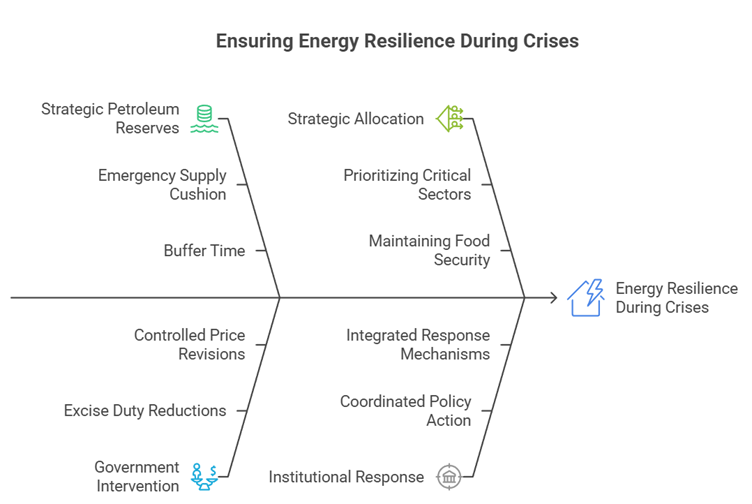
- India has expanded reserves at Visakhapatnam, Mangaluru, and Padur, while additional storage facilities are being planned to enhance emergency preparedness. These reserves provide crucial buffer time during disruptions in global supply chains.
- Example: India signed an agreement with the United Arab Emirates to store nearly 30 million barrels of crude oil in Indian strategic facilities, strengthening energy cooperation and ensuring rapid accessibility during emergencies.
2. Government Intervention Stabilised Domestic Markets During Crisis
- Despite global crude price surges, domestic petrol and diesel prices remained comparatively stable due to excise duty reductions, controlled price revisions, export restrictions on refined fuels, and financial absorption by Oil Marketing Companies (OMCs).
- Public sector refiners were directed to maximise LPG production, particularly because household dependence on cooking gas increased significantly under the Pradhan Mantri Ujjwala Yojana, through which LPG connections rose from about 5 crore in 2014 to over 33 crore.
- Case Study: During peak disruptions, domestic LPG production reportedly increased substantially, while gas allocation prioritised households, fertilizer plants, and public transport systems to avoid cascading socio-economic disruptions.
3. Strategic Allocation of Energy Resources Protected Critical Sectors
- Energy resilience involves not only stockpiling but also prioritising critical sectors during crises. India ensured continued gas supply to fertilizer plants, transport systems, and households to maintain food security and economic continuity.
- Nearly all fertilizer plants reportedly continued receiving a substantial share of required gas supplies, preventing disruption in agricultural production and avoiding inflationary spillovers in food prices.
Example: Coordinated policy action among the Petroleum Ministry, refiners, fertilizer sector, shipping authorities, and the armed forces demonstrated the importance of integrated institutional response mechanisms during external shocks.
III. Challenges, Limitations, and the Way Ahead for Sustainable Energy Resilience
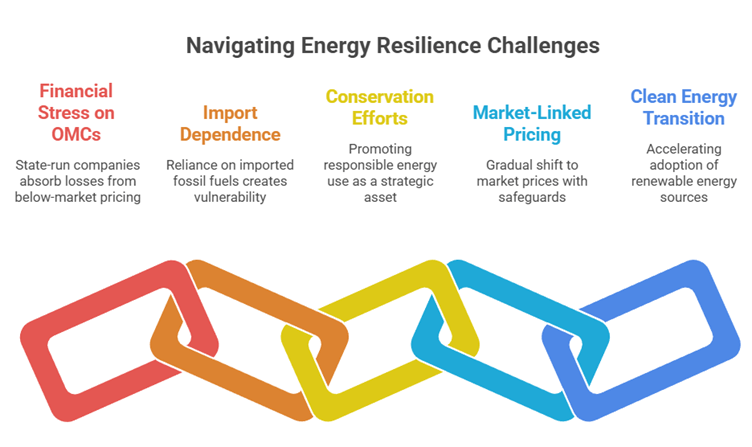
1. Financial Stress on Oil Marketing Companies Limits Sustainability
- State-run OMCs have absorbed major under-recoveries by selling fuels below market-linked prices to shield consumers from inflationary shocks. Estimates suggest losses reached nearly ₹700–₹800 crore per day during periods of peak volatility.
- Although politically stabilising in the short term, prolonged subsidies weaken public finances, distort market signals, and reduce the investment capacity of energy companies.
- Example: The government implemented cumulative fuel price increases of around 7%, yet reports indicated that an additional increase was required to fully offset OMC losses, reflecting the difficulty of indefinitely suppressing market-linked prices.
2. Structural Import Dependence Remains India’s Core Vulnerability
- India’s economy remains deeply dependent on imported fossil fuels across sectors such as aviation, transport, logistics, manufacturing, fertilizers, and agriculture. Therefore, even efficient crisis management cannot fully insulate the economy from prolonged global disruptions.
- Continued volatility in crude oil prices can widen the fiscal deficit, weaken the rupee, increase imported inflation, and adversely affect current account stability.
- Case Study: Global disruptions after the Russia-Ukraine conflict and tensions in West Asia demonstrated how external energy shocks rapidly transmit into domestic inflation, currency pressures, and industrial cost escalation in energy-importing economies like India.
3. Conservation, Transition, and Institutional Reforms are Essential for Future Resilience
- Prime Ministerial appeals for responsible energy consumption, reduced unnecessary travel, and efficient fuel use reflect growing recognition that energy conservation itself is a strategic national asset.
- India must gradually move toward market-linked pricing with calibrated safeguards for vulnerable groups, while simultaneously accelerating clean energy transition and domestic production capacity.
- Example: Expansion of electric mobility through the FAME Scheme, promotion of compressed biogas under the SATAT initiative, and scaling up green hydrogen production represent long-term pathways toward reducing fossil fuel dependence.
Conclusion:
- India’s response to recent global energy disruptions demonstrates that diversification and strategic reserves have become central pillars of national energy resilience. Through diversified sourcing, expansion of strategic petroleum reserves, diplomatic engagement, calibrated state intervention, and prioritisation of critical sectors, India has successfully prevented severe domestic disruption despite extraordinary geopolitical instability.
- However, the crisis also reveals that resilience cannot rely indefinitely on fiscal absorption and administrative control alone. Long-term security will depend on a balanced strategy combining energy diversification, renewable transition, strategic storage expansion, conservation-oriented consumption, market reforms, and technological innovation.
- As global energy systems become increasingly geopolitical and uncertain, India’s ability to build a flexible, diversified, and self-reliant energy architecture will determine not only economic stability but also strategic autonomy in the emerging world order