
Introduction:
- The Supreme Court, as the apex judicial authority, serves a dual function: safeguarding the Constitution and acting as the final appellate forum for legal disputes. Its extraordinary jurisdiction under Article 136 of the Constitution empowers it to grant Special Leave Petitions (SLPs) from any lower court, intended as a selective mechanism to address significant legal questions.
- However, the lack of formal guidelines on its use has led to an unregulated surge in appeals, contributing to massive case backlogs. As of May 2026, data indicates approximately 93,966 cases pending before the Supreme Court. This unbridled expansion has challenged the Court’s capacity to prioritize constitutional interpretation and ensure consistent jurisprudence, while increasing the pressure on judicial resources.
Body:
1. Impact of Unregulated SLP Jurisdiction on Court Functioning
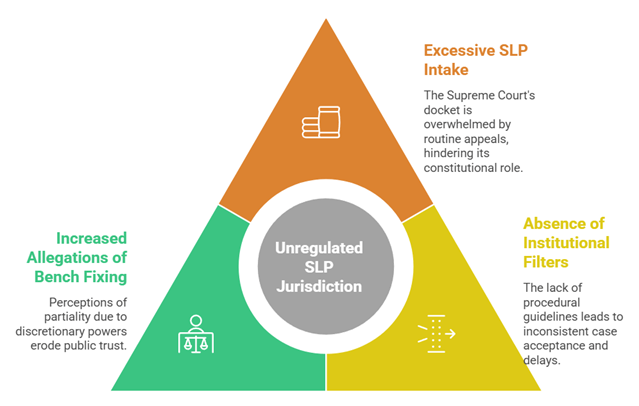
a. Excessive SLP Intake
- The original intent of Article 136 was sparingly applied to cases involving substantial legal questions or errors of law.
- Over time, the Supreme Court’s docket has become dominated by routine appeals, undermining its role as a constitutional arbiter.
- Example: A significant proportion of commercial and contract law disputes, such as in Vijaya Bank & Anr. versus Prashant B. Narnaware, have consumed top court resources, even though they originated from non-constitutional disputes.
b. Absence of Institutional Filters
- Unlike other common law jurisdictions where top courts employ institutional filters to prioritize landmark cases, the Indian system allows a near-open access to SLPs.
- The lack of procedural guidelines or criteria for entertaining SLPs has led to inconsistent case acceptance.
- Case Study: The 2016 Constitution Bench refused to narrow Article 136’s scope, reinforcing the open-ended nature of discretionary jurisdiction and perpetuating the backlog.
c. Increased Allegations of Bench Fixing
- With discretionary powers unchecked, outcomes often appear contingent on the Bench to which cases are listed, leading to perceptions of partiality.
- This unpredictability erodes public confidence in judicial impartiality and diminishes the Court’s legitimacy.
- Persistent divergent rulings create the necessity for larger Bench interventions, further delaying final resolutions.
2. Contribution to Pendency Crisis
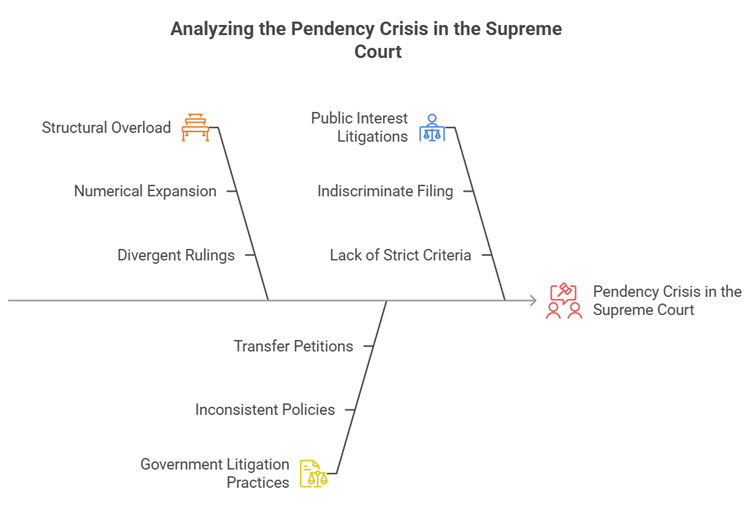
a. Structural Overload
- The Supreme Court’s sanctioned strength was increased from 34 to 38 judges in May 2026 to manage rising caseloads.
- Yet, mere numerical expansion does not resolve systemic inefficiencies; it may exacerbate divergent rulings among Division Benches.
- Example: Increasing the number of Division Benches can multiply conflicting interpretations in contract law and public law disputes, requiring reference to larger Benches for doctrinal clarity.
b. Government Litigation Practices
- Inconsistent litigation policies by the Union and State governments contribute significantly to caseload.
- Recurrent filing of transfer petitions in the Supreme Court prevents consolidation of similar cases in High Courts, prolonging adjudication timelines.
- Case Study: Disputes involving public sector undertakings are often carried to the Supreme Court repeatedly, instead of being resolved conclusively at a single High Court.
c. Public Interest Litigations (PILs)
- The indiscriminate filing of PILs, sometimes driven by personal or political agendas, further inflates case volume.
- Lack of strict application of criteria from rulings such as State of Uttaranchal versus Balwant Singh Chaufal (2010) enables frivolous or unsubstantiated PILs to occupy court time.
- Limiting oral arguments and emphasizing written submissions could streamline the process and reduce pendency.
3. Implications for Constitutional Jurisprudence
a. Dilution of Constitutional Focus
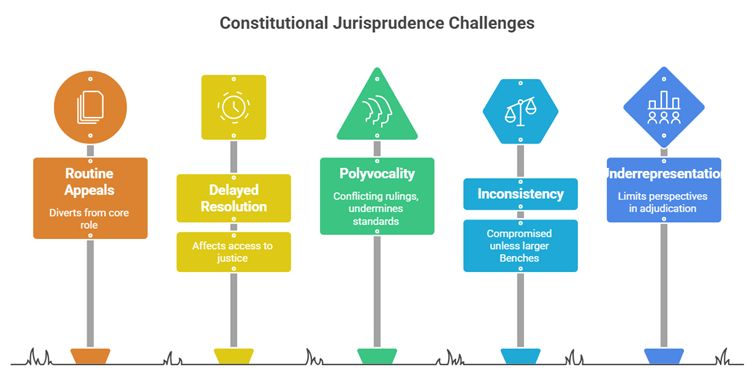
- Overemphasis on routine appeals diverts the Court from its core role as a constitutional arbiter, weakening jurisprudential consistency.
- Significant legal issues impacting fundamental rights or labor laws risk delayed resolution, affecting citizens’ access to justice.
- Example: Contract law disputes with implications on labor mobility necessitate careful adjudication to avoid systemic inconsistencies in rights protection.
b. Doctrinal Inconsistency
- Increased strength and multiple Benches may result in polyvocality, producing conflicting rulings and undermining authoritative legal standards.
- Consistency is compromised unless larger Benches reconcile divergent interpretations.
- Case Study: Frequent discrepancies in interpretation of commercial and civil statutes demonstrate the risk of doctrinal fragmentation.
c. Gender and Diversity Considerations
- Expansion offers an opportunity to address underrepresentation of women and marginalized groups in the apex judiciary.
- Transparent appointments and inclusivity can enhance institutional credibility and broaden perspectives in constitutional adjudication.
- Example: Recommendations for elevating women judges among new appointees can balance historical gender disparities in judicial composition
Conclusion:
- The unregulated expansion of the Supreme Court’s jurisdiction under Article 136 has amplified case backlogs, diverted attention from constitutional adjudication, and fostered doctrinal inconsistencies. Increasing the sanctioned strength of the Court alone will not resolve pendency; it must be complemented by institutional reforms, including clearer SLP guidelines, stricter PIL screening, and a consistent government litigation policy.
- Emphasis on larger Benches for substantial questions of law and encouraging reliance on written submissions can improve efficiency. Surveys indicate that strategic allocation of judicial resources, combined with judicial discipline and policy coherence, could reduce pendency by 20–30% over five years while strengthening the Court’s role as the ultimate constitutional arbiter. This multi-dimensional approach ensures both speedy justice and the preservation of judicial integrity.