

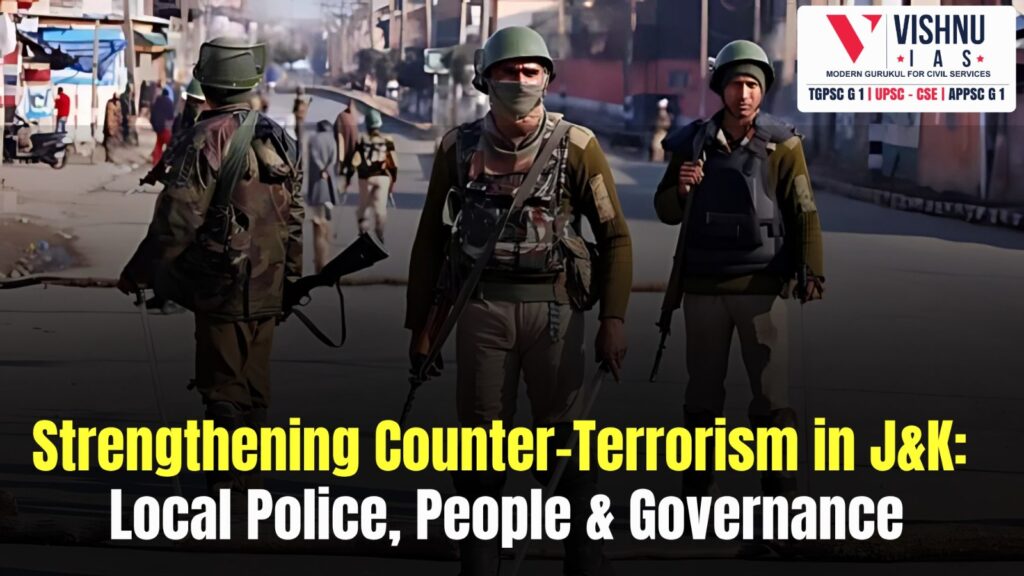
Strengthening Counter-Terrorism in Jammu & Kashmir through Local Policing and Democratic Governance
Counter-terrorism in Jammu & Kashmir has repeatedly revealed the limits of a purely militarised response. As Lieutenant Governor Manoj Sinha underscored on June 16, 2025, the State’s top priority is eradicating terrorism. Equally critical is leveraging the unique “intangible assets” of the Jammu & Kashmir Police (JAKP)—their local origin, terrain-knowledge and ties to the community—to generate high-grade human intelligence. Only through a blend of modern technology, beat policing and people’s participation, anchored in democratic structures, can J&K achieve lasting security.
1. Local Police as the Core of Counter-Terrorism Operations
- Terrain Acquaintance & Population Insights: Personnel from the JAKP, sourced from local areas, have a detailed comprehension of micro-geographies that central or armed forces do not possess.
- Human Intelligence (HUMINT): The establishment of community connections and reliable relationships allows JAKP to identify early warning indicators—previously absent before the Pahalgam incident on April 22, 2025—thereby averting potential attacks.
- Comprehensive Policing Approach: As recommended by the LG, JAKP should integrate foot patrols with advanced technological resources (such as drone surveillance and data analytics) alongside real-time intelligence sharing.
2. Community Involvement & Inter-Agency Cooperation
- Building Trust: Residents are more inclined to report suspicious activities to sarpanchs and MLAs rather than distant central agencies, which improves the flow of information.
- Collaborative Policing: Organized discussions among police, panchayats, and municipal authorities promote shared responsibility for security initiatives, ranging from neighborhood watch programs to counter-radicalization efforts.
- Coordination: A consolidated command under State oversight prevents jurisdictional conflicts among JAKP, CRPF, IB, and the Army, facilitating swift responses and effective resource allocation.
3. Restoring Democratic Governance to Enhance Policing
- Empowering Elected Representatives: Integrating JAKP within the elected government framework guarantees accountability to the voters and aligns policing objectives with community requirements.
- Tiered Security Matrix: Engaging panchayats, municipal councils, MLAs, and MPs as security stakeholders incorporates grassroots intelligence into the formulation of policies.
- Overcoming Elitist Models: A participatory approach mitigates apathy among elected officials; when constituents observe their leaders actively involved in security matters, the community's determination to combat terrorism strengthens.
4. Challenges and Path Forward
- Security vs. Political Overreach: Measures must be implemented to avert the politicization of the police force, maintaining professional autonomy while ensuring democratic supervision.
- Capacity Building: Equipping JAKP with contemporary investigative methodologies and community policing strategies, along with infrastructure enhancements at the Sher-e-Kashmir Police Academy, will improve operational effectiveness.
- Holistic Counter-Radicalisation: Initiatives in education, employment, and cultural engagement, developed in collaboration with local leaders, will tackle the fundamental causes of alienation.
Conclusion
Jammu & Kashmir’s security cannot rest on guns and checkpoints alone. The local police—endowed with terrain acumen and community trust—must spearhead a modern, intelligence-led, participatory counter-terrorism strategy. Restoring full democratic governance and integrating elected representatives into the security matrix will bridge the HUMINT gap, bolster accountability and cultivate collective resilience. Only such a balanced approach can transform temporary gains into enduring peace.