

Introduction:
- The traditional architecture of constitutional law operates on a vertical axis, designed to protect citizens from the arbitrary excesses of the State. However, the rise of big tech conglomerates has disrupted this paradigm. Operating as an electronic Curia, these private platforms wield asymmetrical, sovereign-like data capabilities, reducing autonomous citizens to digital components through mass behavioural tracking, psychological profiling, and predictive manipulation.
- To address this “digital slavery,” the judiciary has begun exploring the horizontal application of fundamental rights—making constitutional guarantees enforceable against non-State, private entities. This paradigm shift was catalysed by the landmark Kaushal Kishor v. State of UP (2023) judgment, wherein a Constitution Bench ruled that fundamental guarantees under Articles 19 and 21 can be enforced against private actors.
Body:
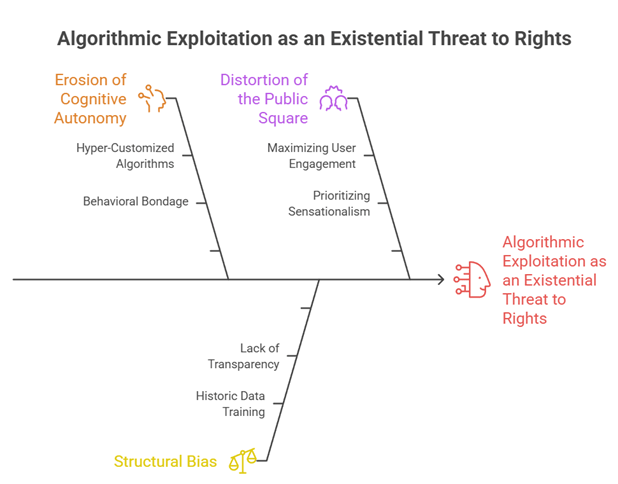
1. Algorithmic Exploitation as an Existential Threat to Rights
Erosion of Cognitive Autonomy and Digital Liberty
- Unchecked artificial intelligence platforms operate on hyper-customized algorithms that quietly engineer human choice, commercial consumption, and political leanings. By engineering public opinion within closed digital ecosystems, these systems subvert free will, turning personal data into tools of behavioural bondage.
- Example / Case Study: THE CAMBRIDGE ANALYTICA SCANDAL demonstrated how psychographic profiling of millions of users without explicit consent could be used to manipulate democratic voting behaviour.
Structural Bias and Automated Discrimination
- Machine learning algorithms are trained on historic human data, which frequently causes them to inherit and institutionalize systemic biases. When automated systems decide creditworthiness, employment, or resource distribution without transparent criteria, they carry out automated discrimination that compromises the right to equal treatment.
- Example / Case Study: COMPAS RECDIVISM RISK ASSESSMENT ALGORITHM in the United States was found to show significant racial bias by disproportionately giving higher risk scores to minority defendants compared to similarly situated counterparts.
Distortion of the Public Square and Epistemic Security
- Platform business models are engineered exclusively to maximize user engagement. Because outrage and sensationalism generate the highest click-through rates, recommendation engines systematically prioritize hyper-partisan content, deepfakes, and synthetic media, fracturing the collective agreement on basic facts required for a functioning democracy.
- Example / Case Study: THE DEEPFAKE VIDEOS OF INDIAN POLITICAL LEADERS widely circulated during national election cycles to misrepresent policy stances and mislead voters.
2. Structural Limitations of Traditional Statutory Legislation
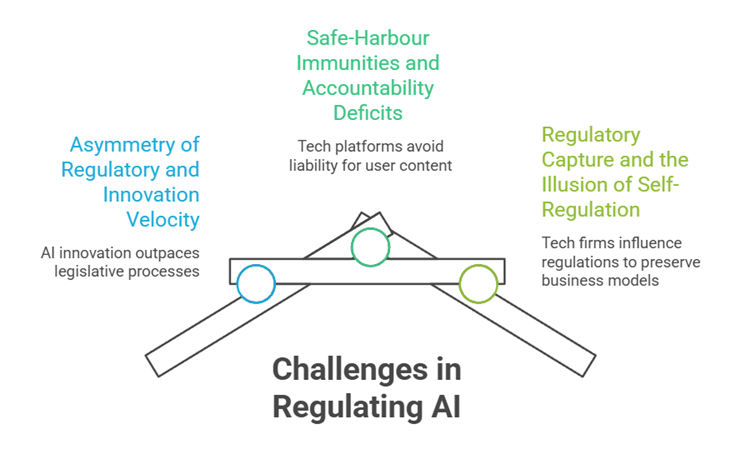
The Asymmetry of Regulatory and Innovation Velocity
- Artificial intelligence develops at the breakneck speed of start-up culture, driven by an ethos to move fast and run perpetual tests on society. Conversely, standard legislative processes are inherently deliberate, slow to evolve, and susceptible to intense corporate lobbying, meaning statutory frameworks are frequently outdated by the time they are enacted.
- Example / Case Study: THE EUROPEAN UNION ARTIFICIAL INTELLIGENCE ACT took years of intense negotiations to pass, during which the rapid emergence of large-scale generative AI foundation models forced late-stage structural revisions to its risk classifications.
Safe-Harbour Immunities and Accountability Deficits
- Historically, big tech monopolies have shielded themselves behind “safe-harbour” protections, which insulate platforms from legal liability for user-generated content. This legal immunity allows recommendation engines to profit from the viral spread of destabilizing disinformation without facing financial or legal consequences for the resulting real-world harms.
- Example / Case Study: THE MYANMAR RO HINGYA CRISIS, where United Nations investigators noted that algorithmic amplification of hate speech on major social media platforms played a significant role in fuelling real-world violence.
Regulatory Capture and the Illusion of Self-Regulation
- Relying on abstract ethical principles or the private consciences of software engineers permits private monopolies to control data governance. Tech firms use corporate social responsibility initiatives and vague ethical guidelines to delay binding state regulation, preserving the business models that drive algorithmic exploitation.
- Example / Case Study: GOOGLE’S ETHICS BOARD DISMISSALS, where internal conflicts and the dissolution of its AI ethics boards highlighted the difficulty of trusting tech monopolies to police their own software development.
3. Operationalizing Horizontality: India’s Path Forward
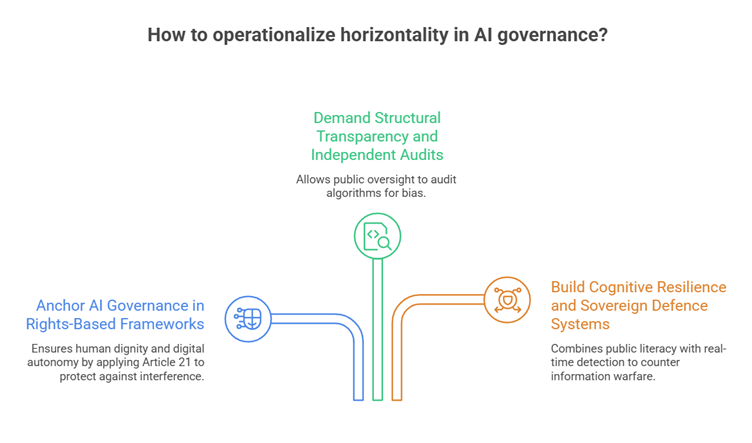
Anchoring AI Governance in Rights-Based Frameworks
- To protect human dignity, the right to an unmanipulated information ecosystem must be treated as a constitutional imperative. Applying Article 21 horizontally ensures that individual digital autonomy and unalienable data ownership are protected from state and private interference alike.
- Example / Case Study: THE K.S. PUTTASWAMY V. UNION OF INDIA (2017) judgment established privacy as a fundamental right under Article 21, providing the judicial foundation to demand that private systems build privacy and cognitive safety into their algorithms by design.
Demanding Structural Transparency and Independent Audits
- The shield of proprietary intellectual property must be modified when algorithms perform public functions or impact critical public sectors. Platforms must be legally compelled to provide structural transparency, allowing independent public oversight bodies to audit their recommendation engines and codebases for bias.
- Example / Case Study: THE ALGORITHMIC ACCOUNTABILITY ACT proposals globally seek to mandate automated impact assessments for high-risk private systems.
Building Cognitive Resilience and Sovereign Defence Systems
- Because technical fixes are rarely sufficient on their own, a comprehensive defence against algorithmic exploitation requires building cognitive resilience within the populace alongside sophisticated, real-time detection systems to neutralize information warfare before it achieves viral velocity.
- Example / Case Study: THE TAIWAN COGNITIVE DEFENSE MODEL combines rapid civic fact-checking networks with public media literacy campaigns to counter external digital manipulation.
Conclusion:
- The evolution of artificial intelligence has moved the main threats to individual liberty from state overreach to private algorithmic exploitation. Leaving the protection of fundamental human rights to ordinary statutory frameworks risks allowing corporate monopolies to outpace democratic accountability. Elevating data governance to a constitutional imperative by expanding the horizontal application of Articles 14, 19, and 21 establishes clear, non-negotiable legal boundaries for technology.
- A multi-layered approach combining strict rights frameworks, mandatory algorithmic transparency, and a strong push for public media literacy will ensure that technology supports rather than undermines human dignity. Ultimately, protecting the digital public square from manipulation is an essential extension of the constitutional commitment to preserve individual life, liberty, and sovereign democratic choice