
Introduction:
- Artificial Intelligence (AI) refers to the capability of machines and computer systems to perform tasks requiring human intelligence such as learning, reasoning, language processing, pattern recognition and decision-making.
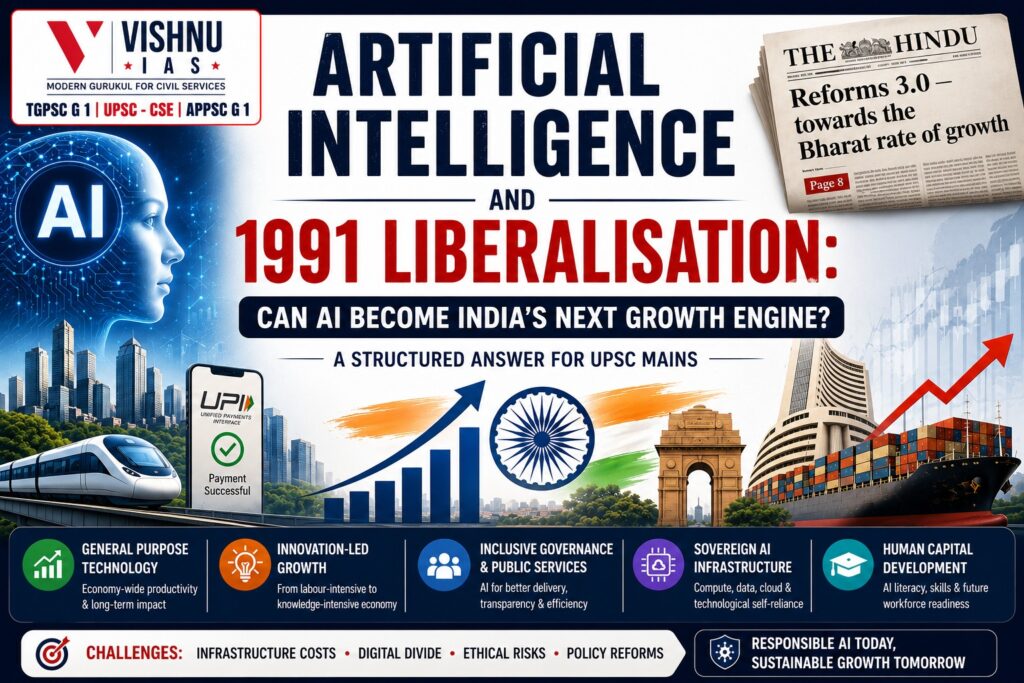
- Just as the 1991 economic liberalisation dismantled structural barriers and integrated India with the global economy, AI represents a General Purpose Technology (GPT) capable of transforming productivity across sectors. With India emerging as the world’s fastest-growing major economy, possessing one of the largest Digital Public Infrastructure (DPI) ecosystems and a rapidly expanding digital economy, AI has the potential to become the next structural growth engine.
- However, like liberalisation, its transformative impact depends not merely on technology but on complementary reforms in institutions, infrastructure, skills, innovation and governance.
Body:
I. AI as the Next Structural Transformation: Why the Comparison with 1991 is Valid
o (a) AI as a General Purpose Technology driving economy-wide productivity
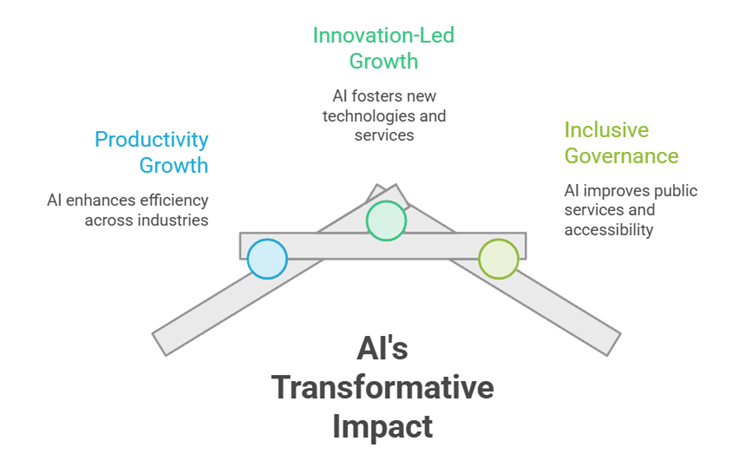
- General Purpose Technology: Similar to electricity and the internet, AI possesses economy-wide applications capable of raising productivity across manufacturing, agriculture, healthcare, education, logistics and governance, thereby creating long-term multiplier effects rather than isolated technological gains.
- Productivity-led Growth: Whereas 1991 reforms liberalised markets by reducing licensing barriers and encouraging private investment, AI liberalises access to knowledge, computation and decision-making, enabling businesses and individuals to produce greater output with fewer resources.
- Example: UPI transformed digital payments by making transactions nearly frictionless, illustrating how public digital infrastructure can create entirely new economic ecosystems.
(b) AI as a catalyst for innovation-led economic growth
- Transition from Labour-intensive to Knowledge-intensive Growth: AI enables movement beyond cost-based competitiveness towards innovation, intellectual property, high-value services and deep-tech entrepreneurship, strengthening India’s long-term competitiveness.
- Expansion of Research Ecosystem: India’s expenditure on Research and Development remains below 1% of GDP, significantly lower than major innovation-driven economies. Greater investment in AI research can improve scientific productivity and global technological competitiveness.
- Case Study: Domestic AI firms developing multilingual foundation models demonstrate India’s capacity to build indigenous large language models adapted to Indian linguistic diversity.
(c) AI as an instrument of inclusive governance and public service delivery
- Improving Governance Efficiency: AI can strengthen evidence-based policymaking through predictive analytics, fraud detection, automated grievance redressal and real-time monitoring of welfare schemes.
- Bridging Regional Disparities: AI-powered language technologies reduce linguistic barriers by enabling governance and education in multiple Indian languages.
- Example: AI-assisted crop advisory systems provide weather-based recommendations to farmers, improving productivity and resilience.
II. Conditions Necessary for AI to Become India’s Next Liberalisation
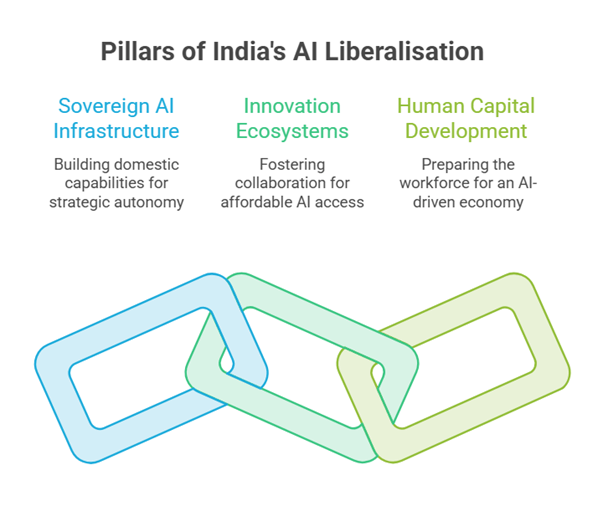
(a) Building sovereign AI infrastructure and technological self-reliance
- Strategic Digital Sovereignty: Dependence exclusively on foreign AI platforms exposes countries to technological vulnerabilities. Indigenous capability in computing infrastructure, cloud systems and foundational AI models enhances strategic autonomy.
- Open-source AI Ecosystem: Hosting open-source foundation models facilitates customisation, transparency, affordability and auditability, especially for governance, defence and public sector applications.
- National Compute Infrastructure: Large-scale deployment requires high-performance computing clusters, secure cloud infrastructure, data centres, energy-efficient computing and nationwide connectivity.
- Example: India’s semiconductor initiatives seek to strengthen domestic electronics manufacturing and reduce strategic dependence.
(b) Expanding innovation ecosystems through public-private collaboration
- Affordable AI Access: Just as inexpensive mobile data accelerated internet adoption, reducing AI computation costs can democratise innovation among startups, educational institutions and researchers.
- Public-Private Partnerships: Collaboration between government, academia, hyperscale cloud providers, startups and research institutions can expand computational infrastructure without imposing excessive fiscal burdens.
- Case Study: Collaborative research programmes between academic institutions and industry have accelerated AI applications in healthcare diagnostics and language technologies.
(c) Developing human capital for an AI-driven economy
- AI Literacy: Digital literacy must evolve into AI literacy encompassing prompt engineering, data interpretation, algorithmic thinking and responsible AI usage.
- Future Workforce Preparation: Universities, technical institutes and schools require curriculum reforms integrating AI, machine learning, ethics and interdisciplinary applications.
- Example: National educational reforms increasingly encourage coding, computational thinking and multidisciplinary learning from early stages.
III. Challenges, Risks and the Way Forward for Responsible AI-led Transformation
(a) Economic and technological constraints
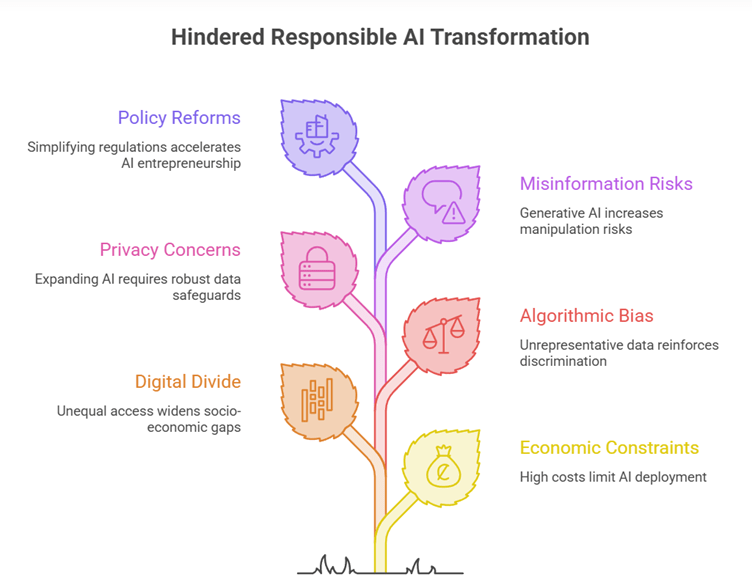
- Infrastructure Costs: Large-scale AI deployment requires significant investments in GPUs, specialised processors, electricity, cooling systems, broadband connectivity and semiconductor supply chains.
- Digital Divide: Unequal internet access, computing resources and digital skills may widen existing socio-economic disparities if AI adoption remains concentrated.
- Example: Several advanced economies continue investing multiple times more in research intensity than India, highlighting the need for sustained innovation financing.
(b) Ethical, legal and governance concerns
- Algorithmic Bias: AI systems trained on unrepresentative datasets may reinforce discrimination affecting employment, finance, healthcare and public services.
- Privacy and Data Protection: Expanding AI requires robust safeguards for personal data, informed consent and cybersecurity.
- Misinformation and Deepfakes: Generative AI increases risks of electoral manipulation, financial fraud and social instability, necessitating responsible governance frameworks.
- Case Study: Deepfake technologies have increasingly been used for identity fraud, highlighting the necessity for watermarking, authentication and digital verification mechanisms.
(c) Policy reforms to maximise AI’s transformational potential
- Ease of Doing Business: Simplifying regulatory compliance, reducing approval timelines and harmonising state-level regulations can accelerate AI entrepreneurship and investment.
- Sector-specific AI Missions: Targeted deployment in healthcare, agriculture, education, judiciary, manufacturing and tourism can generate broad-based productivity gains.
- Example: National AI initiatives increasingly emphasise responsible AI, indigenous innovation and public sector applications.
Conclusion:
- Artificial Intelligence possesses the transformative potential to become for the twenty-first century what economic liberalisation was for 1991—a foundational shift capable of reshaping productivity, innovation and global competitiveness. Yet technology alone cannot guarantee structural transformation.
- Sustained investment in research and development, digital public infrastructure, human capital, ethical governance, sovereign computing capability and regulatory reforms will determine whether AI evolves into India’s next long-term growth engine.
- By combining the strengths of its demographic dividend, digital infrastructure and innovation ecosystem with responsible AI governance, India can transition from being primarily a digital services economy to becoming a globally competitive AI-powered knowledge economy, generating inclusive growth, high-quality employment and sustainable economic expansion over the coming decades.