


Introduction
Judicial Inclusivity and Quality of Justice are closely linked in ensuring a fair and responsive legal system. Judicial inclusivity refers to the representation of diverse social groups—across gender, caste, region, religion, and professional backgrounds—within the judiciary, ensuring that the interpretation and delivery of justice reflects the lived realities of society.
In India, concerns over a homogenous Bench have intensified as the system struggles with over 5 crore pending cases, declining public trust, and perceptions of institutional bias and inaccessibility. Reports such as the India Justice Report have repeatedly highlighted gaps in representation—women constitute only around 14–15% of judges in High Courts and even fewer in higher judicial echelons—raising critical questions about whether lack of diversity affects the quality, empathy, and responsiveness of justice delivery.
1. Conceptual Link: How Judicial Inclusivity Enhances Quality of Justice
1.1 Representation strengthens legitimacy and trust
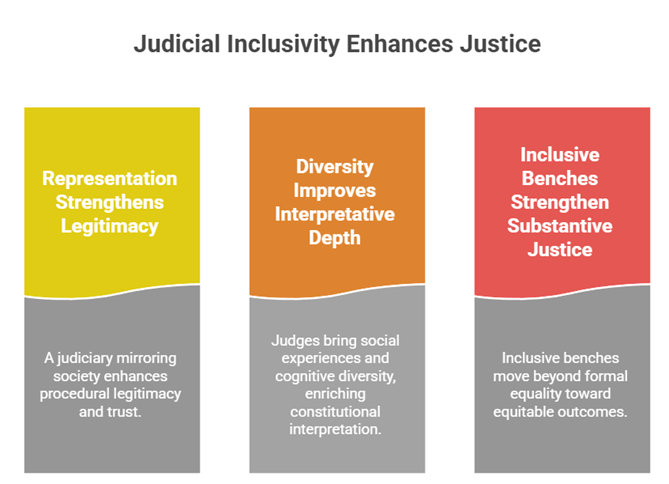
A judiciary that mirrors society enhances procedural legitimacy, making citizens more likely to accept judicial outcomes, even adverse ones. Marginalised communities often perceive courts as distant due to elite dominance, reducing faith in the rule of law.
Example: Increased representation of women judges in lower courts has improved reporting and adjudication in gender-based violence cases, fostering trust among victims.
1.2 Diversity improves interpretative depth and contextual sensitivity
Judges bring social experiences and cognitive diversity, enriching constitutional interpretation beyond formal legalism. Issues like manual scavenging, caste discrimination, or tribal land rights require understanding of ground realities.
Case Study: In the Sabarimala case, opinions of women judges foregrounded gender equality and dignity, illustrating how diversity influences constitutional reasoning.
1.3 Inclusive benches strengthen substantive justice
Inclusivity helps courts move beyond formal equality toward substantive equality, ensuring equitable outcomes. It helps identify structural disadvantages in bail, sentencing, and access to remedies.
Example: Courts have expanded workplace harassment laws post Vishaka Guidelines, reflecting broader societal understanding.
2. Extent to which Diversity Can Address Systemic Insensitivity
2.1 Addressing biases embedded in legal processes
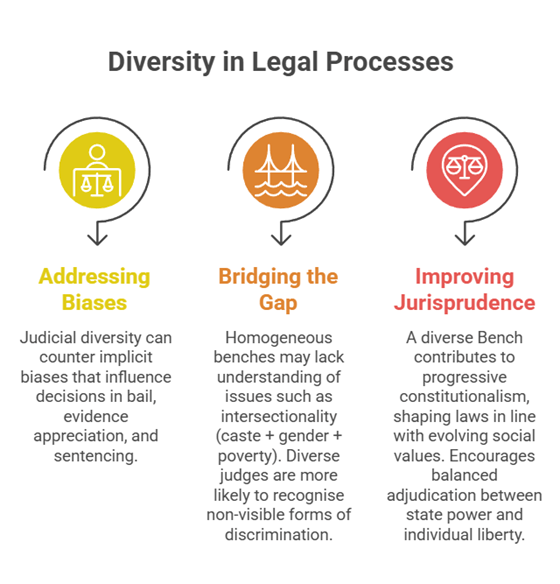
- Judicial diversity can counter implicit biases that influence decisions in bail, evidence appreciation, and sentencing.
- Particularly relevant in laws like UAPA, where prolonged pre-trial detention disproportionately affects vulnerable groups.
- Example: Instances where undertrials spent years in prison before acquittal highlight how lack of empathy and oversight leads to “process as punishment.”
2.2 Bridging the gap between law and lived realities
- Homogeneous benches may lack understanding of issues such as intersectionality (caste + gender + poverty).
- Diverse judges are more likely to recognise non-visible forms of discrimination, such as social stigma or economic coercion.
- Case Study: Judicial interventions in transgender rights (NALSA judgment) reflected a more inclusive understanding of identity and dignity.
2.3 Improving policy-oriented and progressive jurisprudence
- A diverse Bench contributes to progressive constitutionalism, shaping laws in line with evolving social values.
- Encourages balanced adjudication between state power and individual liberty.
- Example: Expansions of Article 21 (Right to Life) into areas like privacy (Puttaswamy case) reflect sensitivity to changing societal norms.
3. Limitations and Complementary Reforms Needed
3.1 Diversity alone cannot resolve structural inefficiencies
- Issues like pendency, adjournment culture, and procedural delays stem from systemic design, not just representation.
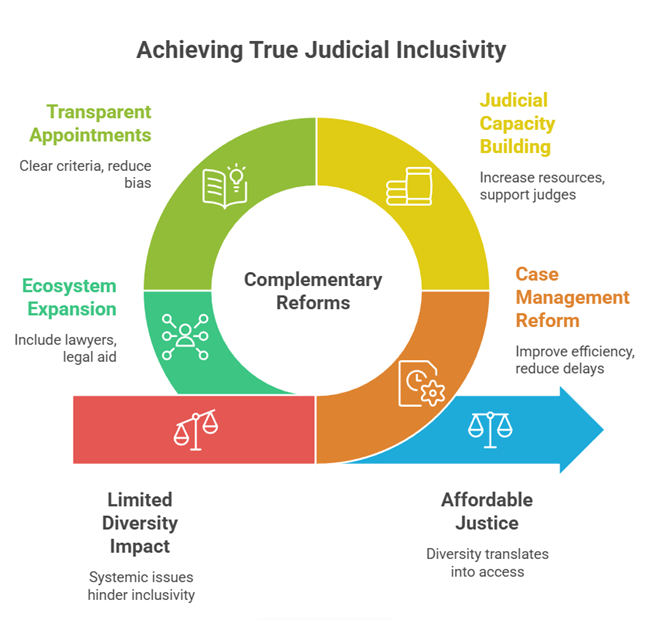
- Without reforms in case management, judicial capacity, and infrastructure, inclusivity has limited impact.
- Example: Despite progressive judgments, delays in implementation dilute their real-world impact.
3.2 Risk of tokenism without institutional change
- Mere presence of diverse judges does not guarantee influence unless supported by transparent appointment processes and institutional backing.
- Collegium opacity and lack of clear criteria hinder genuine inclusivity.
- Example: Repeated concerns about judicial appointments favouring elite networks indicate structural barriers.
3.3 Need for broader ecosystem reforms
- Inclusivity must extend beyond judges to lawyers, legal aid systems, and court accessibility.
- Strengthening institutions like National Legal Services Authority (NALSA) ensures that diversity translates into affordable justice.
- Case Study: Expansion of e-Courts Mission Mode Project has improved access, but digital divides still exclude rural populations.
Conclusion:
- Judicial inclusivity is not merely a question of representation but a determinant of justice quality, legitimacy, and responsiveness. While a more diverse Bench can significantly reduce systemic insensitivity, deepen constitutional interpretation, and restore public confidence, it is not a standalone solution.
- It must operate alongside reforms in judicial infrastructure, procedural efficiency, transparency in appointments, and legal aid accessibility. As India moves toward long-term developmental goals, strengthening inclusivity combined with technological modernisation and institutional accountability can transform the judiciary into a system that is not only legally sound but socially just, ensuring that justice is not delayed, not denied, but truly delivered.