
Introduction
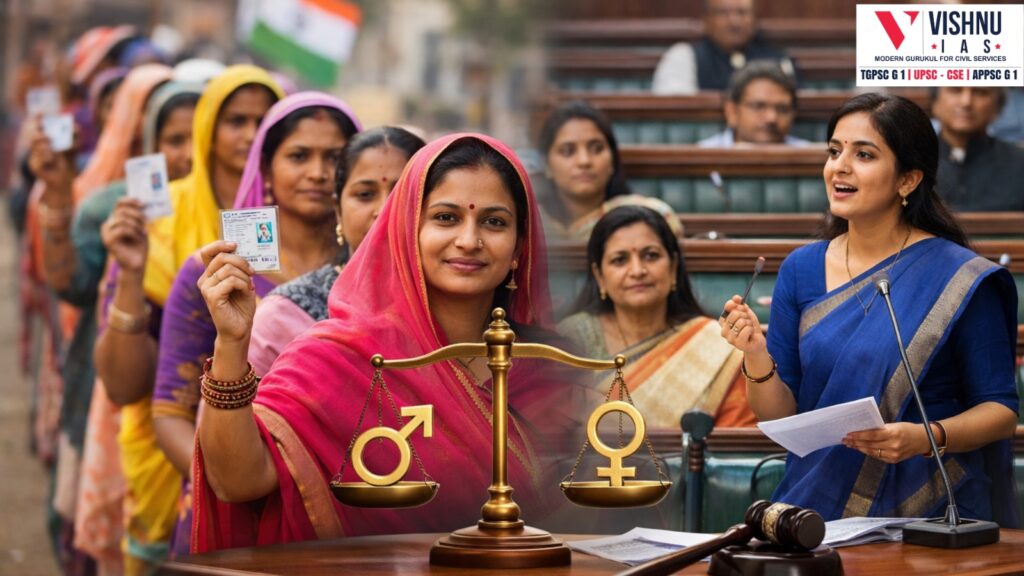
Women’s representation in Indian legislatures refers to the proportion and effectiveness of women’s participation in legislative and decision-making bodies. India presents a paradox where high female voter turnout coexists with low legislative representation.
While women constitute nearly 50% of the population and have, in several states, matched or exceeded male voter turnout in recent elections, their presence remains limited to around 14–15% in Parliament and nearly 9% in State Assemblies.
This gap has been consistently highlighted in global assessments such as the Inter-Parliamentary Union (IPU) rankings, where India lags behind many developing nations. This divergence between political participation and representation reflects deeper structural constraints embedded in political, socio-economic, and institutional frameworks.
Body:
1. Institutional and Political Barriers
1.1 Political Party Gatekeeping and Candidate Selection
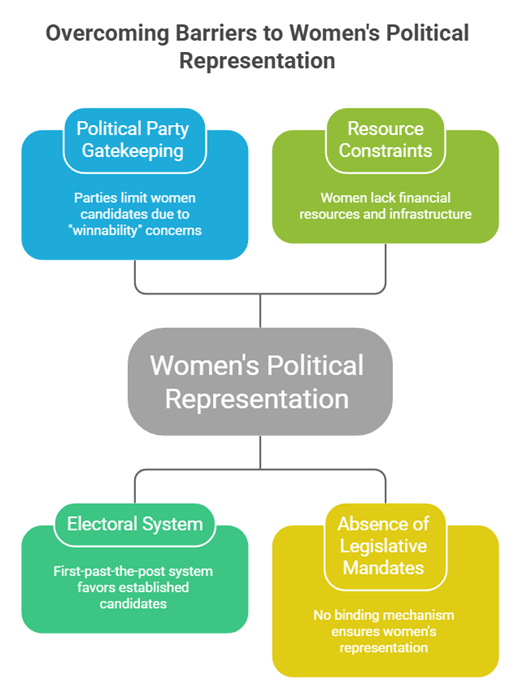
- Political parties act as primary gatekeepers, systematically nominating fewer women candidates due to perceived “winnability” concerns, often reinforcing male dominance in electoral politics.
- Example: General Elections trend – major national parties have historically fielded less than 15% women candidates, despite public commitments to gender inclusion.
- Case Study: Party-level quotas debate – voluntary commitments by parties like Indian National Congress to reserve tickets have not translated into consistent implementation, revealing limits of non-mandatory reforms.
1.2 Electoral System and Resource Constraints
- The first-past-the-post system favors established candidates with strong networks, disadvantaging women who often lack financial resources, political patronage, and campaign infrastructure.
- Women candidates face difficulty accessing campaign financing, a crucial factor in highly competitive elections.
- Example: ADR (Association for Democratic Reforms) reports consistently show a correlation between candidate wealth and electoral success, indirectly disadvantaging women.
1.3 Absence of Legislative Mandates
- Unlike local governance institutions under the 73rd and 74th Constitutional Amendments, there is no binding mechanism ensuring women’s representation in State Assemblies and Parliament.
- Example: Panchayati Raj reservation success – over 33% (and up to 50% in many states) reservation has significantly increased women’s presence, demonstrating the impact of institutional design.
- The delayed operationalization of the Nari Shakti Vandan Adhiniyam further prolongs underrepresentation at higher legislative levels.
2. Socio-Economic and Cultural Constraints
2.1 Patriarchal Norms and Gender Roles
- Deep-rooted patriarchal structures restrict women’s mobility, leadership aspirations, and societal acceptance in public roles.
- Politics is often perceived as a male-dominated and adversarial domain, discouraging women’s participation.
- Example: Rural-urban divide – despite higher participation in voting, women in rural areas face familial and community pressures limiting political careers.
2.2 Education, Awareness, and Leadership Pipeline
- Although female literacy and higher education enrollment have improved, there remains a gap in political literacy and leadership grooming opportunities.
- Women are underrepresented in student politics, party cadres, and civil society leadership pipelines, which act as stepping stones to legislative roles.
- Case Study: Self-Help Groups (SHGs) – initiatives like Deendayal Antyodaya Yojana–NRLM have enhanced grassroots leadership, but transition to formal politics remains limited.
2.3 Safety and Security Concerns
- Concerns about violence, harassment, and reputational risks deter women from entering electoral politics.
- The rise of online abuse and gendered political trolling has further created a hostile environment.
- Example: Women candidates’ experiences in several state elections highlight challenges of campaign safety and intimidation, affecting participation decisions.

3. Structural and Systemic Inequalities
3.1 Economic Dependence and Time Poverty
- Women often face economic dependency and disproportionate burden of unpaid care work, limiting their ability to engage in full-time political careers.
- Electoral politics requires sustained time investment, travel, and networking, which many women cannot afford due to household responsibilities.
- Example: Time-use surveys show women spend significantly more hours on domestic work, reducing political engagement opportunities.
3.2 Elite Capture and Dynastic Politics
- A significant proportion of women representatives come from political families, indicating barriers for first-generation entrants.
- This creates a perception that politics is accessible primarily through elite networks, not merit or grassroots leadership.
- Case Study: Dynastic representation trend – many women MPs/MLAs have familial political backgrounds, limiting broader inclusivity.
3.3 Intersectional Disadvantages
- Women from marginalized communities face double or triple discrimination based on caste, class, and gender.
- While reservation policies exist for SC/ST categories, intersectionality within gender representation remains inadequately addressed.
- Example: Panchayat-level evidence shows that women from disadvantaged groups often face proxy representation (sarpanch pati phenomenon), highlighting deeper systemic inequalities.

Conclusion
India’s democratic strength, reflected in rising female voter participation, remains incomplete without equitable representation in legislatures. Bridging this gap requires a combination of institutional reforms, socio-cultural transformation, and economic empowerment.
The effective implementation of the Women’s Reservation framework, complemented by party-level reforms, leadership training, and gender-sensitive political ecosystems, can accelerate this transition. Evidence from local governance demonstrates that when given opportunity, women leaders contribute to better developmental outcomes and inclusive governance.
As India undergoes rapid socio-economic change, ensuring women’s representation is not merely a question of justice but a prerequisite for a more responsive, legitimate, and resilient democratic system.