


Introduction:
- Technological independence refers to a nation’s ability to design, develop, control, secure, and continuously upgrade critical technologies without excessive dependence on external actors. India has emerged as a global leader in Digital Public Infrastructure (DPI) through platforms such as Aadhaar, UPI, DigiLocker, CoWIN, ONDC, FASTag, and Account Aggregator, creating one of the world’s largest digital ecosystems.
- The scale of this transformation is reflected in the fact that India accounts for nearly half of global real-time digital payment transactions through UPI, while hundreds of millions of citizens are integrated into digital governance and service delivery frameworks.
- However, despite these achievements, India’s Gross Expenditure on R&D remains around 0.7% of GDP, significantly below major innovation-driven economies, raising concerns about the sustainability of technological sovereignty in an era defined by artificial intelligence, semiconductors, cybersecurity, quantum computing, and strategic digital infrastructure.
Body:
I. India’s Success in Building Robust Public Digital Infrastructure
1. Creation of Globally Recognized Digital Public Goods
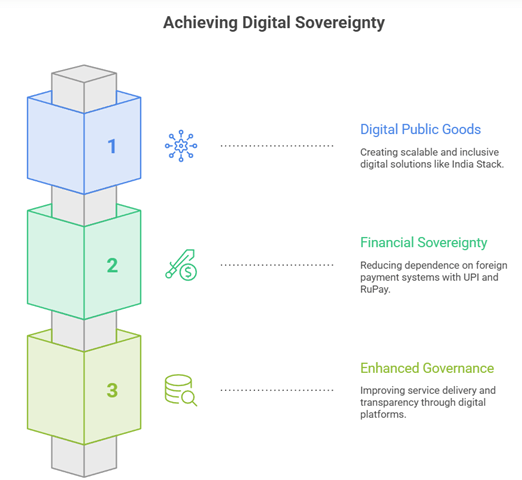
- The India Stack architecture has enabled low-cost, scalable and inclusive digital governance through Aadhaar-based authentication, UPI-enabled payments and DigiLocker-based document verification, reducing transaction costs and enhancing state capacity.
- The integration of JAM Trinity (Jan Dhan–Aadhaar–Mobile) has transformed welfare delivery by minimizing leakages and improving the efficiency of direct benefit transfers, thereby strengthening fiscal governance.
- Example: The CoWIN platform successfully managed one of the world’s largest vaccination drives, demonstrating India’s ability to create population-scale digital solutions under real-time conditions.
2. Strengthening Economic and Financial Sovereignty
- Indigenous payment systems such as UPI and RuPay have reduced dependence on foreign payment networks while expanding financial inclusion across urban and rural regions.
- The emergence of Open Network for Digital Commerce (ONDC) seeks to democratize e-commerce by reducing platform monopolies and creating interoperable digital markets.
- Government initiatives such as Digital India, IndiaAI Mission, and Digital Personal Data Protection framework aim to strengthen domestic control over critical digital ecosystems while promoting innovation.
3. Enhancing Governance, Inclusion and Service Delivery
- Digital platforms have enabled seamless delivery of public services, reducing administrative friction and improving transparency in citizen-state interactions.
- The rise of Account Aggregator architecture facilitates secure and consent-based data sharing, creating new opportunities in credit access and financial inclusion.
- Case Study: During disaster relief operations and welfare transfers, Aadhaar-linked DBT systems have enabled faster and more targeted assistance to beneficiaries, illustrating the developmental potential of digital infrastructure.
II. Why the R&D Deficit Threatens Long-Term Technological Independence
1. Dependence on Foreign Core Technologies
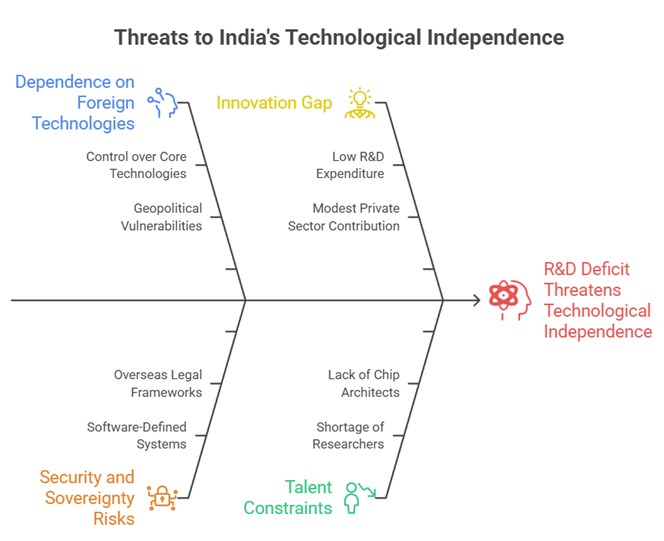
- While India has built strong application-layer infrastructure, many foundational technologies including advanced semiconductors, operating systems, cloud architectures, chip design tools, and high-end AI models remain externally controlled.
- Dependence on foreign technology creates vulnerabilities wherein access to critical software, hardware, or cloud services can be influenced by geopolitical considerations.
- Example: The denial of precise GPS support during the 1999 Kargil conflict highlighted the strategic risks of dependence on foreign-controlled technological infrastructure, eventually leading to the development of NavIC.
2. Emerging Security and Sovereignty Risks
- Modern warfare, critical infrastructure management, telecommunications, and digital governance increasingly rely on software-defined systems, making technological control a national security imperative.
- Foreign-owned digital ecosystems may be subject to overseas legal and regulatory frameworks, potentially affecting data access, operational continuity, and strategic autonomy.
- Case Study: Security concerns arising from foreign-origin surveillance and communication systems have reinforced the importance of indigenous cybersecurity capabilities and trusted digital supply chains.
3. Innovation Gap and Talent Constraints
- India’s R&D expenditure remains substantially lower than innovation-intensive economies, limiting indigenous breakthroughs in frontier sectors such as AI, quantum technologies, advanced materials, biotechnology and semiconductor manufacturing.
- Private sector contribution to research remains relatively modest compared to leading innovation economies where industry drives a large share of scientific advancement.
- The growing demand for specialized expertise in deep-tech sectors has exposed shortages in high-end researchers, chip architects, AI scientists and advanced manufacturing specialists, potentially constraining future competitiveness.
III. Pathways to Achieve Sustainable Technological Sovereignty
1. Deepening Indigenous Innovation Ecosystems
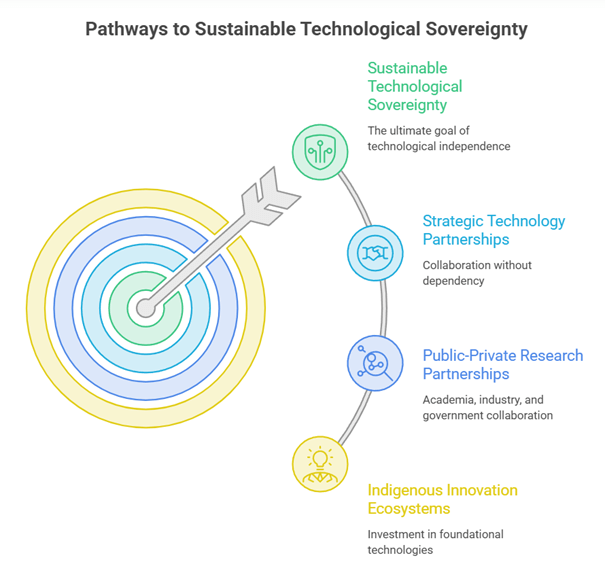
- India must move beyond digital service innovation toward leadership in foundational technologies through greater investments in basic science, applied research and commercialization.
- Schemes such as the National Quantum Mission, Semicon India Programme, IndiaAI Mission, and the National Research Foundation can create long-term innovation capacity if adequately funded and institutionally supported.
- Example: The development of NavIC demonstrates how strategic investment in indigenous capability can transform a vulnerability into a sovereign technological asset.
2. Expanding Public–Private Research Partnerships
- Greater collaboration between academia, startups, industry and government laboratories is essential for translating research into globally competitive products and technologies.
- The emerging model of involving private industry in strategic sectors such as the Advanced Medium Combat Aircraft (AMCA) programme reflects a shift toward innovation-driven defense manufacturing.
- Case Study: The growth of India’s startup ecosystem in fintech, space technology and deep-tech sectors illustrates how targeted policy support can accelerate indigenous innovation and commercialization.
3. Building Strategic Technology Partnerships Without Dependency
- Technological sovereignty does not imply technological isolation; rather, it requires resilient and diversified partnerships that prevent overdependence on any single country or technology provider.
- Joint development and co-production arrangements can facilitate technology acquisition while strengthening domestic capabilities and supply-chain resilience.
- Examples:
- BrahMos missile programme demonstrated the benefits of collaborative technological development while enhancing domestic strategic capacity.
- Micron’s semiconductor assembly and testing facility in Gujarat supports the development of an indigenous semiconductor ecosystem through international cooperation.
- Participation in emerging technology partnerships and trusted supply-chain initiatives can help India access advanced technologies while preserving strategic autonomy.
Conclusion:
- India’s digital transformation demonstrates that it possesses the institutional capacity, market scale, and policy vision required to build world-class public digital infrastructure. However, durable technological independence cannot rest solely on successful digital platforms; it ultimately depends on sustained investments in research, innovation, advanced manufacturing, human capital, and frontier technologies.
- With R&D spending still significantly below the global average and emerging technologies increasingly shaping economic and strategic power, bridging the innovation gap has become a national imperative.
- If India successfully combines its strengths in digital public infrastructure with a robust research ecosystem, it can evolve from being a major technology consumer and platform innovator into a leading creator of next-generation technologies, thereby securing both developmental progress and strategic autonomy in the decades ahead.