
Women Reservation Delimitation India: Impact of Seat Expansion and Political Power Shift
Women Reservation Delimitation India is emerging as a crucial topic in Indian polity, especially after the Constitution (106th Amendment) Act, 2023, which introduces one-third reservation for women in the Lok Sabha and State Assemblies. Combined with delimitation and seat expansion, this reform could significantly reshape India’s political and social power structures.
Introduction
- The Constitution (106th Amendment) Act, 2023 (popularly known as Nari Shakti Vandan Adhiniyam) mandates one-third reservation for women in the Lok Sabha and State Legislative Assemblies, including within SC/ST reserved constituencies. However, its implementation is contingent upon delimitation after the Census, making its timing and sequencing critical.
- Simultaneously, proposals for delimitation (redrawing constituencies based on population) and seat expansion (potentially increasing Lok Sabha strength from 543 to around 800+) introduce a structural reconfiguration of representation. Given that women currently constitute only about 14–15% of Lok Sabha members, while local bodies already demonstrate over 45% female participation due to reservations, these combined reforms could fundamentally alter gender representation, federal balance, and social equity in India’s political system.
Body
1. Transformation of Gender Representation and Political Participation
a) Deepening Women’s Political Inclusion
- The one-third quota can significantly raise women’s representation from current low levels, aligning India closer to countries like Rwanda (over 60% women legislators).
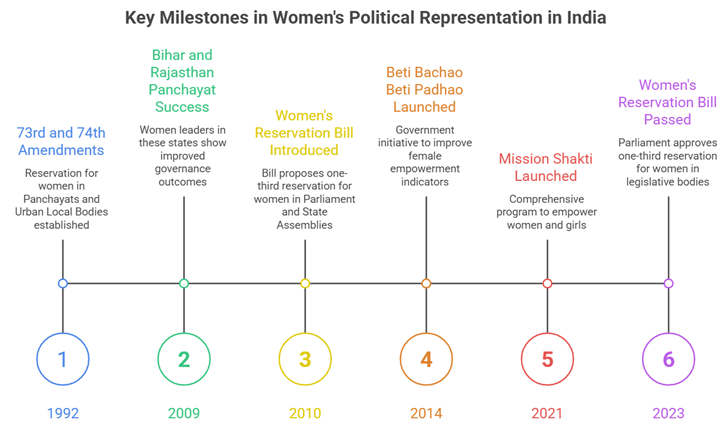
- Example: The success of 73rd and 74th Constitutional Amendments shows that reservation in Panchayats increased women's participation beyond the mandated 33%, with many states reaching 50%.
- Case Study: In states like Bihar and Rajasthan, women leaders in Panchayats have improved outcomes in sanitation, education, and nutrition, indicating governance gains from gender inclusion.
b) Social Diversification within Women’s Representation
- Reservation within SC/ST categories ensures intersectional inclusion, but absence of OBC sub-quota may limit broader social representation.
- Example: Demands for OBC women’s reservation reflect concerns that benefits may be concentrated among relatively privileged groups.
- Schemes like Beti Bachao Beti Padhao and Mission Shakti have improved female empowerment indicators, but political representation remains uneven across social groups.
c) Challenges of Rotation and Political Continuity
- The rotation of reserved constituencies may disrupt accountability and constituency development, as representatives may not get repeated opportunities.
- Example: Earlier debates on the Women’s Reservation Bill highlighted fears that frequent rotation could create “proxy representation” or discourage long-term investment in constituencies.
- Case Study: In Panchayats, some regions observed initial proxy leadership, though this reduced over time as women gained political experience.
2. Regional Power Rebalancing through Delimitation and Seat Expansion
a) Population-Based Redistribution and North–South Divide
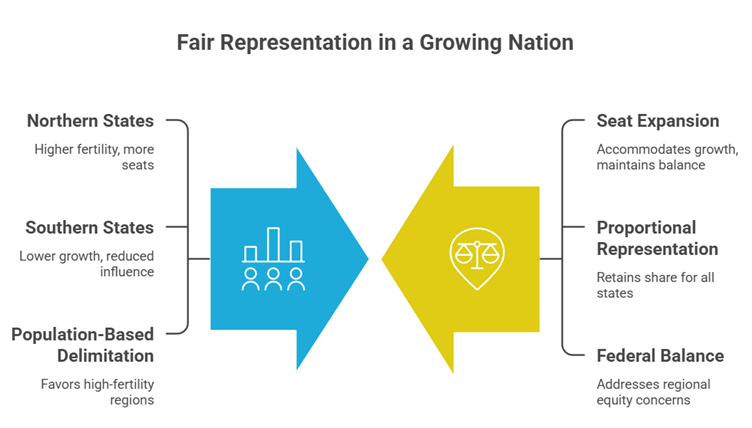
- Delimitation based on population tends to favour northern states like Uttar Pradesh and Bihar, which have higher fertility rates.
- Example: Projections suggest that these states could together approach nearly 180 Lok Sabha seats, while southern states may have relatively fewer increases despite economic contributions.
- Case Study: Southern states like Tamil Nadu and Kerala, which achieved demographic transition early, may face reduced proportional influence, raising concerns about fiscal and political fairness.
b) Seat Expansion as a Balancing Mechanism
- Expanding total seats aims to retain proportional representation while accommodating population growth.
- Example: Increasing Lok Sabha seats to around 800+ could prevent drastic reduction in southern states’ share while still increasing northern representation.
- The ongoing development of the new Parliament building with higher seating capacity reflects institutional preparedness for expansion.
c) Implications for Federalism and Inter-State Equity
- Shifts in seat distribution may alter federal balance, potentially intensifying regional disparities.
- Example: States contributing more to GDP but with lower population growth may perceive reduced influence in national decision-making.
- Case Study: Past debates on Finance Commission allocations already show tensions between population-based and performance-based criteria, which delimitation could further intensify.
3. Data, Timing and Structural Implications for Social Representation
a) Use of Outdated Census Data vs Dynamic Demographics
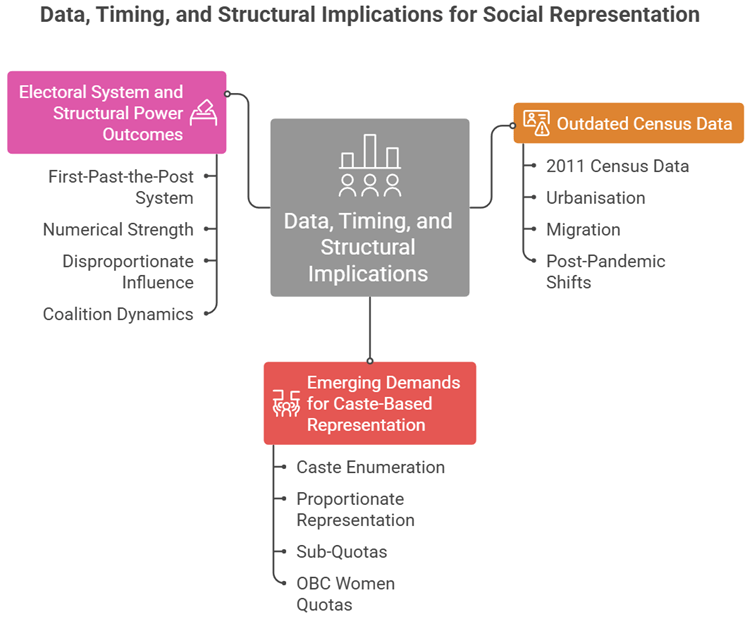
- Using 2011 Census data for delimitation risks misrepresenting urbanisation, migration, and post-pandemic demographic shifts.
- Example: Rapid urban growth in cities like Bengaluru and Hyderabad has significantly altered constituency profiles since 2011.
- Case Study: COVID-19-induced reverse migration exposed gaps in population data, highlighting the need for updated enumeration.
b) Emerging Demands for Caste-Based Representation
- The upcoming Census with potential caste enumeration could trigger demands for proportionate representation and sub-quotas within women’s reservation.
- Example: Several political parties and social groups have demanded inclusion of OBC women quotas to ensure equitable representation.
- State-level caste surveys (e.g., Bihar) have already intensified debates on representation vs population share.
c) Electoral System and Structural Power Outcomes
- India’s first-past-the-post system amplifies the impact of numerical strength, meaning even proportional increases can lead to disproportionate political influence.
- Example: Larger states with more seats can dominate coalition dynamics and national policy priorities.
- Case Study: Historical electoral trends show that states with higher seat counts often play a decisive role in forming central governments.
Conclusion
- The simultaneous implementation of women’s reservation, delimitation, and seat expansion represents one of the most significant transformations of India’s representative framework since independence. While it holds the promise of advancing gender justice and improving democratic inclusivity—especially given evidence from local governance where women’s participation has crossed 45%—it also raises critical concerns about regional balance, data accuracy, and social equity.
- A calibrated approach is essential: conducting delimitation based on updated Census data, ensuring transparent criteria, and addressing demands for inclusive sub-quotas can strengthen legitimacy. With India projected to remain one of the world’s youngest and most diverse democracies, these reforms—if implemented with deliberation and consensus—can reshape political power in a manner that is both representative and equitable, reinforcing the foundations of a robust federal democracy.
- The simultaneous implementation of women’s reservation, delimitation, and seat expansion represents one of the most significant transformations of India’s representative framework since independence. While it holds the promise of advancing gender justice and improving democratic inclusivity—especially given evidence from local governance where women’s participation has crossed 45%—it also raises critical concerns about regional balance, data accuracy, and social equity.
- A calibrated approach is essential: conducting delimitation based on updated Census data, ensuring transparent criteria, and addressing demands for inclusive sub-quotas can strengthen legitimacy. With India projected to remain one of the world’s youngest and most diverse democracies, these reforms—if implemented with deliberation and consensus—can reshape political power in a manner that is both representative and equitable, reinforcing the foundations of a robust federal democracy.
Recap: