
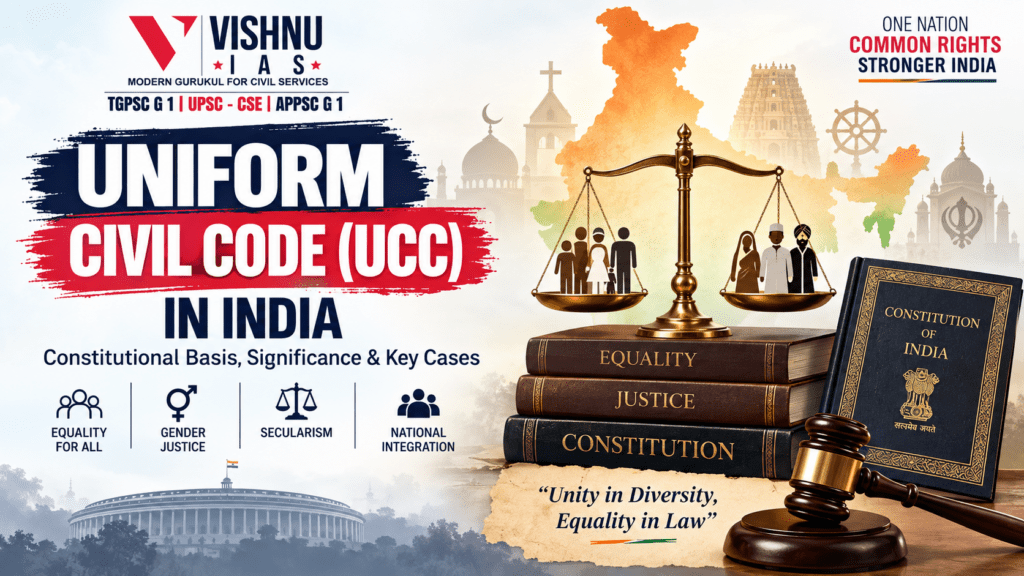
Uniform Civil Code (UCC) in India: Constitutional Basis, Significance & Key Cases
Uniform Civil Code (UCC) in India refers to a common set of civil laws governing all citizens, irrespective of their religion, in matters such as marriage, divorce, adoption, maintenance, guardianship and inheritance. At present, several of these matters are governed by different personal laws and customary practices.
The constitutional vision for a UCC is contained in Article 44, which directs the State to “endeavour to secure” a Uniform Civil Code for citizens throughout India. Thus, UCC seeks to balance the ideals of equality and gender justice with India’s religious and cultural pluralism.
Constitutional Basis of UCC
1. Article 44 – Directive Principle
- Article 44 is the direct constitutional basis for UCC. It is part of the Directive Principles of State Policy (DPSP) and is therefore non-justiciable. It cannot by itself be enforced by a court, but it provides a constitutional direction to the State to work towards common civil laws.
- The Constituent Assembly deliberately placed UCC under the DPSP because the issue involved deep religious, cultural and social sensitivities.
2. Article 14 – Equality before law
- UCC can advance the constitutional principle of equality before law by ensuring that citizens receive similar civil rights irrespective of their religious identity.
- For instance, common rules regarding inheritance, divorce or maintenance could reduce disparities arising from different personal-law regimes.
3. Articles 15 and 21 – Gender justice and dignity
- Article 15 prohibits discrimination, and Article 21 protects life and personal liberty.
- Personal-law reforms can therefore be used to eliminate discriminatory practices and secure equal rights, dignity and autonomy for women in matters of marriage, divorce, inheritance and property.
- The Supreme Court's jurisprudence on practices such as triple talaq illustrates the constitutional concern with discriminatory personal-law practices.
4. Articles 25 and 26 – Freedom of religion
- UCC needs to respect freedom of conscience and religion under Article 25 and the rights of religious denominations under Article 26.
- The constitutional challenge is therefore to distinguish between genuinely religious practices and secular activities associated with religion, which can be regulated by the State.
- In S.R. Bommai v. Union of India (1994), the Supreme Court recognised secularism as a basic feature of the Constitution and emphasised the distinction between matters of faith and secular activities capable of State regulation.
5. Article 29 and cultural diversity
- Article 29 protects the interests of sections of citizens having a distinct language, script or culture. Therefore, a UCC cannot simply equate uniformity with cultural homogenisation.
- This is particularly important for tribal and customary practices, including those enjoying constitutional protection in parts of the North-East.
6. Concurrent List and federal dimension
- Several subjects covered by personal laws, including marriage, divorce, adoption and succession, fall within the Concurrent List.
- Therefore, both Parliament and State Legislatures have legislative competence in these areas. A nationwide UCC would consequently have to account for the federal structure and existing State-specific laws and customs.
Significance of UCC
1. Promotes equality
- A UCC can establish a common set of civil rights and obligations, reducing religion-based differences in the application of civil law.
- It would strengthen the constitutional ideal that citizenship, rather than religious identity, should determine civil rights.
2. Advances gender justice
- One of the strongest arguments for UCC is the possibility of removing discriminatory provisions relating to marriage, divorce, maintenance, guardianship and inheritance.
- A gender-just civil code can give women equal rights and strengthen their constitutional status as equal citizens.
3. Strengthens secularism
- UCC can promote religion-neutral civil law while leaving individuals free to practise and propagate their religion.
- Thus, secularism need not mean hostility towards religion; rather, it can mean that civil rights are not determined by one's religious identity.
4. Promotes national integration
- A common civil framework can strengthen a shared sense of citizenship and constitutional identity.
- It can contribute to the idea of “unity without uniformity”, provided that the UCC is based on common constitutional principles rather than the customs of any particular community.
5. Simplifies the legal system
- Different personal laws can make civil disputes more complex, particularly where people belonging to different communities marry or inherit property.
- A common framework could provide greater legal clarity and predictability and potentially reduce the complexity of adjudication.
6. Enables progressive social reform
- UCC can provide an opportunity to replace discriminatory or outdated practices with laws based on equality, dignity, individual autonomy and children's welfare.
- The experience of Goa, which has a common civil-law framework applicable across communities with certain exceptions, demonstrates that some degree of civil-law uniformity can coexist with social diversity. The Supreme Court has recognised Goa as an example in its UCC-related observations.
Two Important Judicial Decisions
1. Mohd. Ahmed Khan v. Shah Bano Begum (1985)
- The Supreme Court held that a divorced Muslim woman could claim maintenance under the secular maintenance provision then contained in Section 125 of the CrPC, irrespective of her personal law.
- The Court also expressed concern over the absence of a common civil code and emphasised its potential role in removing contradictions arising from different personal laws.
- The case highlighted the relationship between gender justice, secular law and the constitutional aspiration for UCC.
2. Sarla Mudgal v. Union of India (1995)
- The Supreme Court examined cases where Hindu husbands converted to Islam and attempted to contract a second marriage without dissolving the first marriage.
- The Court held that conversion could not be used to circumvent the existing law relating to monogamy and marriage. It also strongly emphasised the need to consider Article 44 and observed that a common civil code could help promote national integration by removing contradictions based on different ideologies.
Limitations
- India has considerable religious, tribal and customary diversity. For example, customary systems in parts of the North-East have distinctive rules relating to marriage, inheritance and property. A uniform code that ignores such diversity may generate resistance and undermine trust.
- There are also concerns regarding Article 25 religious freedom, Article 29 cultural rights, federalism and the possibility of majoritarian influence in determining the content of the common code.
- The 21st Law Commission's 2018 consultation had emphasised that secularism cannot be understood as requiring uniformity, and suggested reforming discriminatory provisions within existing personal laws where necessary.
Way Forward
- Identify and remove discriminatory provisions in all personal laws, rather than targeting any particular community.
- Codify personal laws wherever possible to improve clarity and ensure compatibility with fundamental rights.
- Undertake wide consultation with religious and tribal communities, women's organisations, legal experts and civil society.
- Adopt a gradual and reform-oriented approach, allowing legitimate customs to coexist with constitutional values where they do not violate equality and dignity.
- Ensure that the final code is based on constitutional morality rather than the practices of the majority community.
Conclusion
A Uniform Civil Code can become an important instrument for advancing equality, gender justice, secularism and national integration. However, in a plural society like India, its legitimacy will depend not merely on achieving legal uniformity but on creating a rights-based and inclusive civil framework. Thus, the constitutional objective should be “uniformity in rights, not homogenisation of identities”.