
How the UK-India Free Trade Agreement is Reshaping India’s Global Capability Centres Ecosystem
The UK-India Free Trade Agreement (FTA), under negotiation since January 2022, is poised to become a milestone in bilateral economic relations between two of the world’s most prominent service-driven economies. According to the UK’s Department for Business and Trade, bilateral trade stood at £38.1 billion in 2023, and the FTA is expected to double this figure by 2030, enhancing collaboration across goods, services, investment, and innovation.
Within this landscape, Global Capability Centres (GCCs) — centralized units of multinational corporations (MNCs) that offer technology, finance, HR, R&D, and analytics support — are emerging as crucial instruments of digital globalization. The UK-India Free Trade Agreement has the potential to reshape the GCC ecosystem in India by streamlining regulatory, digital, and labour mobility barriers. This becomes especially relevant as British firms increasingly seek strategic R&D partnerships and knowledge-based services from India, beyond cost-efficiency goals.
Economic & Strategic Significance of The FTA For GCC Expansion
- Deepening UK-India Innovation Linkages
- R&D and Emerging Tech: The FTA can formalize collaboration in AI, quantum computing, fintech, and life sciences. UK-based banks like Barclays and Standard Chartered already operate GCCs in India for cybersecurity and analytics functions.
- Bilateral Start-up Exchange: Initiatives like the UK-India Tech Partnership and STARTUP20 complement the FTA’s vision by fostering co-innovation and incubation.
- Example: HSBC’s Technology India Centre in Pune is one of its largest global hubs, aligning R&D, finance, and cloud services—supported by India's skilled talent and liberal tech policy.
- Increasing Cross-Border Services Trade
- Services Sector Gains: The UK’s services exports to India grew 22.4% in 2023. The FTA can institutionalize this trend, especially in consulting, education, healthcare, and IT services.
- Easing Double Taxation & Data Localisation Norms: Key issues like double taxation relief and data sovereignty are expected to be streamlined.
- Case Study: Deloitte India’s white paper (2024) highlights India-based GCCs now manage global tax compliance and transfer pricing for MNCs.
- Enhancing Foreign Direct Investment (FDI) and Job Creation
- Incentivising GCCs in Tier-2/3 Cities through FTA-triggered investment flows.
- Government Incentives: PLI Scheme for IT Hardware, Industrial Policy Draft 2023, and state incentives are driving growth.
- Example: Uttar Pradesh’s first GCC Conclave (2025) saw Microsoft and HCL exploring investments.
- Strategic Realignment Post-Brexit
- Post-Brexit, the UK is pivoting toward Indo-Pacific economies; the FTA allows digital market access via India.
- Example: British tech firms like ARM and BT Group are exploring India for talent and digital market integration.
Policy, Governance, And Regulatory Facilitation
- Regulatory Harmonisation and Ease of Doing Business
- Harmonizing data protection and digital service norms via alignment of UK's Digital Bill and India’s DPDP Act.
- Example: IP management simplification for UK MNCs through FTA provisions.
- Talent Mobility and Professional Skilling
- Mutual Recognition of Qualifications and schemes like Skill India, FutureSkills PRIME aiding workforce readiness.
- Example: Migration and Mobility Partnership (2021) enabling 3,000 Indian professionals/year in the UK.
- Creation of a National GCC Policy Framework
- Budget 2025 to unveil a national policy via MeitY, NASSCOM, and Invest India.
- Example: Telangana’s IT GCC Policy 2023 offering extensive fiscal incentives.
- IP and Cybersecurity Collaboration
- FTA may align UK and Indian cybersecurity protocols, especially for finance and health GCCs.
- Case Study: The UK’s NCSC has worked with Indian agencies under the 2021 Cybersecurity MoU.
Socio-Economic, Regional, And Diplomatic Impacts
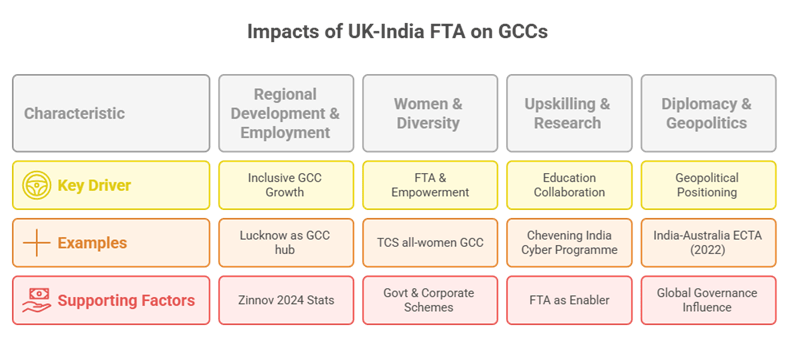
- Regional Development and Employment Creation
- GCC decentralization toward Tier-2 cities like Lucknow, Bhubaneswar promotes inclusive development.
- Stats: Zinnov 2024 reported 65 new GCCs launched in non-metro cities, employing over 45,000 graduates.
- Women and Diversity in Digital Workforces
- FTA-fueled job growth and remote work improve gender and social diversity.
- Example: TCS’s all-women GCC in Chennai serving UK clients highlights inclusive models.
- Upskilling, Academia and Research Collaboration
- Joint UK-India R&D centers and easing mobility of scholars enhance tech talent pipelines.
- Example: Chevening India Cyber Programme enables student R&D in UK universities.
- Diplomacy, Strategic Signalling and Economic Statecraft
- The FTA as a digital-age alliance model between two major democracies.
- Example: India-Australia ECTA (2022) provides a template for digital trade chapters.
Conclusion:
The UK-India Free Trade Agreement stands as a strategic lever to reimagine the GCC ecosystem in India — transforming them from cost-saving units into innovation and value creation hubs. By integrating digital trade, professional mobility, regulatory coherence, and R&D cooperation, the FTA can help India leapfrog into the top echelon of global digital services exporters.
The FTA offers more than tariff reductions — it can architect a knowledge-based partnership that empowers both nations in the age of digital globalization.
Recap: