
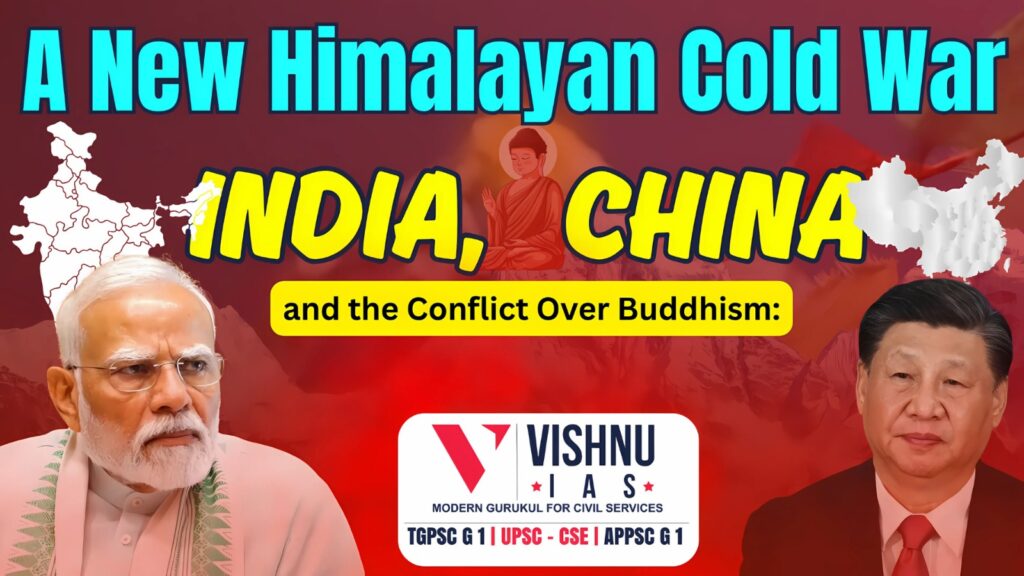
Faith as a Strategic Frontier in the India-China Rivalry over the Himalayas
In the 21st century, geopolitical competition between India and China has expanded beyond traditional military and economic domains into more subtle instruments of soft power—with faith and spiritual influence emerging as pivotal tools. Nowhere is this more evident than in the India-China Himalayan rivalry, where Buddhism, once a unifying spiritual force, is being deployed as a strategic asset by both nations.
In this region, where territorial boundaries often blur into cultural and spiritual landscapes, the control over religious institutions, the reincarnation of Lamas, and monastic allegiances have become tools to assert sovereignty and legitimacy. This has turned the serene monasteries of Ladakh, Arunachal Pradesh, and Tibet into the epicentres of geopolitical manoeuvring.
Faith as a Tool of Geopolitical Statecraft
- China’s Politicization of Tibetan Buddhism
- Reincarnation as Political Control: Since 2007, China mandates that all reincarnate lamas (tulkus) be state-approved—a process legitimized through "Order No. 5".
- Golden Urn Method: China plans to use the Qing-era ritual to anoint a state-backed 15th Dalai Lama.
- Panchen Lama Case: The Dalai Lama’s appointee remains missing since 1995 while China backs its own version.
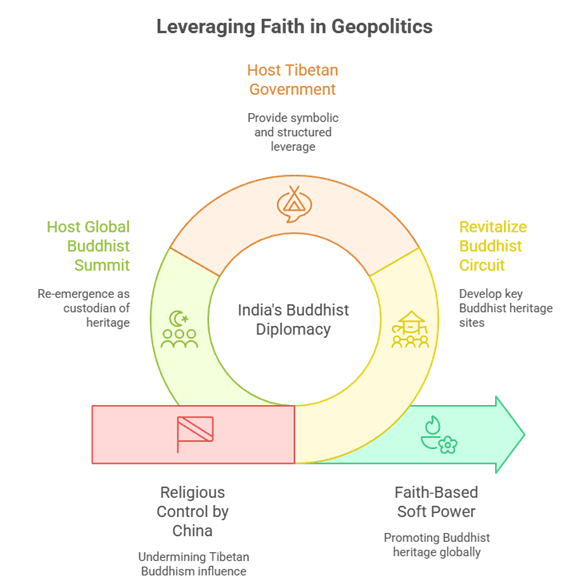
- India’s Belated Buddhist Diplomacy
- Promotion of the Buddhist Circuit under PRASHAD scheme.
- Hosting of the Tibetan Government-in-Exile in Dharamshala since 1959.
- Global Buddhist Summit (2023): First summit held with participation from 30+ countries.
Faith-Based Identity and Border Influence
- Monasteries in border areas influence local politics and allegiances.
- Spiritual claims are used to assert territorial control (e.g., Tawang).
- China’s outreach to Bhutan through monastery construction near Doklam and Lhuentse.
Faith as a Mechanism of Cultural Integration
- China builds temples and offers scholarships to regional monks.
- Over 1,700 Tibetan monasteries are digitally surveilled.
- Lumbini Project: $3 billion Buddhist park and airport, projecting soft power in Nepal.
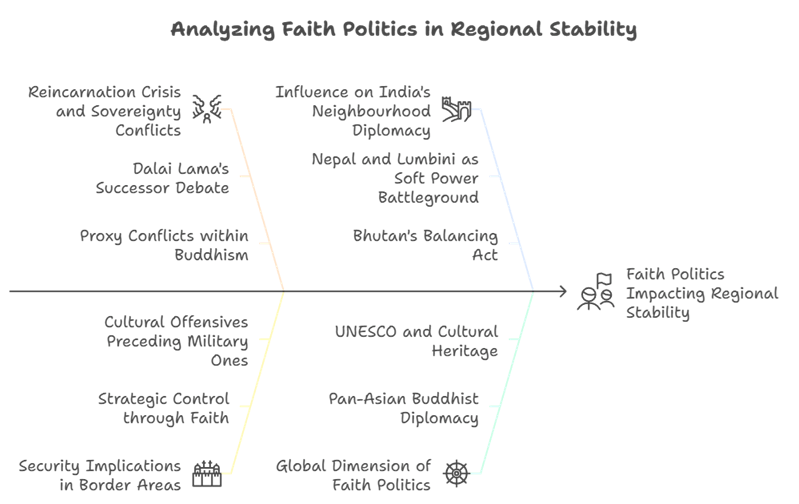
Impact on Regional Stability and Sovereignty
- Dalai Lama Succession Crisis: Will reshape religious allegiances in the Himalayas.
- Proxy Conflicts: Example: Dual Karmapa lineage backed separately by India and China.
- Dorje Shugden Sect: Backed by China to divide Tibetan Buddhist leadership.
Security Implications in Border Areas
- Religious leaders influence border sentiment (e.g., Ladakh).
- China’s military narratives increasingly invoke Buddhist history.
- Galwan Valley Example: China’s spiritual framing post-2020 clash.
Influence on India’s Neighbourhood Diplomacy
- China’s Lumbini push reshapes regional spiritual corridors.
- Bhutan remains vulnerable despite resistance to hosting the Dalai Lama.
- Mongolia Case Study: Sanctioned by China for inviting the Dalai Lama in 2016.
Global Dimension of Faith Politics
- Both countries engage with Buddhist-majority nations like Sri Lanka, Myanmar, and Vietnam.
- India seeks UNESCO recognition for Buddhist heritage sites.
- Mongolia balances religious freedom with economic ties to China.
Policy Initiatives, Challenges, and Future Prospects
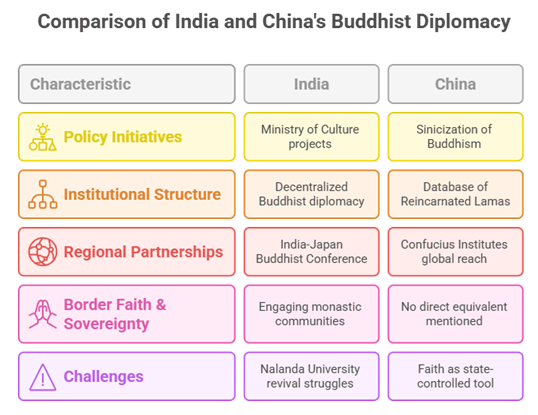
- India's Ministry of Culture initiatives: Buddha Circuit, Buddhist chairs, ICCR programs.
- Act East Policy incorporates Buddhist diplomacy to counter Chinese influence.
- India-Japan Buddhist partnership and BIMSTEC Buddhist Heritage Circuit proposals.
- Local Development: Vibrant Villages Programme integrates monasteries into civil planning (e.g., Hemis Monastery’s support in 2020).
Conclusion
In the rugged, high-altitude landscape of the Himalayas, faith is no longer just a matter of the soul—it is a strategic frontier. As India and China vie for influence, the spiritual landscape is being reshaped by geopolitical ambitions, with monasteries, reincarnations, and ritual authority becoming critical instruments of soft power.
The outcome of this India-China Himalayan rivalry could determine the cultural-political fabric of the region for decades. With the 14th Dalai Lama’s succession on the horizon, decisions taken today will echo across borders and redefine Asia’s spiritual identity for generations.
Recap: