Slow Decay of the Liberal International Order: Dangers, Causes and Emerging Global Alternatives
The Slow Decay of the Liberal International Order is reshaping global governance, geopolitical stability, and multilateral cooperation. The liberal international order refers to the system of rules, institutions, norms, and cooperative mechanisms established after World War II to regulate relations among sovereign states and prevent large-scale conflict. Anchored by institutions such as the United Nations, it rests on principles of sovereign equality, multilateralism, rule of law, collective security, and open economic exchange.
When Harry S. Truman addressed the UN’s founding in 1945, he emphasized restraint and shared responsibility as the basis for durable peace. This system helped prevent direct war between major powers for over seven decades, even as global military expenditure reached over $2.4 trillion in 2024 (SIPRI) and more than 75% of global trade continued under rule-based frameworks linked to the WTO system.
However, growing unilateralism, weakening institutional legitimacy, and geopolitical competition signal a slow decay of this order, raising concerns about future global stability and governance.
I. Dangers Arising from the Slow Decay of the Liberal International Order
1. Erosion of Sovereignty, Rule of Law, and Norm-Based Stability
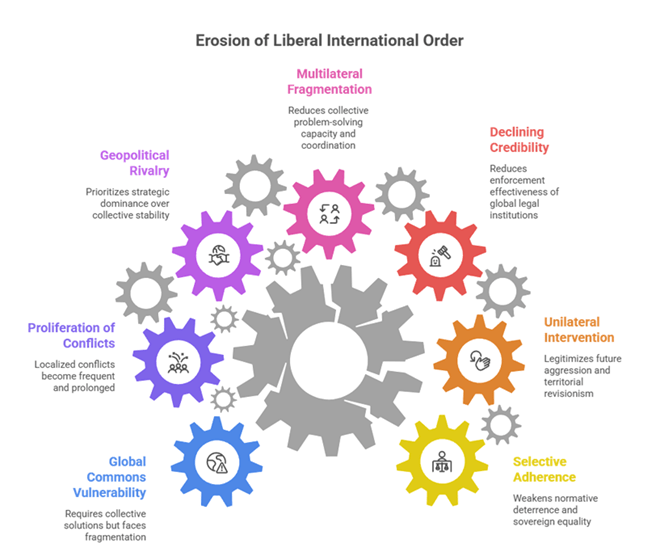
- Selective adherence to international law weakens normative deterrence. When powerful states disregard norms, smaller states lose faith in protections guaranteed by international law, undermining sovereign equality.
- Precedents of unilateral intervention legitimize future aggression.
- Example: Crimea Annexation (2014) demonstrated how weakening norms enables territorial revisionism.
- Declining credibility of global legal institutions such as the International Court of Justice due to reliance on voluntary compliance.
- Case Study: South China Sea Arbitration (2016) illustrated limits of legal authority without enforcement capacity.
2. Fragmentation of Multilateralism and Global Governance
- Withdrawal or disengagement from multilateral institutions reduces collective problem-solving capacity.
- Institutional paralysis due to geopolitical rivalry, especially veto use in the UN Security Council.
- Example: Syrian Civil War divisions prevented decisive humanitarian intervention despite mass casualties exceeding 500,000.
- Weakening economic governance and rise of protectionism through trade weaponization and sanctions.
3. Increased Risk of Geopolitical Instability and Multipolar Competition
- Emergence of competitive spheres of influence replacing cooperative frameworks.
- Example: Taiwan Strait tensions threaten trade routes handling over 50% of maritime commerce.
- Proliferation of regional conflicts and proxy wars.
- Example: Yemen conflict prolonged humanitarian crisis affecting over 20 million people.
- Vulnerability of global commons governance including climate change and cyber threats.
- Example: Despite the Paris Agreement, 2023 recorded as the hottest year.
II. Structural Causes Behind the Decay of the Liberal International Order
1. Shifting Power Balance and Rise of New Global Powers
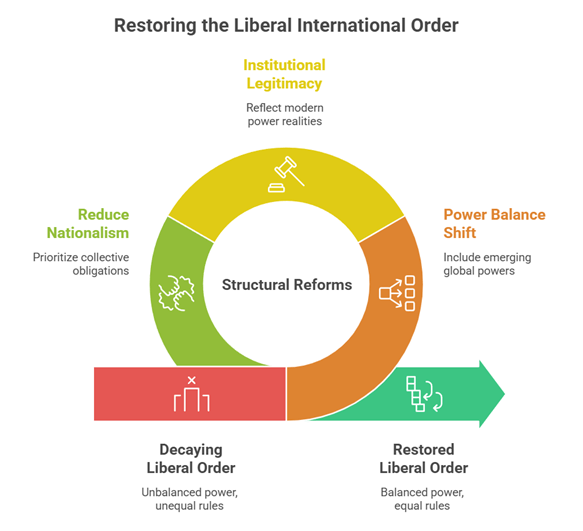
- Transition from unipolarity to multipolarity challenges existing hierarchies.
- China’s Belt and Road Initiative spans over 150 countries, reshaping governance dynamics.
- Middle powers such as India pursue strategic multi-alignment (e.g., QUAD and BRICS participation).
2. Institutional Legitimacy Deficits and Structural Inequalities
- Outdated post-war institutional structures.
- Selective rule enforcement undermines trust.
- Technological change outpaces regulatory mechanisms (e.g., fragmented cyber warfare regulations).
3. Rise of Nationalism, Populism, and Strategic Competition
- Domestic pressures promote unilateralism.
- Economic nationalism disrupts integration.
- Case Study: US–China Trade War disrupted global supply chains.
- Weaponization of interdependence through sanctions and export controls.
III. Possible Alternatives That May Replace the Liberal International Order
1. Emergence of a Multipolar and Regionalized Global Order
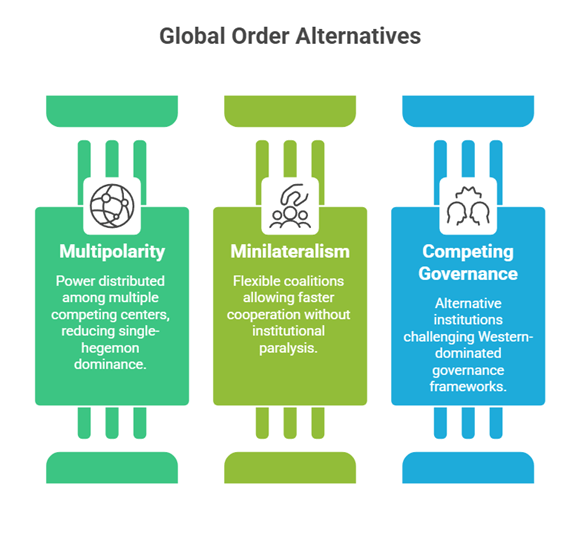
- Power distributed among multiple centers.
- Example: European Union strategic autonomy initiatives.
- Regional organizations such as the African Union gaining prominence.
- Example: Regional Comprehensive Economic Partnership (RCEP) covering nearly 30% of global GDP.
2. Rise of Minilateralism and Issue-Based Coalitions
- Flexible coalitions allow faster cooperation.
- Case Study: International Solar Alliance promoting renewable collaboration.
- Technology and economic alliances shaping global standards.
3. Emergence of Competing Governance Models and Parallel Institutional Systems
- Alternative institutions such as the New Development Bank.
- Sino-centric or regionalized frameworks like the Belt and Road Initiative.
- Hybrid global order combining cooperation and competition.
Conclusion
The slow decay of the liberal international order represents not merely an institutional crisis but a transformational shift in global power and governance. While challenges persist, its foundational principles remain embedded in global diplomacy, with 193 countries participating in UN mechanisms and multilateral trade exceeding $32 trillion annually (UNCTAD).
Rather than collapsing entirely, the emerging future is likely to be a hybrid multipolar order combining multilateral institutions, regional frameworks, and flexible coalitions. Strengthening institutional legitimacy, expanding representation, enhancing compliance mechanisms, and fostering cooperative leadership will ensure global governance evolves rather than disintegrates.
As global interdependence deepens, cooperative frameworks remain indispensable to prevent fragmentation and ensure sustainable peace, stability, and prosperity.
Recap: