Right to Disconnect Bill 2025 and Article 21: Protecting Autonomy in India’s Digital Economy
Introduction
The Right to Disconnect Bill 2025 Article 21 debate highlights a critical transformation in modern labour relations. The Right to Disconnect refers to an employee’s entitlement to disengage from work-related digital communications beyond prescribed working hours without fear of reprisal. In a hyper-connected digital economy, characterised by remote work, platform-based employment and algorithmic management, the boundary between professional and personal life has increasingly eroded.
Empirical assessments by international labour institutions and national time-use surveys consistently indicate that prolonged digital availability is associated with heightened stress, sleep deprivation, and declining mental well-being, especially among urban, white-collar and service-sector workers.
In India, the introduction of the Right to Disconnect Bill, 2025, as a private member’s bill, comes against the backdrop of the four consolidated labour codes, which continue to regulate work primarily through time-based constructs rooted in the physical workplace. The constitutional question thus arises: whether the right to disconnect is merely a statutory labour protection or an essential extension of the Right to Life and Personal Liberty under Article 21, safeguarding individual autonomy, dignity and mental health in a digitally mediated world.
I. Constitutional Foundations: Individual Autonomy and Article 21
Expansion of Article 21 to include dignity, privacy and mental well-being
-
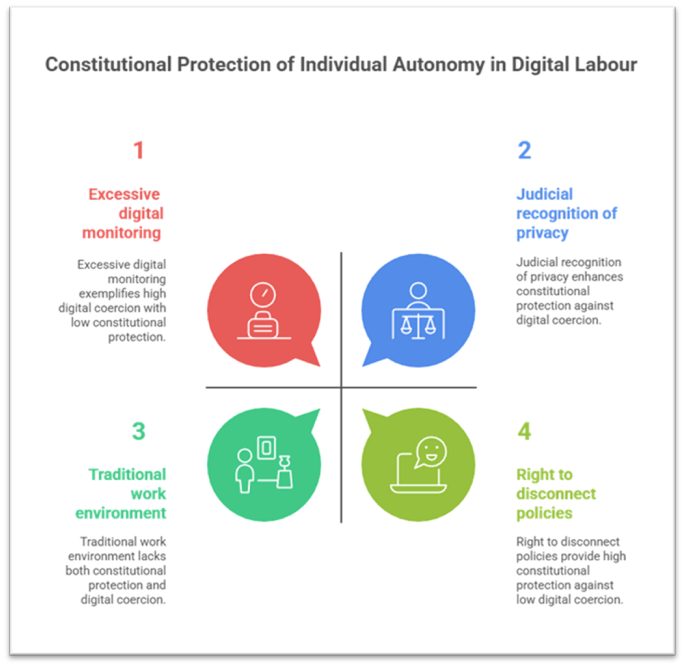
Judicial interpretation has transformed Article 21 from a narrow guarantee of physical existence into a broad protection of dignity, privacy, autonomy and psychological integrity, making freedom from constant digital surveillance and compulsion a constitutional concern rather than a contractual convenience.
-
The continuous expectation of after-hours responsiveness compromises an individual’s ability to exercise control over personal time, directly implicating decisional autonomy recognised under constitutional jurisprudence.
-
Examples: Judicial recognition of privacy as intrinsic to life and liberty has already extended constitutional protection into non-physical domains such as data, decisional freedom and bodily autonomy, creating a logical pathway for protecting temporal autonomy in digital labour.
Right to Disconnect as protection against digital coercion
-
In modern workplaces, employer control increasingly operates through emails, messaging platforms and productivity-tracking tools, converting personal time into latent work time without formal recognition or compensation.
-
Such indirect coercion undermines the voluntariness of rest, transforming leisure into an extension of managerial control, which conflicts with the constitutional promise of meaningful liberty.
-
Case Studies: Reports of employee burnout and litigation over excessive digital monitoring in IT and service sectors illustrate how constant connectivity functions as a form of invisible compulsion rather than free choice.
Substantive due process and proportionality
-
Article 21 requires that any restriction on liberty must be fair, just and reasonable; unchecked employer expectations of perpetual availability fail the test of proportionality when weighed against legitimate business interests.
-
The right to disconnect introduces a constitutional balance between economic efficiency and human dignity, reinforcing that productivity cannot override fundamental freedoms.
-
Government initiatives: The broader constitutional ethos aligns with welfare-oriented labour reforms and occupational safety measures embedded in India’s labour codes, though digital autonomy remains under-articulated.
II. Legal Necessity within India’s Labour Law Framework
Conceptual gap in defining ‘work’ in a digital economy
-
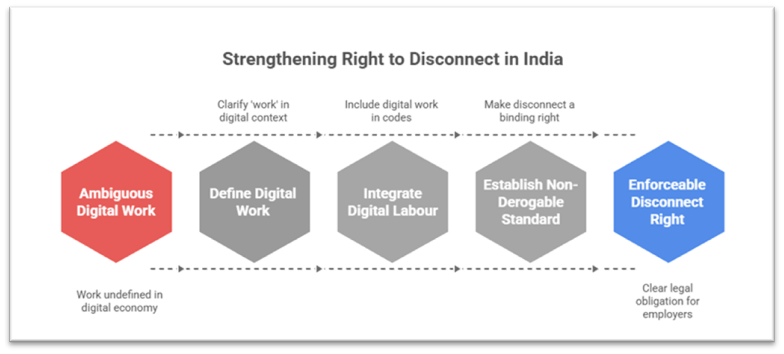
Indian labour law continues to conceptualise work as activity performed within defined hours and physical spaces, leaving after-hours digital engagement in a legal grey zone.
-
The Right to Disconnect Bill regulates communication behaviour without clarifying whether such engagement constitutes legally cognisable “work,” thereby weakening its enforceability.
-
Examples: Employees responding to late-night emails or participating in virtual meetings outside office hours often find such time excluded from overtime calculations, exposing the limitations of existing definitions.
Interaction with labour codes and employer control
-
The Occupational Safety, Health and Working Conditions Code prescribes limits on working hours and rest, but its application to digital availability remains ambiguous.
-
Without integrating digital labour into the working-time framework, the right risks becoming a discretionary workplace norm rather than a binding labour standard.
-
Government initiatives: Labour code reforms aimed at standardisation and simplification have yet to address algorithmic management, remote work surveillance and digital command structures.
Mandatory standard versus contractual flexibility
-
The Bill does not clearly specify whether the right to disconnect is a non-derogable labour standard or a right subject to contractual modification through employer policies or agreements.
-
Excessive contractual flexibility could dilute the right, particularly in asymmetrical employment relationships where workers lack bargaining power.
-
Case Studies: International experience shows that where disconnect rights are left entirely to employer policy, enforcement becomes uneven and dependent on organisational culture rather than legal obligation.
III. Comparative Perspectives and Normative Justification
Employer control as the determinant of working time
-
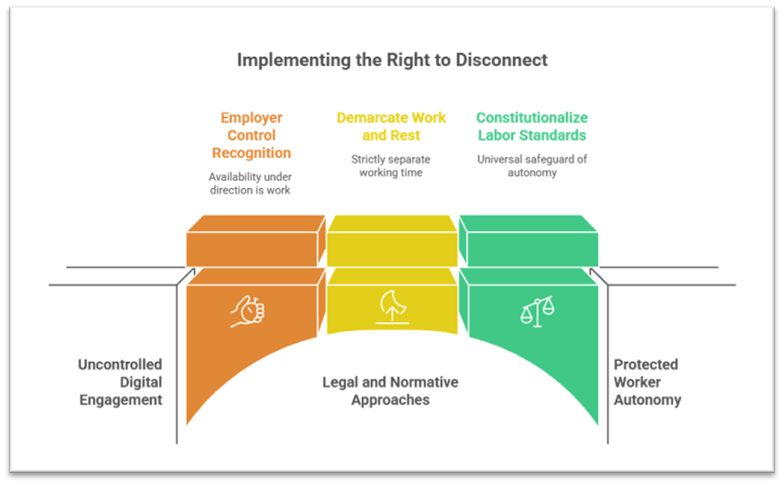
Comparative jurisprudence demonstrates that the effectiveness of the right to disconnect depends on recognising employer control over time, not merely active labour, as constituting work.
-
Jurisdictions that equate availability under employer direction with working time ensure that digital engagement is legally accounted for within labour protections.
-
Examples: European judicial approaches treating standby and on-call periods as working time illustrate how digital availability can be legally integrated without redefining work itself.
Demarcation of work and rest rather than redefining labour
-
Some legal systems avoid redefining work altogether, instead strictly separating working time from rest time and embedding digital communication norms within collective bargaining and statutory limits.
-
This approach reinforces the sanctity of rest as a legal entitlement rather than a managerial concession.
-
Government initiatives: India’s emphasis on welfare legislation and social justice aligns with such demarcation, though statutory articulation remains incomplete.
Constitutionalisation of labour standards
-
Treating the right to disconnect as constitutionally grounded elevates it from a sector-specific labour reform to a universal safeguard of autonomy applicable across evolving forms of work.
-
This approach ensures resilience against technological change, preventing future forms of digital compulsion from escaping legal scrutiny.
-
Case Studies: Global debates on platform work and gig employment reveal that rights anchored in constitutional values adapt more effectively than narrowly framed statutory protections.
Conclusion:
The Right to Disconnect Bill, 2025 acknowledges a critical transformation in the nature of work, where digital technologies have collapsed the boundary between labour and leisure. However, without integrating digital engagement into the legal understanding of working time and employer control, the right risks remaining a symbolic norm rather than an enforceable guarantee.
Constitutionally, the freedom to disengage is inseparable from Article 21’s protection of life, dignity, mental health and personal autonomy, making the right to disconnect more than a labour standard—it is a safeguard against digital overreach.
A constructive way forward lies in harmonising labour codes with constitutional values, explicitly recognising digital availability under employer control as legally relevant working time, and clarifying the non-derogable nature of the right. By grounding the right firmly in Article 21, India can ensure that technological progress strengthens, rather than erodes, human freedom in the world of work.