
India Model of Developmental Partnership with Africa: A Sustainable Alternative to Extractive Investment Models
The India Model of developmental partnership with Africa refers to a cooperative, demand-driven and capacity-building approach that prioritises mutual benefit, local ownership, and long-term sustainability, rather than short-term profit extraction. Rooted in shared anti-colonial solidarity and South-South Cooperation, India’s engagement with Africa has evolved into a development-centric economic partnership.
This approach has gained renewed momentum amid shifting global supply chains, India’s outreach through high-level diplomatic visits, and Africa’s growing role in global governance, exemplified by the African Union’s inclusion as a permanent G-20 member in 2023. As Africa emerges as a key growth frontier and India seeks diversification away from volatile Western markets, the India–Africa relationship offers a distinct alternative to dominant extractive and resource-centric investment models pursued by some other global powers.
I. Core Features of the ‘India Model’ of Developmental Partnership
1. Demand-Driven and Partnership-Based Cooperation
- India’s engagement is guided by African priorities rather than imposed conditionalities, aligning with national development plans and regional aspirations.
- Example: Lines of Credit extended by India support projects proposed by African governments in areas like rural electrification, irrigation, and transport, ensuring local relevance.
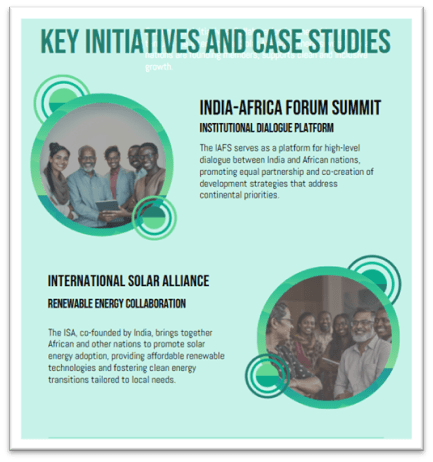
- Government Initiative: The India–Africa Forum Summit (IAFS) institutionalises dialogue on equal footing, reflecting India’s philosophy of consultation and co-creation.
2. Capacity Building and Human Capital Development
- A defining pillar of the India Model is investment in skills, institutions, and people, recognising development as a human-centric process.
- Case Study: The Indian Technical and Economic Cooperation (ITEC) programme trains thousands of African professionals annually in IT, public administration, healthcare, and entrepreneurship.
- Government Initiatives: Establishment of the Pan-African e-Network and e-VidyaBharti/e-ArogyaBharti projects has expanded access to tele-education and tele-medicine across the continent.
3. Affordable and Appropriate Technology Transfer
- India emphasises frugal innovation, offering technologies suited to African socio-economic realities rather than capital-intensive solutions.
- Example: Indian pharmaceutical companies supplying affordable generic medicines have strengthened Africa’s public health resilience.
- Government Initiative: Collaboration in renewable energy through the International Solar Alliance, where several African nations are founding members, supports clean and inclusive growth.
II. Economic Engagement Beyond Extraction
1. Trade Diversification and Value Addition
- India seeks to move beyond commodity-centric trade by promoting manufacturing, agro-processing, and value-added exports, aligning with Africa’s industrialisation goals.
- Example: Indian firms establishing textile and automobile assembly units in East and Southern Africa contribute to local employment and industrial ecosystems.
- Government Initiative: Engagement with the African Continental Free Trade Area (AfCFTA) enhances regional market access for Indian and African enterprises.
2. Support for MSMEs and Inclusive Growth
- Unlike capital-heavy investments by other powers, India’s model creates space for micro, small and medium enterprises, fostering grassroots economic linkages.
- Case Study: Indian MSMEs in pharmaceuticals, light engineering, and food processing have successfully penetrated African markets.
- Government Initiatives: Expanded Lines of Credit, local currency trade mechanisms, and export insurance support reduce risk perception and enable MSME participation.
3. Infrastructure with Developmental Intent
- Indian infrastructure investments focus on connectivity, logistics, and social utility, not merely resource evacuation.
- Example: Indian-funded railway and port modernisation projects enhance hinterland access and regional trade for African economies.
- Government Initiative: The Sagarmala-aligned India–Africa maritime cooperation vision aims to lower freight costs and integrate supply chains.
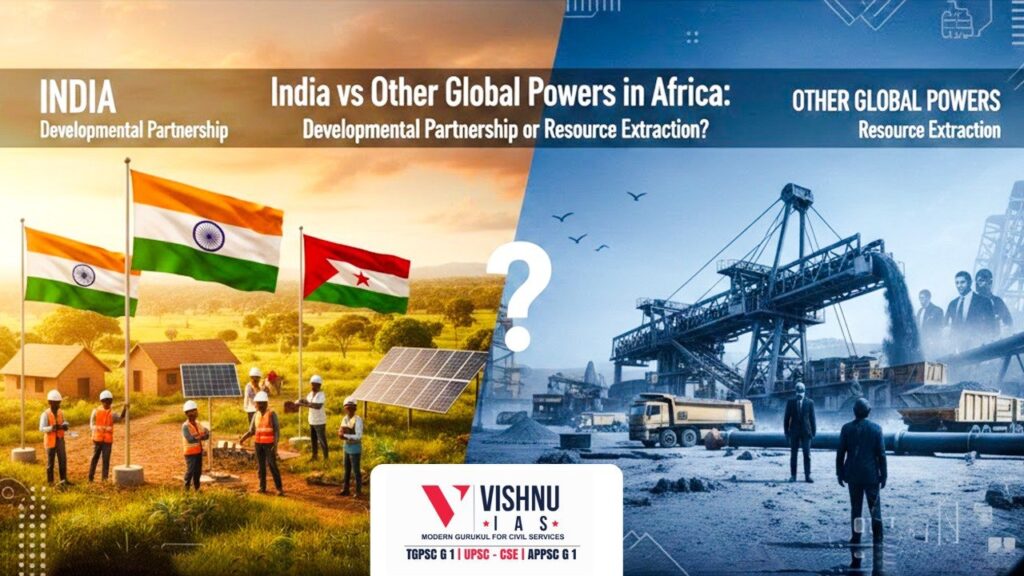
III. Contrast with Extractive Models of Other Global Powers
1. Resource Extraction vs Sustainable Partnership
- Extractive models prioritise raw material extraction for external consumption with limited local value addition.
- India emphasises joint ventures, local manufacturing, and skill transfer.
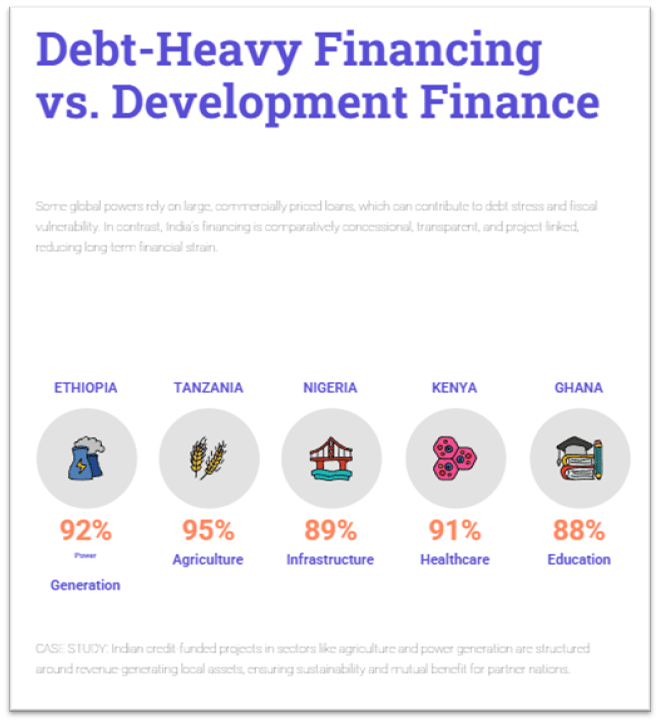
2. Debt-Heavy Financing vs Development Finance
- Some global powers rely on large, commercially priced loans, contributing to debt stress.
- India’s financing is comparatively concessional, transparent, and project-linked.
3. Geopolitical Leverage vs Strategic Autonomy
- Extractive investments often carry strategic leverage and political influence.
- India’s approach respects African strategic autonomy and reinforces multipolarity.
Conclusion:
The India Model of developmental partnership with Africa represents a balanced, ethical, and future-oriented framework integrating trade, capacity building, technology transfer, and people-centric development. As Africa’s share in global growth expands and India targets a substantial increase in bilateral trade by 2030, this model positions India as a trusted development partner rather than a transactional investor.
In an increasingly multipolar global economy, a recalibrated and scaled-up India–Africa developmental compact can contribute not only to Africa’s transformation but also to India’s aspiration of becoming a resilient and inclusive global economic power.
Recap: